
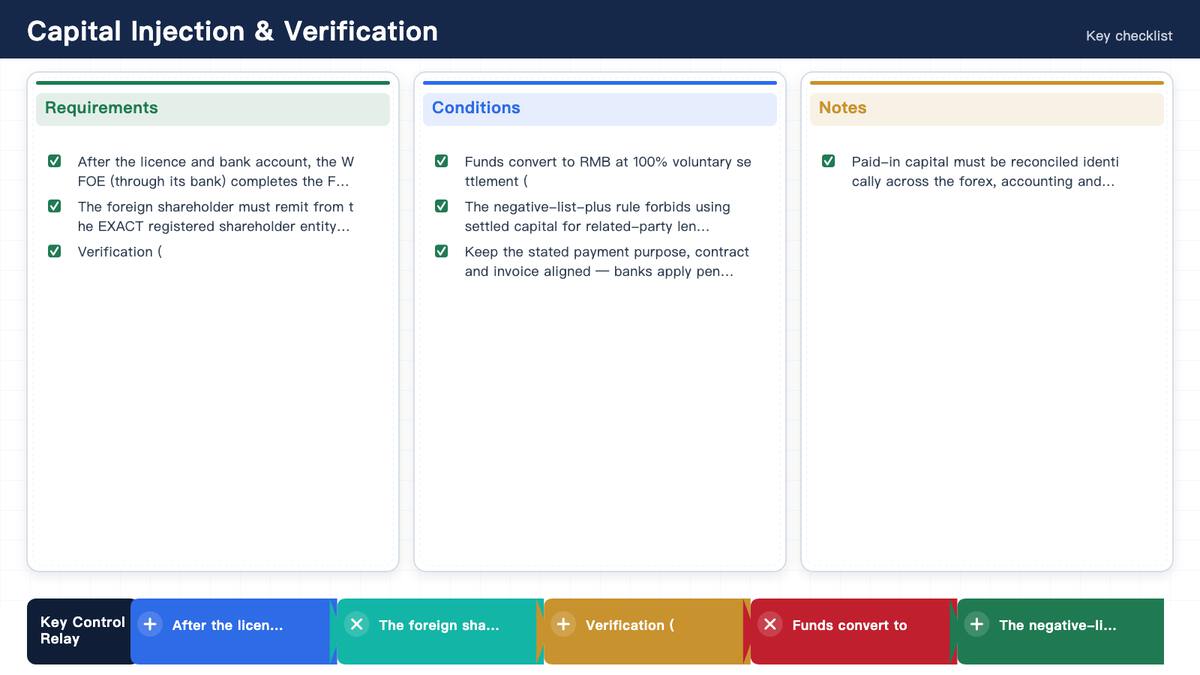
- After the licence and bank account, the WFOE (through its bank) completes the FDI basic-information registration and opens a capital account in the WFOE’s name — the bank, not SAFE, handles FDI registration.
营业执照与银行账户齐备后,WFOE(经其银行)办理境内直接投资基本信息登记,并以 WFOE 名义开立资本金账户——FDI 登记由银行而非外汇局办理。- The foreign shareholder must remit from the EXACT registered shareholder entity; a mismatch (e.g. a sibling company) triggers a “投资人缴款人不一致” filing issue.
外国股东须从登记的股东主体 exact 汇出;若不一致(如兄弟公司)将触发”投资人缴款人不一致”说明。- Verification (验资) is much reduced but not abolished: no routine report for a cash-funded standard WFOE, but it is required for non-cash contributions (IP, land-use rights, in-kind) and useful for licences/banks.
验资大幅弱化但未废止:现金出资的标准 WFOE 通常无需例行报告,但非货币出资(知识产权、土地使用权、实物)必需,对许可/银行亦有用途。- Funds convert to RMB at 100% voluntary settlement (意愿结汇) into a “settlement-to-be-paid account”, and may only be used within business scope on a true, self-use (真实、自用) basis.
资金可按 100% 意愿结汇存入”结汇待支付账户”,且须在公司经营范围内遵循真实、自用原则使用。- The negative-list-plus rule forbids using settled capital for related-party lending to the parent, speculative property purchases, or direct equity investment (unless a licensed investment entity).
“负面清单+”规则禁止将结汇资金用于向母公司关联放贷、投机性购房或直接股权投资(持牌投资主体除外)。- Keep the stated payment purpose, contract and invoice aligned — banks apply penetration review and may decline a payment whose purpose does not match the underlying document.
应使申报用途、合同与发票三者一致——银行实施穿透审核,对用途与单据不符的付款可能拒付。- Paid-in capital must be reconciled identically across the forex, accounting and credit-information publicity system records each time you inject.
每次注入后,应在外汇、会计与信用信息公示系统三方核对,确保实收资本金额一致。
Capital Injection & Verification | 资本金汇入与验资
Overview
A WFOE’s registered capital becomes real money only when the foreign shareholder actually remits it into China. This note covers the mechanics of that process: opening the foreign-exchange capital account, injecting subscribed capital in foreign currency or cross-border RMB, the role of verification (验资) today, and the permitted use of the funds once they are in. The rules are shaped by the SAFE direct-investment reform (汇发〔2015〕13号 and 19号), which moved FDI registration to banks and introduced voluntary settlement (意愿结汇). The objective is a clean, traceable capital trail that satisfies both the foreign-exchange authority and the tax authority.
The foreign-exchange capital account
After the business licence is issued and the bank account is opened, the WFOE (through its bank) completes the FDI basic-information registration (境内直接投资基本信息登记). The bank then opens a capital account (资本金账户 / 结汇待支付账户) in the name of the WFOE. Under the 2015 reform, the foreign-exchange authority no longer registers or approves the FDI upfront — the bank does it and reports through the capital-account information system. There is no fixed cap on the aggregate capital-account balance relative to registered capital in the modern regime, but each remittance must correspond to a valid capital contribution and be properly recorded.
Injecting registered capital
The foreign shareholder remits funds from overseas to the WFOE’s capital account. Funds may be in a freely convertible foreign currency or as cross-border RMB. The remittance must be a genuine capital contribution — not a disguised loan or a payment for goods/services — and must match the shareholder and amount in the FDI registration. On receipt, the bank performs the “currency contribution entry registration” (货币出资入账登记) and issues the FDI capital-inflow registration form (FDI入账登记表) and the foreign-exchange receipt documents. The WFOE should obtain a capital contribution certificate (出资证明书) and reflect the paid-in amount in its books and in the credit-information publicity system.
Verification (验资): much reduced, not abolished
Historically, every capital injection required aCPA-issued capital verification report (验资报告). The 2015 SAFE reform cancelled the capital-verification inquiry system (验资询证制度) for FDI and removed the non-cash and equity-acquisition confirmation registrations. For a standard WFOE funded in cash, a separate verification report is generally no longer a routine foreign-exchange prerequisite. However, verification is still required or expected in specific situations: where the articles or a licence demand it, for non-cash contributions (capital contributed in kind, intellectual property, land-use rights) which need valuation and transfer-of-title evidence, and where the company later wants to evidence paid-in capital to a bank, a tender, or in a capital-increase filing. Treat a verification report as situation-driven, not automatic.
Settlement and permitted use of funds
Capital in the foreign-currency capital account can be converted to RMB under the voluntary settlement rule at 100% (意愿结汇,比例暂定100%), with the RMB placed into a “settlement-to-be-paid account” (结汇待支付账户). Use of the funds is governed by a negative-list-plus principle: money must be used within the company’s business scope, on a true and self-use (真实、自用) basis, and not for expressly prohibited purposes (e.g. certain restricted investment or related-party lending contrary to rules). Typical permitted uses include paying suppliers, staff, rent, taxes, and the company’s own operating expenses; direct equity investment by a non-investment WFOE is constrained. Banks monitor payments from the settlement-to-be-paid account and may request underlying contracts and invoices.
The negative-list-plus discipline is best understood by what it forbids as much as what it permits. Beyond related-party lending, the settled capital may not be used to purchase non-self-use real estate for speculation, to subscribe to financial products that are effectively margin or wealth-management exposures contrary to the rules, or to make direct equity investments unless the WFOE itself is a licensed investment entity. Banks apply “penetration” review: for larger payments they look through to the ultimate use and may decline a payment whose stated purpose does not match the underlying document. Keeping the stated purpose, the contract, and the invoice aligned is therefore not paperwork theatre but the actual control that keeps the funds movable.
Another practical point concerns timing and exchange-rate risk. Because the voluntary-settlement rate is the market rate on the day of conversion, a parent that delays settlement hoping for a better rate carries FX exposure on the RMB side; conversely, leaving capital in the foreign-currency account avoids that conversion risk but earns little and may not match RMB-denominated payables. Many WFOEs settle in tranches matched to near-term RMB obligations rather than converting the whole injection at once, which also smooths the bank’s payment monitoring and avoids large idle balances in the settlement-to-be-paid account.
Documentation and traps
Keep a tight paper trail: the FDI registration confirmation, the inbound remittance advice, the FDI capital-inflow registration form, the capital contribution certificate, and (if prepared) the verification report. Common pitfalls: remitting from a party that does not match the registered shareholder (触发”投资人缴款人不一致”说明); mixing capital with related-party service payments (which are subject to withholding tax, not capital); and converting capital to RMB and on-lending to the parent or an affiliate, which can be challenged. Align the forex, accounting, and tax records so the paid-in amount is identical everywhere.
Practical example
Concrete walk-through: a newly licensed WFOE has registered capital of RMB 3,000,000 subscribed by its Hong Kong parent. Before any money moves, the WFOE’s bank completes the FDI basic-information registration and opens a capital account in the WFOE’s name. On 15 March 2026 the parent remits USD 430,000 from its HK account. The bank checks that the remitter exactly matches the registered shareholder (the HK parent, not a sibling company), performs the currency contribution entry registration, and issues the FDI capital-inflow registration form. At an assumed spot rate the USD converts to roughly RMB 3,000,000-equivalent, which the WFOE records as paid-in capital and reflects on the credit-information publicity system within 20 working days.
The WFOE then needs RMB to pay local suppliers. It elects voluntary settlement at 100%, and the bank places RMB into the settlement-to-be-paid account (结汇待支付账户). When the WFOE pays an office-rent invoice of RMB 200,000, the bank reviews the lease contract and the VAT invoice and releases payment — a permitted “true and self-use” operating expense. What the WFOE must not do is take RMB 500,000 from that account and on-lend it to the HK parent; that would breach the negative-list restriction on related-party lending and invite a forex challenge. Each downstream payment is backed by a contract and invoice, so the trail stays clean.
A second sub-scenario shows when verification is required: suppose the same parent contributes a registered trademark valued at RMB 1,000,000 instead of cash. Here a CPA valuation and a capital verification report are needed, the trademark must be assigned to the WFOE (title transfer evidenced), and the non-cash contribution is recorded. Skipping verification here would leave the WFOE unable to evidence paid-in capital to a bank or in a later capital-increase filing.
What to do next
- Complete the FDI basic-information registration with your bank before remitting, and open the capital account in the WFOE’s name.
- Remit from the exact registered shareholder entity; keep the amount consistent with the FDI registration to avoid mismatch filings.
- Decide deliberately whether you need a verification report — required for non-cash contributions and useful for licences/banks, but not a routine forex step for cash.
- Settle to RMB via the settlement-to-be-paid account and keep every payment backed by a real contract and invoice.
- Reconcile the paid-in capital across forex, accounting, and the credit-information publicity system each time you inject.
Sources
- 国家外汇管理局 — 直接投资外汇管理改革(汇发〔2015〕13号、19号):<https://www.safe.gov.cn/hebei/2015/0616/153.html>
- 国家外汇管理局 — 资本项目高水平开放(FDI 基本可兑换):<https://www.safe.gov.cn/guangdong/2022/1030/2410.html>
- 商务部、市场监管总局 — 《外商投资信息报告办法》:<https://www.mofcom.gov.cn/dl/file/20211203231513.pdf>
- 国家市场监督管理总局 (SAMR) — 企业登记与出资公示:<http://www.samr.gov.cn/> (official portal)
- 国家企业信用信息公示系统 — 出资信息公示:<http://www.gsxt.gov.cn/> (official portal)
Related reading
- see also: Registered capital under the new Company Law (10-registered-capital-new-company-law)
- see also: WFOE registration timeline: 2026 benchmark (08-wfoe-registration-timeline-2026)
- see also: Cross-border service payments (12-cross-border-service-payments)
资本金汇入与验资
概述
外商独资企业的注册资本,只有在外国股东实际汇入中国后才成为真金白银。本文说明该流程的机制:开立外汇资本金账户、以外币或跨境人民币注入认缴资本、当下”验资”的角色,以及资金入境后的允许用途。规则由外汇局直接投资改革(汇发〔2015〕13号、19号)塑造——它将 FDI 登记下放银行并引入意愿结汇。目标是形成一条干净、可追踪的资本金轨迹,同时令外汇局与税务局满意。
外汇资本金账户
营业执照核发、银行账户开立后,WFOE(通过其银行)办理境内直接投资基本信息登记。银行随后以 WFOE 名义开立资本金账户/结汇待支付账户。依 2015 年改革,外汇局不再事前登记或核准 FDI——由银行办理并通过资本项目信息系统报送。现行制度下资本金账户余额相对注册资本无硬性封顶,但每一笔汇入须对应有效的资本出资并妥善记录。
资本金注入
外国股东从境外将资金汇入 WFOE 的资本金账户。资金可为可自由兑换外币或跨境人民币。汇入须为真实的资本出资——而非变相贷款或货物/服务付款——且须与 FDI 登记中的股东与金额一致。收款后,银行办理货币出资入账登记,出具 FDI 入账登记表与涉外收入申报表等外汇收款凭证。WFOE 应取得出资证明书,并将实收金额入账并在信用信息公示系统反映。
验资:大幅弱化,未废止
历史上每笔出资都需注册会计师出具的验资报告。2015 年外汇改革取消了 FDI 验资询证制度,并取消了非货币出资与收购中方股权出资确认登记。对以现金出资的标准 WFOE,单独的验资报告通常已非例行的外汇前置条件。但特定情形下验资仍被要求或期待:章程或许可有要求时;非货币出资(实物、知识产权、土地使用权)需评估与财产权转移证明时;以及公司后续需向银行、招投标或增资备案证明实收资本时。应将验资报告视为”情境驱动”,而非自动。
结汇与资金用途
外币资本金账户中的资金可按意愿结汇规则以 100% 结汇(意愿结汇,比例暂定100%),人民币存入”结汇待支付账户”。资金使用受”负面清单+”原则约束:须在公司经营范围内,遵循真实、自用原则,不得用于明令禁止的目的(如某些受限投资或违规的关联放贷)。典型允许用途包括支付供应商、员工、租金、税款及公司自身营运开支;非投资性 WFOE 的直接股权投资受约束。银行监控结汇待支付账户支付,并可能要求提供基础合同与发票。
负面清单+的纪律,须从其禁止项与允许项两方面理解。除关联放贷外,结汇资金不得用于购买非自用的投机性房地产、不得认购实质为杠杆或理财敞口的金融产品,亦不得进行直接股权投资(除非该 WFOE 本身系持牌投资主体)。银行实施”穿透”审核:对较大额支付,会看穿至最终用途,并可能拒付用途与基础单据不符的付款。因此使”申报用途、合同、发票”三者一致,并非形式文章,而是保障资金可动用的实际控制。
另一实务要点在于时点与汇率风险。意愿结汇适用结汇当日的市场汇率,母公司若拖延结汇博取更好汇率,便在人民币侧承担汇率敞口;反之将资本留存外币账户虽规避了折算风险,却几乎无息,且可能无法匹配人民币计价的应付款。许多 WFOE 按近期人民币义务分批结汇,而非一次性全额结汇,这既平滑了银行的支付监测,也避免结汇待支付账户出现大额闲置余额。
单据与陷阱
保留严密单据链:FDI 登记凭证、汇入回单、FDI 入账登记表、出资证明书,以及(如制备)验资报告。常见陷阱:从与登记股东不一致的第三方汇入(触发”投资人缴款人不一致”说明);将资本与关联方服务费支付混同(后者需扣缴税款,非资本);以及结汇后放贷给母公司或关联方,可能受质疑。应使外汇、会计与税务记录的实收金额三处一致。
实操示例
具体流程:一家新设 WFOE 由其香港母公司认缴注册资本 300 万元。在任何资金流动前,WFOE 的银行先完成境内直接投资基本信息登记,并以 WFOE 名义开立资本金账户。2026 年 3 月 15 日,母公司从香港账户汇出 43 万美元。银行核对汇款人确为登记的股东(香港母公司,而非兄弟公司),办理货币出资入账登记,并出具 FDI 入账登记表。按当时即期汇率,43 万美元约合 300 万元人民币,WFOE 将其记为实收资本,并于 20 个工作日内在信用信息公示系统反映。
WFOE 随后需要人民币支付本地供应商。其选择 100% 意愿结汇,银行将人民币存入结汇待支付账户。当 WFOE 支付 20 万元办公租金发票时,银行审核租赁合同与增值税发票后放款——属允许的”真实、自用”营运支出。WFOE 绝不能从账户取出 50 万元放贷给香港母公司;那将违反关联放贷的负面清单限制并招致外汇质疑。每笔下游付款均有合同与发票支撑,轨迹因此保持干净。
第二个子场景说明何时需要验资:假设同一母公司以估值 100 万元的注册商标(而非现金)出资。此时需注册会计师评估并出具验资报告,商标须过户至 WFOE(提交权属转移证明),非货币出资方予登记。若在此跳过验资,WFOE 将无从向银行或后续增资备案证明实收资本。
下一步建议
- 在汇出前通过银行完成 FDI 基本信息登记,并以 WFOE 名义开立资本金账户。
- 从登记的股东主体 exact 汇出;保持金额与 FDI 登记一致,避免不匹配申报。
- 审慎判断是否需验资报告——非货币出资必需,对许可/银行有用,但现金出资非常规外汇步骤。
- 经结汇待支付账户结汇为人民币,并确保每笔支付有真实合同与发票支撑。
- 每次注入后,在外汇、会计与信用信息公示系统三方核对实收资本。
来源
- 国家外汇管理局 — 直接投资外汇管理改革(汇发〔2015〕13号、19号):<https://www.safe.gov.cn/hebei/2015/0616/153.html>
- 国家外汇管理局 — 资本项目高水平开放(FDI 基本可兑换):<https://www.safe.gov.cn/guangdong/2022/1030/2410.html>
- 商务部、市场监管总局 — 《外商投资信息报告办法》:<https://www.mofcom.gov.cn/dl/file/20211203231513.pdf>
- 国家市场监督管理总局(SAMR)— 企业登记与出资公示:<http://www.samr.gov.cn/>(官方门户)
- 国家企业信用信息公示系统 — 出资信息公示:<http://www.gsxt.gov.cn/>(官方门户)
相关阅读
- 见:新《公司法》下的注册资本(10-registered-capital-new-company-law)
- 见:外商独资企业注册周期:2026 年基准(08-wfoe-registration-timeline-2026)
- 见:跨境服务费支付(12-cross-border-service-payments)