
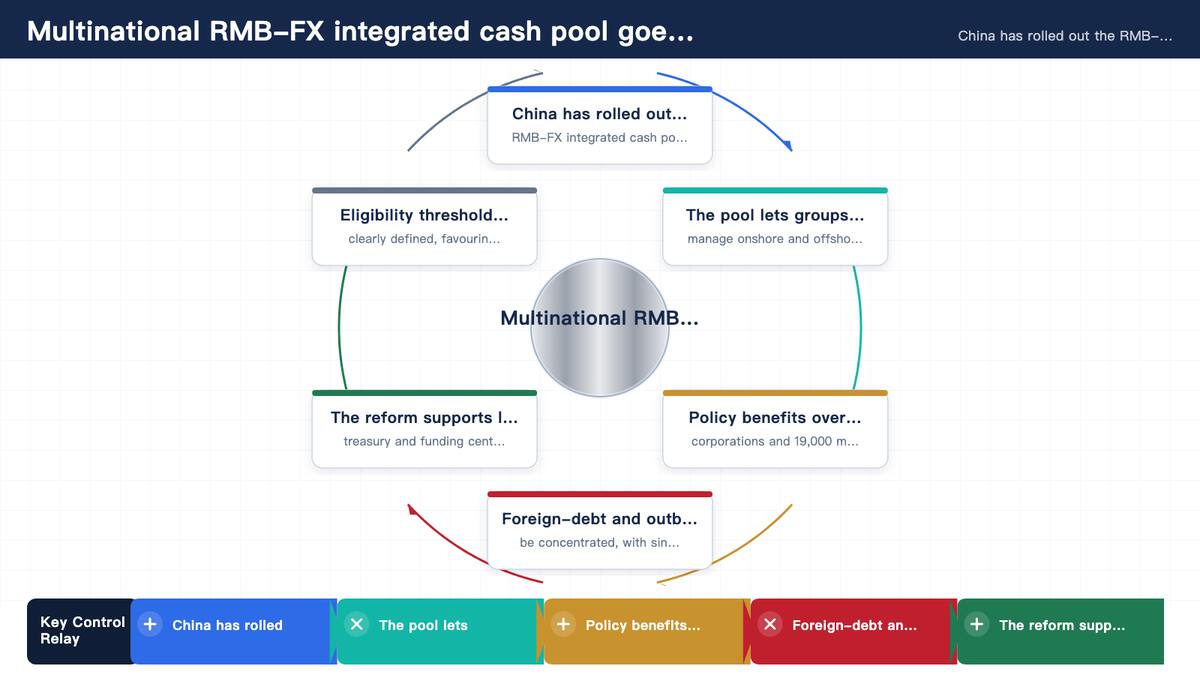
- China has rolled out the RMB-FX integrated cash pool for multinational corporations nationwide as of March 2026. 自2026年3月起,中国已将跨国公司本外币一体化资金池试点推广至全国。
- The pool lets groups centrally manage onshore and offshore RMB and foreign-currency funds under a single quota-based filing regime. 该资金池允许集团在单一额度备案制下,集中管理境内外人民币及外币资金。
- Policy benefits over 1,100 multinational corporations and 19,000 member entities, covering USD 2.1 trillion in cross-border flows. 该政策惠及1100余家跨国公司与19000家成员企业,覆盖2.1万亿美元跨境资金流动。
- Foreign-debt and outbound-loan quotas can be concentrated, with single-transaction filing no longer required within the quota. 外债与境外放款额度可集中调配,额度内单笔业务无需逐笔备案。
- The reform supports locating regional treasury and funding centres inside China. 此项改革有利于跨国公司将区域性资金中心与司库职能布局在中国境内。
- Eligibility thresholds are high but clearly defined, favouring large, compliant multinationals. 准入门槛较高但规则清晰,主要惠及经营规模大、合规记录良好的跨国公司。
- Current-account centralised collection/payment and netting settlement reduce FX conversion and bank fees. 经常项目集中收付与轧差净额结算可降低结售汇成本与银行手续费。
Multinational RMB-FX integrated cash pool goes national | 跨国公司本外币一体化资金池全国推广
Overview
On 6 March 2026, the People’s Bank of China (PBOC) and the State Administration of Foreign Exchange (SAFE) issued the *Notice on Matters Relating to the RMB-FX Integrated Cash Pool Business for Multinational Corporations* (《关于跨国公司本外币一体化资金池业务有关事宜的通知》). The notice converts the previously piloted RMB-FX integrated cash pool from a regional trial into a nationwide regime. For foreign investors operating in China, it removes one of the most persistent frictions in cross-border treasury management: the separation of RMB and foreign-currency pools and the per-transaction approval model.
This article explains what changed, who qualifies, and how a multinational group should think about restructuring its China treasury under the new rules.
What is the RMB-FX integrated cash pool?
A cash pool lets a corporate group concentrate balances across subsidiaries into a single managed structure, so surplus cash in one entity can fund deficits in another. China historically ran two parallel systems:
- A RMB cross-border cash pool (usually under the PBOC / SAFE “cross-border two-way RMB fund pooling” framework).
- A foreign-currency cash pool (under SAFE’s foreign-debt and outbound-loan quota rules).
The integrated pool merges both into a single onshore/offshore pool covering RMB and foreign currencies, supervised under a quota-based filing regime rather than per-transaction approval.
What the nationwide rollout changes
| Dimension | Before (pilot) | After (nationwide, Mar 2026) |
|---|---|---|
| Geographic scope | Selected pilot regions only | Nationwide |
| Currency coverage | Separate RMB / FX pools | Single integrated RMB+FX pool |
| Approval model | Often case-by-case | Quota-based filing |
| Foreign debt / outbound loan | Per-entity quotas | Concentrated group quota |
| Within-quota transactions | Filed individually | No single-transaction filing |
The most important operational shift is the move from approval to filing. Once a group’s pool quota is set and filed, routine transfers, surplus allocation, and netting settlement inside the quota no longer require SAFE’s sign-off on every transaction.
Key functions available in the pool
- Fund centralisation (资金集中): collect and concentrate member balances.
- Surplus allocation (余缺调剂): move liquidity from cash-rich to cash-poor entities.
- Current-account centralised collection and payment (经常项目集中收付): a designated entity handles collections and payments on behalf of the group.
- Netting settlement (轧差净额结算): offset intercompany receivables/payables and settle only the net amount, cutting FX conversion and bank fees.
Eligibility thresholds
To set up an integrated pool, the onshore parent / designated entity must meet SAFE thresholds:
- Onshore members’ annual foreign-exchange receipts and expenditure ≥ RMB 7 billion.
- Onshore consolidated revenue ≥ RMB 10 billion.
- Offshore consolidated revenue ≥ RMB 2 billion.
- At least 3 member entities in the pool.
- No major foreign-exchange violations in the preceding 2 years.
These thresholds target large, well-established multinationals rather than small entrants. Groups below the bar can still use the older separate RMB and FX pooling channels.
Quota concentration: foreign debt and outbound loans
Under the old model, each entity held its own foreign-debt quota and outbound-loan quota. The integrated pool lets the group concentrate these quotas at the group level. Within the approved quota:
- Single-transaction filing is no longer required.
- The group allocates debt and loan capacity flexibly across members.
- Cross-border lending between related entities becomes far simpler to execute.
This is especially useful for groups that fund China operations from offshore holding companies, or that on-lend to overseas affiliates.
Scale of the reform
SAFE reports that the policy benefits 1,100+ multinational corporations and 19,000 member entities, covering roughly USD 2.1 trillion in cross-border fund flows. That scale signals the regime is now a core part of China’s cross-border capital management toolkit, not a fringe pilot.
Strategic implications for foreign investors
- Build the regional treasury in China. With a single integrated pool and quota filing, China can serve as a genuine in-country treasury hub rather than a passive cash sink.
- Reduce FX leakage. Netting settlement and centralised conversion lower transaction costs.
- Plan for the thresholds. Groups near the RMB 7bn / RMB 10bn lines should model consolidated figures early.
- Coordinate with banks. Pool onboarding still requires a qualified onshore bank and a filed quota; start the bank selection and filing package early.
Related reading
- SAFE guidance on cross-border capital pool and foreign-debt registration
- PBOC rules on cross-border RMB pooling
- SAFE annual report on cross-border capital flows
Sources
- SAFE / PBOC Notice (Henan SAFE repost) — 《关于跨国公司本外币一体化资金池业务有关事宜的通知》, March 2026
- People’s Daily — SAFE report (2026-01-15) on nationwide rollout of the integrated cash pool
跨国公司本外币一体化资金池全国推广
概述
2026年3月6日,中国人民银行与国家外汇管理局联合发布《关于跨国公司本外币一体化资金池业务有关事宜的通知》,将此前在部分地区试点的本外币一体化资金池正式推广至全国。对于在华经营的外国投资者而言,这消除了跨境资金管理中长期存在的一大痛点——人民币与外币资金池分离、以及逐笔审批的管理模式。
本文说明政策变化、准入条件,以及跨国集团应如何在新规下重构中国区司库安排。
什么是本外币一体化资金池?
资金池是指集团将多家成员企业的账户余额集中到一个统一结构中进行管理,使资金充裕企业的盈余可调剂给资金短缺企业。中国过去并行两套体系:
- 人民币跨境资金池(通常依据人行/外汇局”跨境双向人民币资金池”框架)。
- 外币资金池(依据外汇局外债与境外放款额度规则)。
一体化资金池将二者合并为覆盖人民币与外币的单一境内外资金池,并在额度备案制而非逐笔审批下接受监管。
全国推广带来的变化
| 维度 | 试点前 | 全国推广后(2026年3月) |
|---|---|---|
| 地域范围 | 仅限部分试点地区 | 全国 |
| 币种覆盖 | 人民币/外币分设 | 单一本外币一体化池 |
| 审批模式 | 多为例外审批 | 额度备案制 |
| 外债/境外放款 | 按企业分设额度 | 集团集中额度 |
| 额度内业务 | 逐笔备案 | 无需单笔备案 |
最重要的操作变化是从审批转向备案。一旦集团的池额度核定并备案,额度内日常的调拨、余缺调剂与轧差结算不再需要外汇局对每笔交易逐一核准。
资金池可使用的核心功能
- 资金集中: 归集并集中管理成员企业余额。
- 余缺调剂: 将资金从充裕方调拨至短缺方。
- 经常项目集中收付: 由指定企业代表集团统一办理收付。
- 轧差净额结算: 对冲集团内部应收应付,仅就净额结算,减少结售汇与银行手续费。
准入门槛
设立一体化资金池,境内主办企业须满足外汇局设定的门槛:
- 境内成员企业上年度外汇收支规模 ≥ 70亿元人民币。
- 境内营业收入 ≥ 100亿元人民币。
- 境外营业收入 ≥ 20亿元人民币。
- 池内至少 3家 成员企业。
- 近 2年 无重大外汇违规行为。
这些门槛主要面向规模大、合规记录良好的成熟跨国公司,而非小型新进入者。未达门槛的集团仍可使用原有的人民币与外币分设资金池渠道。
额度集中:外债与境外放款
旧模式下,每家企业各自持有外债额度与境外放款额度。一体化资金池允许集团在集团层面集中这些额度。在核定额度内:
- 单笔业务无需逐笔备案。
- 集团可在成员间灵活调配外债与放款能力。
- 关联企业间的跨境借贷执行更为简便。
这对于由境外控股公司为中国业务融资、或向海外关联企业发放贷款的集团尤为有利。
改革规模
外汇局数据显示,该政策惠及 1100余家 跨国公司与 19000家 成员企业,覆盖约 2.1万亿美元 跨境资金流动。这一规模表明,该机制已成为中国跨境资本管理工具箱中的核心组成部分,而非边缘试点。
对外国投资者的战略意义
- 将区域司库建在中国。 借助一体化资金池与额度备案,中国可成为真正的在岸资金枢纽,而非被动的资金沉淀地。
- 降低汇兑损耗。 轧差结算与集中结售汇减少交易成本。
- 提前规划门槛。 接近70亿/100亿元线的集团应尽早测算合并口径数据。
- 与银行协同。 资金池落地仍须具备资质的境内银行及核定备案额度,应尽早启动银行遴选与备案材料准备。
相关阅读
- 外汇局跨境资金池及外债登记指引
- 人民银行跨境人民币资金池规则
- 外汇局跨境资金流动年度报告
来源
- 外汇局/人民银行通知(河南外汇局转载) — 《关于跨国公司本外币一体化资金池业务有关事宜的通知》,2026年3月
- 人民网 — 外汇局报道(2026-01-15)关于一体化资金池全国推广