
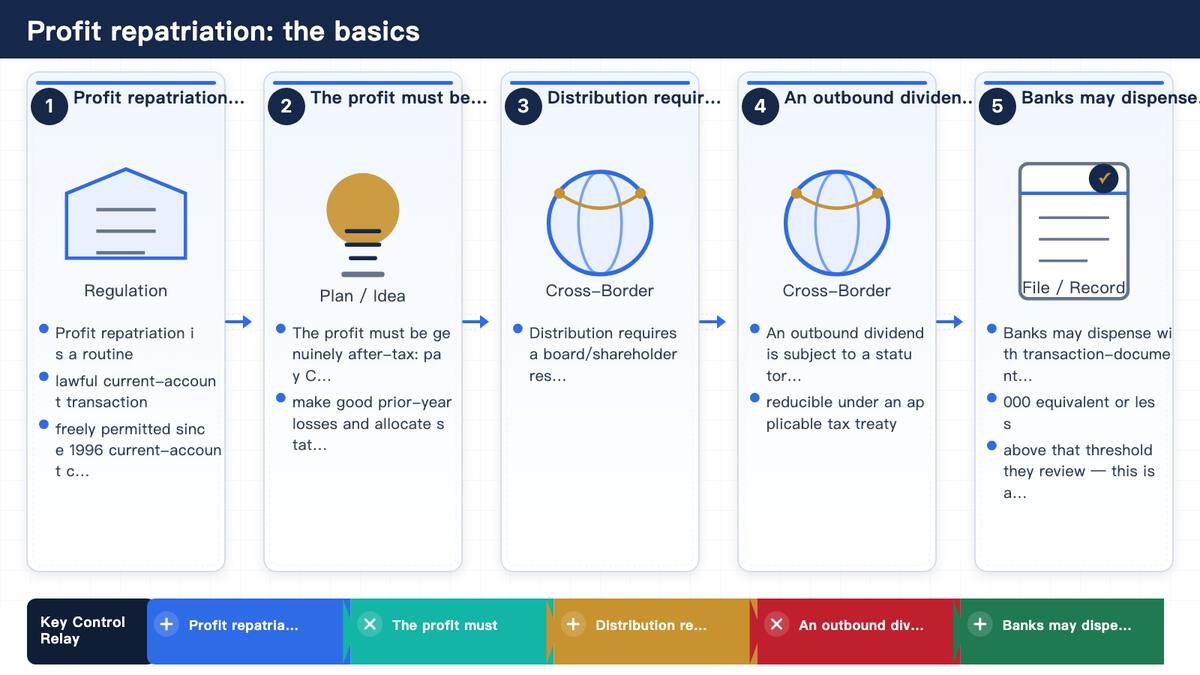
- Profit repatriation is a routine, lawful current-account transaction, freely permitted since 1996 current-account convertibility — not a capital-control event.
利润汇出是常规、合法的经常项目交易,自 1996 年经常项目可兑换以来自由允许,并非资本管制事件。- The profit must be genuinely after-tax: pay CIT first (standard rate 25%), make good prior-year losses and allocate statutory reserves before any distribution.
利润必须确为税后:先缴企业所得税(标准税率 25%),弥补以前年度亏损并计提法定公积金后方可分配。- Distribution requires a board/shareholder resolution — a foreign parent cannot simply sweep cash out of a Chinese subsidiary.
分配须经董事会/股东决议——外国母公司不能简单将资金从中国子公司划走。- An outbound dividend is subject to a statutory 10% withholding tax (WHT) at source, reducible under an applicable tax treaty.
对外支付的股息须在源头按 10% 法定预提所得税缴纳,并可依适用税收协定降低。- Banks may dispense with transaction-document review for profit remittances of USD 50,000 equivalent or less; above that threshold they review — this is a review rule, not a cap on the amount.
等值 5 万美元以下利润汇出,银行原则上可不审核交易单证;超此门槛则审核——这是审核规则,而非金额上限。- A compliant current-account remittance needs no SAFE pre-approval; forex capital may be settled voluntarily at up to 100%.
合规的经常项目汇出无需外汇局事前审批;外汇资本金可按意愿结汇,比例最高 100%。- Under a September 2025 SAFE notice, an FIE’s domestically generated forex profit may be re-invested in China instead of being sent home.
据国家外汇管理局 2025 年 9 月通知,外商投资企业境内产生的外汇利润可开展境内再投资,而非汇回境外。- The standard bank package is: a written application, the profit-distribution resolution, audited financial statements, and the Chinese tax clearance certificates.
银行标准材料包为:书面申请、利润分配决议、经审计财务报表,以及中国税务机关完税证明。
Profit repatriation: the basics | 利润汇出:基础要点
Overview
For a foreign-invested enterprise (FIE) in China, repatriating profit is a routine, lawful current-account transaction — not a capital-control event. Chinese policy has treated direct-investment profit remittance as freely permitted since current account convertibility was achieved in 1996, and the authorities have repeatedly affirmed that “the window once opened will not be closed.” The practical constraint is not permission but paperwork: the profit must be genuinely after-tax, the distribution must follow company-law and tax formalities, and the bank must see evidence the funds are real and compliant. This article walks through the end-to-end sequence — after-tax profit, board/shareholder resolution, tax clearance including the outbound withholding tax, and the foreign-exchange remittance — and notes the 2025 rule that lets forex profit be re-invested domestically instead of being sent home.
The sequence: after-tax profit → resolution → tax → remittance
Step one is that the profit must be after-tax. The company first pays corporate income tax (CIT) on its taxable income (the standard rate is 25%, reduced rates apply in designated zones and for qualifying enterprises). Before any distribution, the company must, under company law, make good prior-year losses and allocate statutory reserves where required; only distributable profit may be paid out as dividends.
Step two is the distribution resolution. Profit distribution by an FIE requires a resolution of the board of directors (or shareholders’ meeting) approving the profit-sharing. A foreign parent cannot simply sweep cash out of a Chinese subsidiary; the dividend must be formally declared through the company’s governance process, with the resolution document serving as the key evidence for the bank.
Step three is tax. The distributed dividend, interest or royalty paid to a non-resident recipient is subject to a statutory 10% withholding tax (WHT) at source, reducible under an applicable tax treaty — this is covered in detail in our companion article *Withholding tax on outbound payments*. The company must also hold a tax clearance (完税证明) for the underlying corporate tax and, for the outbound payment, complete the withholding and any treaty-relief filing. Only after these tax steps can the net amount be remitted.
Documentation the bank will require
When you take the dividend to the bank for outward remittance, the bank applies “three lines of defence” (展业三原则 — know-your-customer, due diligence, continuous monitoring) and reviews authenticity and compliance. The standard document set for direct-investment profit remittance (per the *Capital Account Foreign Exchange Business Guidelines (2020)*, item 6.11) is: a written application; the shareholder or board profit-distribution agreement/resolution relating to the remittance; audited financial statements; and the relevant tax certificates (完税证明) from China.
A threshold rule applies to document review: for profit remittances of USD 50,000 equivalent or less, banks generally may dispense with transaction-document review; for amounts above USD 50,000 equivalent, the bank reviews the documents. These are review-threshold rules, not a tax or a quota — there is no cap on the amount that can be remitted if it is genuine after-tax profit supported by the required papers. Note also that the remittance is treated as current-account regardless of whether the shareholder is a company or an individual; even an overseas individual shareholder’s dividend is handled under the direct-investment profit-remittance rules, not as a personal foreign-exchange purchase.
FX steps and the 2025 domestic re-investment option
On the foreign-exchange side, the FIE’s foreign-exchange capital is settled under the “voluntary settlement” (意愿结汇) regime at up to 100%, with settled RMB parked in a settlement-to-be-paid account (结汇待支付账户) until used. For the dividend itself, once taxed and documented, the bank converts and remits in foreign currency directly; no SAFE pre-approval is needed for a compliant current-account remittance.
A significant 2025 easing is worth flagging. Under SAFE’s September 2025 notice on deepening cross-border investment and financing reform, an FIE’s domestically generated foreign-exchange profit — and an overseas investor’s foreign-exchange profit lawfully earned — may be re-invested domestically. The forex may be credited to the invested enterprise’s capital account or capital-project settlement account and used per the relevant account rules. In other words, a parent that does not need the cash offshore can recycle the forex profit into a new or existing China investment (including into a different in-China project) without first converting and re-injecting, which removes a layer of exchange and round-trip friction.
Common pitfalls
Most remittance delays are self-inflicted. They include: attempting to distribute before prior-year losses are made good; lacking a properly adopted board/shareholder resolution; missing or stale tax-clearance certificates; confusing a capital-account injection with a profit distribution; and treating the USD 50,000 review threshold as a limit. Another frequent issue is the withholding-tax step being left to the last minute, so the net amount and the remittance date are mis-modelled. Plan the CIT, the WHT, the resolution and the FX instruction as one calendar, not four separate tasks.
What to do next
- Confirm the distributable profit is truly after-tax and that prior-year losses and statutory reserves are dealt with first.
- Adopt a proper board/shareholder profit-distribution resolution before any cash moves.
- Settle the 10% outbound withholding tax (or the reduced treaty rate) and obtain the Chinese tax clearance certificates.
- Prepare the bank package: written application, distribution resolution, audited financials, and tax certificates.
- Remember the USD 50,000 equivalent review threshold is a documentation rule, not a cap.
- If the cash is not needed offshore, consider the 2025 SAFE domestic re-investment path to avoid round-trip conversion.
Sources
- SAFE: Notice on Deepening Reform of Cross-border Investment and Financing Foreign Exchange Management (Sept 2025)
- SAFE Ningxia: Q&A on FIE profit/dividend outward payment under the Capital Account Guidelines
- PBOC/SAFE clarification: FIEs may handle profit remittance under normal procedures (China Economy)
- SAFE: Notice reforming the capital-account settlement mode for FIEs (voluntary settlement)
Related reading
- see also: Withholding tax on outbound payments
- see also: Tax treaty benefits for foreign investors
- see also: Free trade zone bonded logistics playbook
利润汇出:基础要点
概述
对在中国设立的外商投资企业(FIE)而言,利润汇出是一项常规的、合法的经常项目交易,而非资本管制事件。自 1996 年实现经常项目可兑换以来,中国的政策一直将直接投资利润汇出视为自由允许,监管当局也多次重申”打开的窗户不会再关上”。真正的约束不在于许可,而在于手续:利润必须确为税后利润,分配须遵循公司法与税务形式要求,银行须见到资金真实合规的证据。本文按端到端顺序展开——税后利润、董事会/股东决议、含对外预提所得税的完税、以及外汇汇出,并提示 2025 年允许外汇利润境内再投资、而非汇回境外的规则。
流程:税后利润 → 决议 → 纳税 → 汇出
第一步,利润必须是税后的。公司先就应纳税所得额缴纳企业所得税(标准税率 25%,指定区域与符合条件的企业适用优惠税率)。任何分配前,公司须按公司法弥补以前年度亏损并计提法定公积金;只有可分配利润方能作为股息支付。
第二步是分配决议。外商投资企业的利润分配须经董事会(或股东会)作出批准利润分配的决议。外国母公司不能简单地将资金从中国子公司划走;股息须经公司治理程序正式宣告,决议文件即银行所需的关键证据。
第三步是纳税。支付给非居民收款人的股息、利息或特许权使用费,须在源头按 10% 的法定预提所得税(WHT)缴纳,并可依适用税收协定降低——详见本系列姊妹篇《对外支付的预提所得税》。公司还须持有所得税完税证明,并就对外支付完成扣缴及可能的协定待遇备案。只有在这些税务步骤完成后,净额方可汇出。
银行所需单证
将股息提交银行办理对外汇出时,银行执行”展业三原则”(了解客户、尽职调查、持续监测)并审核真实性与合规性。境内直接投资利润汇出的标准单证(依据《资本项目外汇业务指引(2020 年版)》”6.11 境内直接投资利润汇出”)包括:书面申请;与本次利润汇出相关的股东或董事会利润分配协议/决议;经审计的财务报表;以及中国税务机关出具的相关完税证明。
存在一道审核门槛规则:等值 5 万美元(含)以下的利润汇出,银行原则上可不审核交易单证;等值 5 万美元以上的,银行审核单证。这是审核门槛规则,而非税收或配额——只要是基于真实税后利润、备齐所需材料,汇出金额并无上限。另需注意,无论股东是企业还是个人,汇出均按经常项目管理;即便是境外个人股东的股息,也依境内直接投资利润汇出规则办理,而非作为个人购汇。
外汇步骤与 2025 年境内再投资选项
在外汇方面,外商投资企业外汇资本金按”意愿结汇”制度办理,比例最高 100%,结汇所得人民币存入”结汇待支付账户”待用。就股息本身而言,一旦完税并备妥单证,银行直接以原币种购付汇汇出;合规的经常项目汇出无需外汇局事前审批。
2025 年的一项重大放宽值得关注。根据国家外汇管理局 2025 年 9 月《关于深化跨境投融资外汇管理改革有关事宜的通知》,外商投资企业境内合法产生的外汇形式利润、境外投资者合法取得的外汇利润,可开展境内再投资;相关外汇资金可划入被投资企业的资本金账户或股权出让方的资本项目结算账户,按相关账户管理要求使用。换言之,母公司在境外不需用款时,可将外汇利润再投入新的或既有在华项目(包括不同的在华项目),而无须先结汇再重新注入,从而省去一层汇兑与往返摩擦。
常见陷阱
多数汇出延误是”自找的”。包括:在弥补以前年度亏损前即试图分配;缺少正式通过的董事会/股东决议;完税证明缺失或过期;将资本项目注资与利润分配混淆;以及把等值 5 万美元审核门槛误当作限额。另一常见问题是预提所得税步骤被拖到最后一刻,导致净额与汇出日期测算错误。应将企业所得税、预提税、决议与外汇指令作为同一日程来规划,而非四项独立任务。
下一步建议
- 确认可分配利润确为税后,并先处理以前年度亏损与法定公积金。
- 在任何资金划转前,通过正式的董事会/股东利润分配决议。
- 结清 10% 的对外预提所得税(或适用的协定低税率),并取得中国完税证明。
- 备妥银行材料包:书面申请、分配决议、经审计财报、完税证明。
- 记住等值 5 万美元审核门槛是单证规则,而非限额。
- 若境外不需用款,可考虑 2025 年外汇局境内再投资路径,避免往返结汇。
来源
- 国家外汇管理局:关于深化跨境投融资外汇管理改革有关事宜的通知(2025 年 9 月)
- 外汇局宁夏:FIE 利润/股息对外支付问答(《资本项目外汇业务指引》)
- 央行/外汇局澄清:外企可按程序正常办理利润汇出(中国经济网)
- 外汇局:改革外商投资企业外汇资本金结汇管理方式(意愿结汇)
相关阅读
- see also: 对外支付的预提所得税
- see also: 外商投资企业的税收协定待遇
- see also: 自贸区保税物流实操手册