
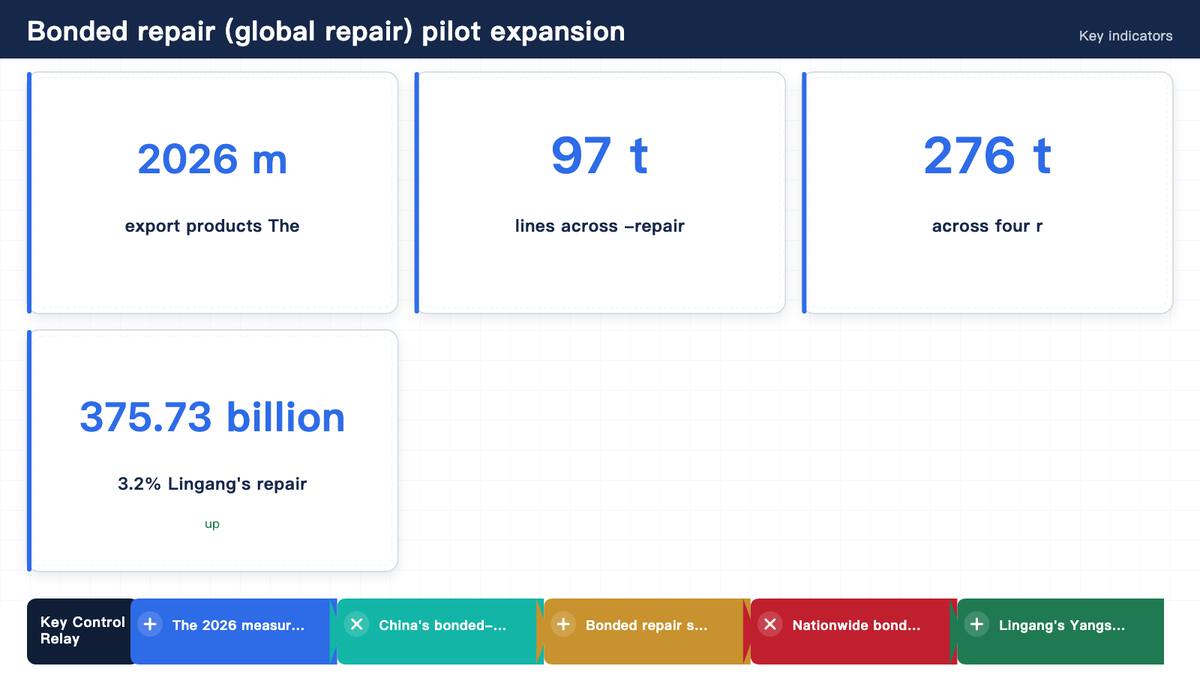
- The 2026 measures let export products and parts enter comprehensive bonded zones for bonded repair and re-export, free of the repair catalogue and used-machinery import ban. 2026年措施允许出口产品及零部件进入综合保税区开展保税维修并复运出境,不受维修目录与旧机电进口禁令限制。
- China’s bonded-repair product catalogue expanded from 97 to 276 tariff lines across four batches. 中国保税维修产品目录历经四批由97个增至276个税号。
- Bonded repair supports “Made in China” after-sales service and extends the domestic industry value chain. 保税维修支撑”中国制造”售后服务体系,延伸国内产业价值链。
- Nationwide bonded-zone repair imports and exports reached RMB 375.73 billion in 2025, up 3.2%. 2025年全国保税区维修进出口达3757.3亿元,同比增长3.2%。
- Lingang’s Yangshan zone posted RMB 25.3 billion bonded-repair trade in Jan–Apr 2026, up 108.4%. 临港洋山片区2026年1至4月保税维修贸易达253.09亿元,同比增长108.41%。
Bonded repair (global repair) pilot expansion | 保税维修(全球维修)业务试点扩大
China is scaling up its bonded repair (sometimes called “global repair”) regime, letting goods be brought into comprehensive bonded zones (CBZs) for repair and then re-exported. For foreign manufacturers, brands and supply-chain operators, this creates a low-friction way to service global products through a China base while keeping goods outside the domestic customs flow until a decision is made to sell them inland.
Overview
Bonded repair means imported or exported goods enter a CBZ, are repaired using imported or domestic parts, and leave the zone again (usually re-exported) without paying import duty or VAT on the goods themselves during the repair stay. It is a pillar of China’s push to upgrade its processing-trade and after-sales service capabilities.
The 2026 State Council measures
General Office of the State Council Letter [2026] No. 40 — “Several Measures to Promote the Capacity-Building and Quality Improvement of Comprehensive Bonded Zones” (国办函〔2026〕40号, issued 2026-04-14) explicitly promotes bonded repair:
- Domestic export products and parts may enter CBZs for repair and re-export.
- Such repair operations are exempt from the bonded-repair product catalogue restriction and the used/old machinery import ban.
- Authorities will explore negative-list management for repair businesses.
- A phased rollout will allow some repaired goods to be transferred into domestic sale (内销) under control.
This is a meaningful liberalization: previously repair scope was constrained by the catalogue and old-machinery import rules; the 2026 measures loosen both for export-bound repair.
What it means for foreign firms
- A global brand can route warranty/refurbishment repair of its exported products through a China CBZ without triggering full import formalities.
- Spare parts can be brought in and consumed in repair without duty, provided goods ultimately re-export.
- The negative-list approach signals broader, catalogue-light access going forward.
Catalogue expansion: 97 to 276 tariff lines
China’s bonded-repair product catalogue has expanded in four batches:
| Batch | Timing | Added lines | Resulting total |
|---|---|---|---|
| Initial | — | — | 97 tariff lines |
| Batch 1–3 | prior years | +20 | 117 |
| Batch 4 | Dec 2025 | +179 | 276 tariff lines |
The fourth batch, added in December 2025, brought 179 new items, taking the catalogue from 97 to 276 tariff lines. Coverage now spans aviation, ships, engineering machinery, precision electronics, and medical devices — sectors where high-value, long-life goods generate recurring repair demand.
This expansion widens the universe of products eligible for streamlined bonded repair even before the catalogue exemption in the 2026 measures is applied.
Why bonded repair matters strategically
- After-sales service for “Made in China”: Repair hubs in CBZs let Chinese exporters and foreign brands support products sold worldwide, keeping service close to manufacturing.
- Value-chain extension: Repair, refurbishment and reverse-logistics add high-skill jobs and keep economic value onshore.
- Supply-chain resilience: A CBZ repair base can serve Asia-Pacific or global markets with bonded, duty-deferred flows.
Latest trade figures
The regime is already large and growing:
- 2025 nationwide: bonded-zone repair imports and exports reached RMB 375.73 billion, up 3.2% year-on-year.
- Lingang (Shanghai) Yangshan: 2025 bonded repair trade RMB 63.75 billion (+59.2%); Jan–Apr 2026 RMB 25.309 billion, up 108.41% — showing accelerating momentum after the policy push.
These numbers indicate bonded repair is shifting from pilot to mainstream logistics activity, with Lingang as a flagship growth pole.
Sources
- State Council — 国办函〔2026〕40号 — 《关于促进综合保税区扩能提质的若干措施》(2026-04-14), promoting bonded repair, catalogue exemption and negative-list exploration.
- Lingang Government Reply (临港新片区) — 2026 reply citing Lingang Yangshan bonded-repair trade figures (2025 and Jan–Apr 2026).
保税维修(全球维修)业务试点扩大
中国正在扩大保税维修(亦称”全球维修”)制度,允许货物进入综合保税区(CBZ)维修后再复运出境。对于外国制造商、品牌商及供应链运营方而言,这提供了一种低摩擦的全球化产品售后路径——以中国为基地开展维修,同时使货物在决定内销前始终处于海关特殊监管流程之外。
概述
保税维修是指进口或出口货物进入综合保税区,使用进口或国产零部件进行维修,随后离开园区(通常复运出境),维修停留期间货物本身免予缴纳进口关税与增值税。它是中国推动加工贸易升级与售后服务能力建设的支柱举措。
2026年国务院措施
《国务院办公厅关于促进综合保税区扩能提质的若干措施》(国办函〔2026〕40号,2026年4月14日印发)明确促进保税维修:
- 国内出口产品及零部件可进入综合保税区开展维修并复运出境。
- 此类维修业务不受保税维修产品目录限制,亦不受旧机电进口禁令约束。
- 主管部门将探索负面清单管理模式。
- 将分阶段推进部分已维修货物转入内销(在监管下)。
这是一次实质性放开:此前维修范围受目录与旧机电进口规则约束,2026年措施对面向出口的维修同时弱化了两项限制。
对外资企业的含义
- 全球品牌可将其出口产品的保修/翻新维修通过中国综合保税区流转,无需触发完整进口手续。
- 零部件可带入并在维修中耗用而免关税,前提是货物最终复出口。
- 负面清单思路预示着未来更宽、弱目录化的准入。
目录扩容:由97增至276个税号
中国保税维修产品目录历经四批扩容:
| 批次 | 时间 | 新增税号 | 累计总数 |
|---|---|---|---|
| 初始 | — | — | 97个税号 |
| 第1–3批 | 往年 | +20 | 117 |
| 第4批 | 2025年12月 | +179 | 276个税号 |
第四批于2025年12月新增179项,使目录由97增至276个税号。覆盖范围现已涵盖航空、船舶、工程机械、精密电子及医疗器械——这些高价值、长寿命行业产生持续的维修需求。
即便在2026年措施目录豁免适用之前,此次扩容已拓宽了可享简化保税维修的产品范围。
保税维修的战略意义
- “中国制造”售后支撑: 综合保税区维修枢纽使中国出口商与外国品牌能够服务全球售出产品,令服务贴近制造。
- 价值链延伸: 维修、翻新与逆向物流创造高技能岗位,并将经济价值留在本土。
- 供应链韧性: 综合保税区维修基地可以保税、递延关税的流向服务亚太乃至全球市场。
最新贸易数据
该制度规模已具且持续增长:
- 2025年全国: 保税区维修进出口达3757.3亿元,同比增长3.2%。
- 临港(上海)洋山: 2025年保税维修贸易637.5亿元(+59.2%);2026年1至4月253.09亿元,同比增长108.41%——政策推动后动能加速。
这些数据表明,保税维修正由试点走向主流物流活动,临港为标志性增长极。
来源
- 国务院办公厅 — 国办函〔2026〕40号 — 《关于促进综合保税区扩能提质的若干措施》(2026-04-14),促进保税维修、目录豁免与负面清单探索。
- 临港新片区管委会答复 — 2026年答复,引述临港洋山保税维修贸易数据(2025年及2026年1至4月)。