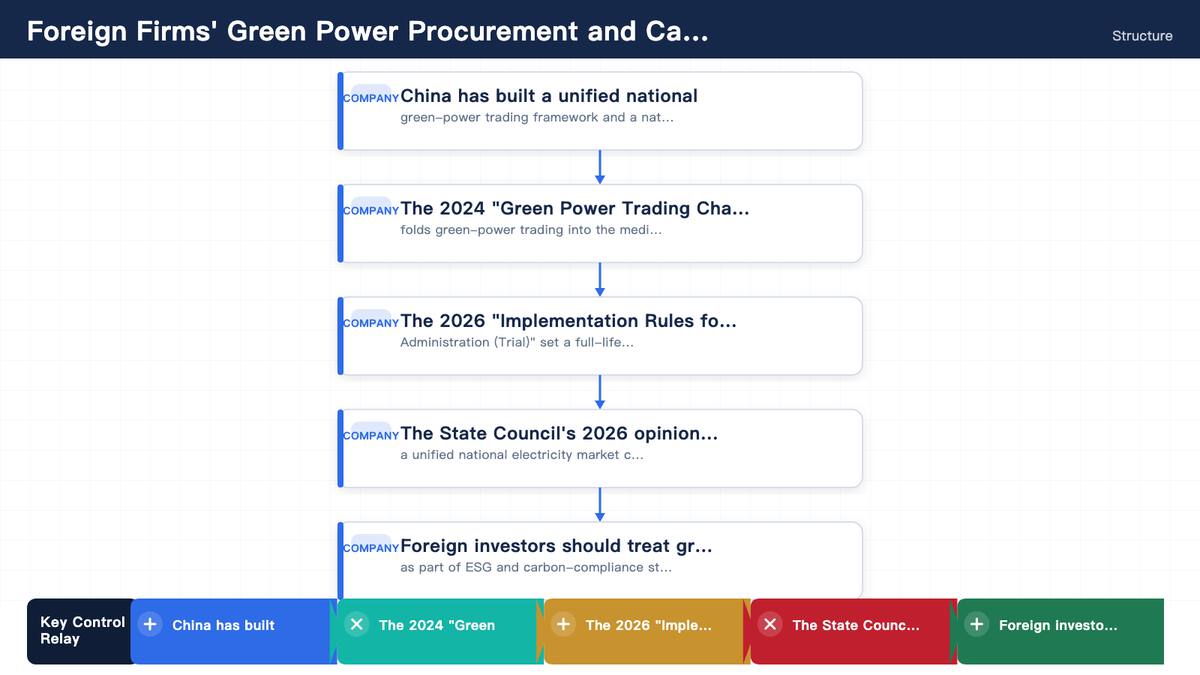
- China has built a unified national green-power trading framework and a nationwide Green Electricity Certificate (GEC) system; foreign-invested enterprises registered in China can open accounts and procure GECs like any domestic user.
中国已建立全国统一的绿色电力交易框架与覆盖全国的绿色电力证书(绿证)制度;在境内合法注册的外商投资企业与境内用户一样可开设账户并采购绿证。- The 2024 “Green Power Trading Chapter” folds green-power trading into the medium- and long-term electricity market, letting users buy renewable attributes together with the power they consume.
2024年《绿色电力交易专章》将绿色电力交易融入电力中长期交易,使用户可随所用电量一并购买可再生能源环境属性。- The 2026 “Implementation Rules for GEC Administration (Trial)” set a full-lifecycle regime — account opening, issuance, transfer and cancellation — and require, from 1 January 2026, that the GEC’s generation year match the consumption year.
2026年《可再生能源绿色电力证书管理实施细则(试行)》建立了账户、核发、划转、核销的全生命周期机制,并要求自2026年1月1日起绿证电量生产年份与消费年份保持一致。- The State Council’s 2026 opinion on a unified national electricity market calls for a mandatory-plus-voluntary green-power consumption system and studies linking GECs into carbon accounting.
国务院办公厅2026年关于完善全国统一电力市场体系的实施意见提出建立强制与自愿相结合的绿证消费制度,并研究将绿证纳入碳排放核算的可行路径。- Foreign investors should treat green-power procurement as part of ESG and carbon-compliance strategy: GECs are the recognised proof of renewable consumption and increasingly feed into carbon disclosures.
外资投资者应将绿电采购纳入ESG与碳合规战略:绿证是公认的可再生能源消费凭证,并日益衔接碳披露。- Cross-border green-power trading with Hong Kong and Macao follows the same green-power trading principles, giving Greater Bay Area users a practical cross-boundary option.
与港澳的跨境绿电交易参照同一绿色电力交易原则,为粤港澳大湾区用户提供切实可行的跨境选项。
Foreign Firms’ Green Power Procurement and Carbon Market Compliance | 外资企业绿电采购、绿证与碳市场履约
Why this matters now
As multinational groups face tightening Scope 2 (purchased electricity) disclosure and supply-chain decarbonisation requirements, China’s rapid build-out of a green-power market has become directly relevant to foreign-invested enterprises (FIEs) operating on the mainland. Two developments converge: a mature, unified green-power trading mechanism, and a standardised Green Electricity Certificate (GEC) system that serves as the recognised proof of renewable consumption. For an FIE, buying green power in China is no longer a niche procurement choice — it is a core instrument for meeting global ESG commitments, customer requirements and emerging carbon-accounting rules.
The green-power trading framework
The “Green Power Trading Chapter” of the Basic Rules for Medium- and Long-Term Electricity Trading (NDRC and NEA, Fa Gai Neng Yuan [2024] No. 1123, July 2024) embeds green-power trading within the broader electricity market. Its design principles are straightforward: renewable generation and eligible users trade green power under medium- and long-term contracts, and the GEC is the foundational certificate evidencing renewable production, consumption and environmental attributes. Provincial authorities guide users to participate on a “within-province primary, cross-region supplementary” basis, and cross-border green-power trading with Hong Kong and Macao follows the same principles.
The Green Electricity Certificate system
The GEC is the national voucher for renewable environmental attributes. The Implementation Rules for GEC Administration (Trial) (NEA, issued late 2025 and published January 2026) codify the full lifecycle:
- Accounts. Power users — including business entities lawfully registered in China — may open a unique real-name GEC account on the national GEC issuance-and-trading system or any GEC trading platform. Foreign-related users with renewable energy exchange with China may also register with valid documentation.
- Issuance. One GEC is issued per 1,000 kWh of renewable generation, monthly, covering wind, solar, biomass, geothermal, marine and eligible hydro.
- Transfer. GECs are transferred in real time from seller to buyer upon transaction completion; green-power trading volumes carry their GECs and cannot be re-traded.
- Cancellation. GECs are cancelled upon expiry (two years), upon declaration of green-power consumption, or upon CCER registration — and from 1 January 2026 the GEC generation year must match the consumption year, raising the bar for time-matched claims.
The 2026 unified electricity market opinion
The State Council’s 2026 opinion on improving the unified national electricity market strengthens the green dimension. It calls for improving the nationally unified GEC market, giving GECs a fuller role as the basis for renewable production, consumption and environmental-attribute recognition, and accelerating a mandatory-plus-voluntary green-power consumption system. It also promotes green-power consumption certification using blockchain, strengthens traceability, and studies viable paths to incorporate GECs into carbon-emission accounting — a signal that green-power proof may increasingly offset carbon obligations.
Carbon-market linkage and compliance posture
Green-power procurement does not sit in isolation from China’s carbon regime. The national carbon-emissions trading market (ETS) covers large emitters, and the policy direction is toward *dual control* — shifting from controlling energy intensity to controlling total carbon emissions — which raises the strategic value of renewable-consumption evidence. For an FIE, the practical chain is: buy green power and receive GECs (proof of renewable consumption), account for residual emissions through the ETS where applicable, and document both for global Scope 2 and supply-chain disclosures. The 2026 opinion’s study of incorporating GECs into carbon accounting is the thread to watch: if GECs become an accepted offset against carbon obligations, early movers with clean procurement records gain a measurable compliance advantage. Foreign groups should therefore build green-power procurement into the China ESG playbook now, rather than treating it as an ad-hoc purchase.
Practical steps for foreign-invested enterprises
- Open a GEC account early. A lawfully registered FIE can register directly; group entities should consolidate procurement to maximise matching and traceability.
- Buy green power through the trading centre. Sign medium- and long-term green-power contracts and let the associated GECs flow to your account automatically.
- Match year and attribute. From 2026, align the GEC generation year with your consumption year and keep cancellation records as ESG evidence.
- Connect to carbon strategy. Track the evolving linkage between GECs and carbon accounting; prepare to use GECs in both disclosures and any future offset mechanism.
- Use GBA cross-border options. For Greater Bay Area operations, explore Hong Kong–Macao cross-border green-power arrangements under the same trading principles.
Related reading
Green-power procurement sits beside China’s national carbon-emissions trading market and the dual-control transition on carbon emissions. FIEs should read the three together: buy green power (GEC), account for residual emissions (carbon market), and document both for global reporting.
外资企业绿电采购、绿证与碳市场履约
为何当下值得关注
随着跨国集团面临日益收紧的范围二(外购电力)披露与供应链脱碳要求,中国快速建成的绿色电力市场已与在岸运营的外商投资企业(FIE)直接相关。两股趋势交汇:成熟的全国统一绿色电力交易机制,以及作为可再生能源消费公认凭证的标准化绿色电力证书(绿证)制度。对外资企业而言,在中国采购绿电已不再是小众采购选择,而是履行全球ESG承诺、满足客户要求并衔接新兴碳核算规则的核心工具。
绿色电力交易框架
《电力中长期交易基本规则——绿色电力交易专章》(国家发展改革委、国家能源局,发改能源〔2024〕1123号,2024年7月)将绿色电力交易嵌入更广泛的电力市场。其设计原则清晰:可再生能源发电企业与符合条件的用户以中长期合同交易绿电,绿证作为证明可再生能源生产、消费与环境属性的基础凭证。地方政府按照”省内为主、跨省区为辅”引导用户参与,与港澳的跨境绿电交易参照同一原则执行。
绿色电力证书制度
绿证是中国可再生能源环境属性的国家级凭证。《可再生能源绿色电力证书管理实施细则(试行)》(国家能源局,2025年底印发、2026年1月发布)对全生命周期作出规范:
- 账户。 电力用户——包括在境内合法注册的经营主体——可在国家绿证核发交易系统或任一绿证交易平台开设唯一实名绿证账户;与中国境内有可再生能源电量交换的国外用户亦可凭有效证件注册。
- 核发。 每1000千瓦时可再生能源电量核发1个绿证,按月核发,覆盖风电、太阳能、生物质、地热、海洋能及符合条件的水电。
- 划转。 交易完成后绿证由卖方账户实时划转至买方;绿色电力交易电量对应的绿证随交易划转且不得再次交易。
- 核销。 绿证在有效期届满(两年)、声明绿色电力消费或完成CCER登记时核销;自2026年1月1日起,绿证电量生产年份须与消费年份一致,提高了年份匹配要求的门槛。
2026年统一电力市场意见
国务院办公厅2026年关于完善全国统一电力市场体系的实施意见强化了绿色维度。其提出完善全国统一的绿证市场,进一步发挥绿证作为可再生能源电力生产、消费与环境属性认定的基础凭证作用,并加快建立强制与自愿相结合的绿证消费制度。意见还倡导以区块链等技术开展绿电消费认证、强化溯源,并研究将绿证纳入碳排放核算的可行路径——这预示着绿电凭证可能日益用于抵减碳义务。
碳市场衔接与合规姿态
绿电采购并非孤立于中国碳制度之外。全国碳排放权交易市场(ETS)覆盖重点排放单位,政策方向正转向”双控”——由管控能耗强度转向管控碳排放总量——这提升了可再生能源消费凭证的战略价值。对外资企业而言,实操链条是:采购绿电并取得绿证(可再生能源消费凭证)、在适用时通过ETS核算剩余排放,并为全球范围二与供应链披露留痕。2026年意见关于”研究将绿证纳入碳排放核算”的提法值得持续跟踪:若绿证成为可抵减碳义务的认可凭证,拥有清洁采购记录的先行者将获得可量化的合规优势。因此,外资集团应将绿电采购纳入在华ESG打法,而非将其视为临时采购。
外商投资企业实务步骤
- 尽早开设绿证账户。 依法注册的FIE可直接注册;集团内主体宜统筹采购以提升匹配度与可追溯性。
- 通过交易中心购买绿电。 签订中长期绿电合同,使对应绿证自动流入本方账户。
- 对齐年份与属性。 2026年起使绿证生产年份与消费年份一致,并留存核销记录作为ESG证据。
- 衔接碳战略。 跟踪绿证与碳核算的衔接演进,为在披露与潜在抵减机制中运用绿证做好准备。
- 善用大湾区跨境选项。 大湾区运营可依据同一交易原则探索与港澳的跨境绿电安排。
延伸阅读
绿电采购与中国全国碳排放权交易市场及碳双控转型并列。外资企业应将三者一并研读:购买绿电(绿证)、核算剩余排放(碳市场)、并为全球报告留痕。
Sources
- 国家发展改革委、国家能源局:《电力中长期交易基本规则——绿色电力交易专章》(发改能源〔2024〕1123号)— https://www.gov.cn/zhengce/zhengceku/202408/content_6970133.htm
- 国家能源局:《可再生能源绿色电力证书管理实施细则(试行)》解读(2026-01-07)— https://www.nea.gov.cn/20260107/3f7a58d6f6a54b1a96b29e0f50cbd04d/c.html
- 国务院办公厅:《关于完善全国统一电力市场体系的实施意见》(2026年国务院公报)— https://www.gov.cn/gongbao/2026/issue_12586/202602/content_7059937.html