
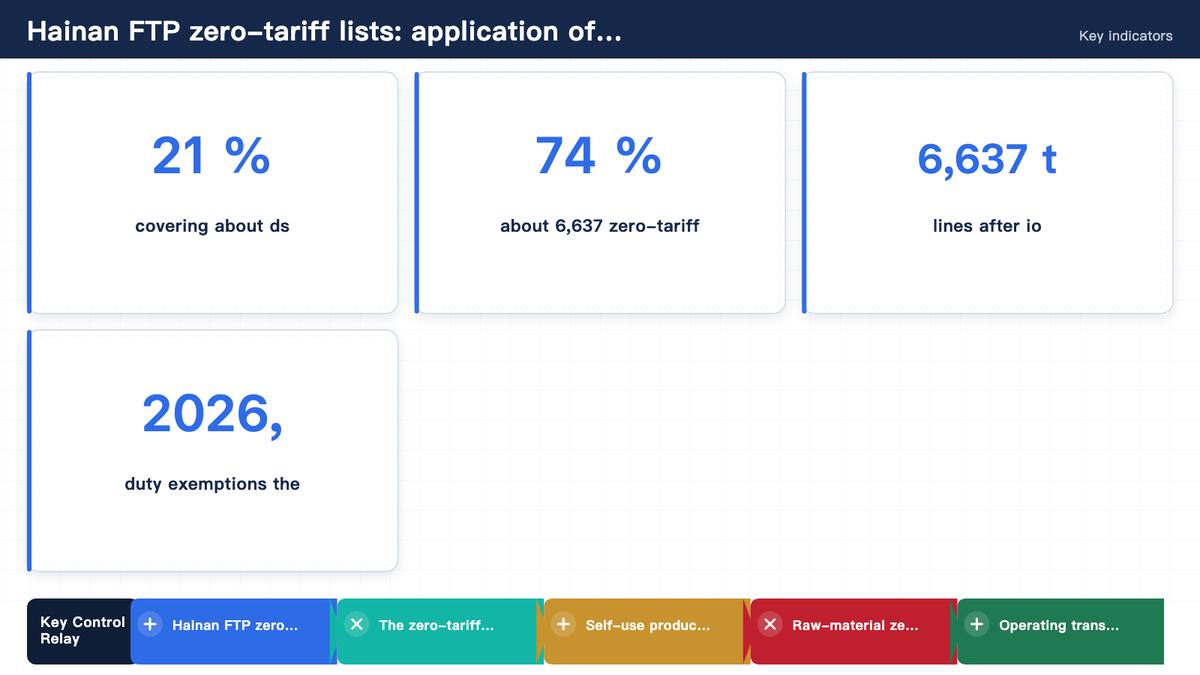
- Hainan FTP zero-tariff policy uses a “one negative, three positive” list design: a negative list for self-use production equipment and positive lists for raw materials, operating transport/vessels, and resident consumer goods.
海南自贸港零关税政策采取”一负三正”清单设计:自用生产设备适用负面清单,原辅料、营运用交通工具及游艇、岛内居民消费品适用正面清单。- The zero-tariff item ratio rose from 21% to 74%, covering about 6,637 tariff lines after island-wide sealing.
封关后零关税商品比例由21%升至74%,覆盖约6637个税目。- Self-use production equipment is zero-tariff except items on the negative list; in the first half of 2026, equipment duty exemptions exceeded RMB 12.6 billion, with a single enterprise saving up to RMB 40 million.
自用生产设备除负面清单商品外均零关税;2026年上半年设备免税规模超126亿元,单家最高免税额达4000万元。- Raw-material zero tariff applies only to Hainan-registered enterprises for in-island production or “two-ends-out” processing, and goods may not be transferred or taken off-island without approval and tax top-up.
原辅料零关税仅限海南注册企业用于岛内生产或”两头在外”加工,未经审批补缴不得转让或出岛。- Operating transport and yachts must be registered under the Hainan flag / operating base; vehicles serving the mainland are capped at 120 days’ cumulative mainland stay per year, except point-to-point shuttle services.
营运用交通工具及游艇须以海南为船籍港/运营基地;往来内地车辆每自然年度内地停留累计不超120天,”点对点”即往即返车辆除外。- Beneficiary entities must keep stock and accounting ledgers and may not on-transfer zero-tariff goods to non-beneficiaries or individuals; second-line movement to the mainland triggers top-up unless the 30% processing-value-added exemption applies.
享惠主体须建立进销存台账,不得将零关税货物流转给非享惠主体或个人;经二线进入内地须补缴,除非适用30%加工增值豁免。
Hainan FTP zero-tariff lists: application of raw-material, self-use equipment and transport/vessel schedules | 海南自贸港零关税清单(原辅料、自用设备、交通工具)适用
Overview
The zero-tariff regime is the headline instrument of the Hainan Free Trade Port (FTP). After island-wide customs operation began on 18 December 2025, the zero-tariff item ratio rose from 21% to 74%, covering about 6,637 tariff lines — above the RCEP starting level. For foreign-invested manufacturers, traders and duty-sensitive consumer businesses, correctly applying the three zero-tariff positive lists (raw materials, operating transport/vessels, resident consumer goods) and the single negative list (self-use production equipment) is the difference between a viable Hainan cost base and an unexpected mainland tariff bill.
Market context
Zero-tariff coverage follows a “one negative, three positive” (一负三正) structure defined in the Master Plan:
- Self-use production equipment — *negative list* management.
- Raw materials for production — *positive list* management.
- Operating transport and yachts — *positive list* management.
- Resident consumer imported goods — *positive list* management.
Goods not on the equipment negative list, and goods on the three positive lists, enter Hainan tariff-free on import. The relief covers customs duty, import VAT and consumption tax unless specifically excluded.
Key 2026 developments
Self-use production equipment (negative list). Enterprises registered in Hainan with independent legal personality that import self-use production or R&D equipment enjoy exemption from customs duty, import VAT and consumption tax, except for items on the negative list (nationally prohibited imports and goods explicitly denied exemption by law/regulation). In the first half of 2026 alone, equipment duty exemptions exceeded RMB 12.6 billion, with a single enterprise’s maximum saving reaching RMB 40 million. Compliance note: advance filing is required and the equipment may not be transferred, leased out or taken off-island for five years without approval and tax settlement.
Raw materials (positive list). The first batch, issued by the Ministry of Finance, GACC and the State Taxation Administration in November 2020, covered 169 eight-digit tariff lines (coconuts, coal, petrochemicals, optical-fibre preforms, and aircraft/ship repair parts), managed as a positive list. The list has since been expanded several times; a 2025 supplementary list added hundreds of items spanning chemicals, plastics, rubbers, specialty papers, metals, machinery parts and laboratory glassware. Eligibility is limited to Hainan-registered enterprises using the materials for in-island production, or for “two-ends-out” (两头在外) processing or services-trade consumption. Raw materials are for the enterprise’s own production use only, under customs supervision, and may not be transferred within the island or taken off-island except upon approval and payment of applicable duties.
Operating transport and yachts (positive list). Shipping, aviation and tourism enterprises qualified as beneficiaries that import vessels, aircraft and yachts for operating transport and tourism enjoy tariff, import VAT and consumption tax exemptions. Such craft must be registered under the Hainan flag / operating base and operated per transport, civil-aviation and maritime rules. Vehicles may serve passenger/cargo transport to and from the mainland, provided at least one end of the trip originates or terminates in Hainan; mainland stay is capped at 120 cumulative days per calendar year (calculated by natural days, regardless of trip count), with an exemption for point-to-point, immediate-return services. In the centenary period, the “China Yangpu Port” register reached 86 vessels (4.688 million tonnes), keeping Hainan second nationally in international-voyage tonnage.
Maintenance parts. Parts imported for maintaining aircraft, vessels, yachts and production equipment may be exempt from top-up duty if they meet specified conditions (e.g. repairing aircraft/vessels that entered from abroad and will re-export; repairing Hainan-based carriers’ aircraft; repairing Hainan-flagged ships; repairing zero-tariff yachts and equipment). A maintenance materials ledger is required and diversion to other use is prohibited.
Resident consumer goods (positive list). From 11 February 2026, island residents may purchase designated imported consumer goods zero-tariff through opened resident-goods duty-free stores (first five stores). The catalogue covers about 202 consumer items with an annual per-capita quota of RMB 10,000, for personal use only; reselling or proxy purchasing is prohibited.
Practical steps
- Map your HS codes to the relevant zero-tariff list before importing; confirm whether your good is on the equipment negative list or one of the three positive lists.
- Confirm beneficiary status — only Hainan-registered independent legal entities with real operation qualify; file in advance.
- Segregate equipment from materials — equipment carries a five-year no-transfer restriction; raw materials must stay within your production and may not be on-transferred or taken off-island without approval.
- For transport/yachts, complete flag/operating-base registration and annual use verification; model the 120-day mainland-stay cap for vehicles.
- Maintain ledgers — stock, accounting and (for maintenance) materials ledgers; keep contracts and logistics documents to evidence in-island circulation among beneficiaries.
- Plan the second-line movement — zero-tariff goods and their processed products circulate duty-free among beneficiaries, but transfer to non-beneficiaries, individuals, or crossing the second line into the mainland triggers top-up unless the ≥30% processing-value-added exemption applies.
Related reading
- Hainan FTP sealing mechanism and foreign-investor implications (see article 150).
- Hainan FTP 15% corporate income tax and encouraged-industry catalogue (see article 153).
Sources
- 海南自由贸易港官方网站 — 核心政策60条(零关税政策)
- 海南自由贸易港官方网站 — 原辅料”零关税”政策增补清单(PDF)
- 海南省人民政府网 — 海南自由贸易港封关百日记者招待会(2026-03-26,含6637项税目数据)
海南自贸港零关税清单(原辅料、自用设备、交通工具)适用
概述
零关税制度是海南自由贸易港最具标志性的政策工具。2025年12月18日全岛封关运作后,零关税商品比例由21%升至74%,覆盖约6637个税目,高于RCEP起步水平。对于外资制造、贸易及对关税敏感的消费类企业而言,正确适用三张零关税正面清单(原辅料、营运用交通工具及游艇、岛内居民消费品)与一张负面清单(自用生产设备),直接决定了海南成本基地是否可行,以及是否会意外产生内地关税账单。
市场背景
零关税覆盖遵循《总体方案》确定的“一负三正”结构:
- 自用生产设备——适用*负面清单*管理。
- 生产原辅料——适用*正面清单*管理。
- 营运用交通工具及游艇——适用*正面清单*管理。
- 岛内居民消费品——适用*正面清单*管理。
未列入设备负面清单的商品,以及列入三张正面清单的商品,进口进入海南免征关税。除特别排除外,减免范围涵盖关税、进口环节增值税与消费税。
2026年核心进展
自用生产设备(负面清单)。 在海南注册且具有独立法人资格的企业,进口自用生产或研发设备,除负面清单商品(国家禁止进口及法律法规明确不予免税的商品)外,免征关税、进口环节增值税与消费税。仅2026年上半年,设备免税规模即超126亿元,单家最高免税额达4000万元。合规要点:须提前备案,且设备5年内不得转租、转让或出岛,否则须审批并补缴税款。
原辅料(正面清单)。 首批清单由财政部、海关总署、税务总局于2020年11月发布,涵盖169个8位税目(椰子、煤炭、石化品、光导纤维预制棒、飞机船舶维修零部件等),实行正面清单管理。清单此后多次扩容;2025年增补清单新增数百项,覆盖化工、塑料、橡胶、特种纸、金属、机械零部件及实验室玻璃器皿等。适用主体限于海南注册企业,用于岛内生产自用,或以”两头在外”模式加工贸易、服务贸易所消耗。原辅料仅限企业自身生产使用,接受海关监管,不得在岛内转让或出岛,确需转让或出岛的须审批并补缴税款。
营运用交通工具及游艇(正面清单)。 取得享惠资格的航运、航空、旅游企业,进口用于交通运输、旅游业的船舶、航空器及游艇,免征关税、进口环节增值税与消费税。此类交通工具须以海南为船籍港/运营基地,并按交通运输、民航、海事主管部门规定营运。车辆可从事往来内地客货运输,但始发地及目的地至少一端须在海南自贸港内;在内地停留时间每自然年度累计不超过120天(按自然日计算,不计次数),”点对点””即往即返”车辆不受该天数限制。封关百日,”中国洋浦港”登记在册船舶86艘(468.82万吨),国际航行船舶总吨位稳居全国第二。
维修零部件。 用于维修航空器、船舶、游艇及生产设备的零部件,满足特定条件(如维修从境外进境并将复运出境的航空器/船舶、以海南为主基地的航企所运营航空器、海南籍船舶、零关税进口游艇及设备等)的,可免于补缴进口税收;须建立维修物料台账,禁止私自挪用。
岛内居民消费品(正面清单)。 自2026年2月11日起,岛内居民可通过开设的日用消费品免税店(首批5家)零关税购买指定进口消费品。目录约涵盖202项消费品,每人每年1万元额度,限自用,禁止代购倒卖。
实务步骤
- 对照HS编码匹配相应零关税清单,确认商品属于设备负面清单还是三张正面清单之一。
- 确认享惠主体资格——仅海南注册、实质性运营的 independent legal entity 可享,须提前备案。
- 区分设备与原辅料——设备附5年不得转让限制;原辅料须留于自身生产,未经审批不得转让或出岛。
- 交通工具及游艇须完成船籍港/运营基地登记与年度使用核查;对往来内地车辆测算120天停留上限。
- 建立台账——进销存台账、会计核算台账及(维修)物料台账;留存合同与物流单据以证明岛内享惠主体间流通。
- 规划二线出岛——零关税货物及其加工制成品在享惠主体间流通免补税,但流转至非享惠主体、个人或经二线进入内地须补缴,除非适用≥30%加工增值免关税。
延伸阅读
- 海南自贸港封关运作机制与对外资含义(参见150篇)。
- 海南自贸港企业所得税15%优惠与鼓励类产业目录(参见153篇)。
来源