
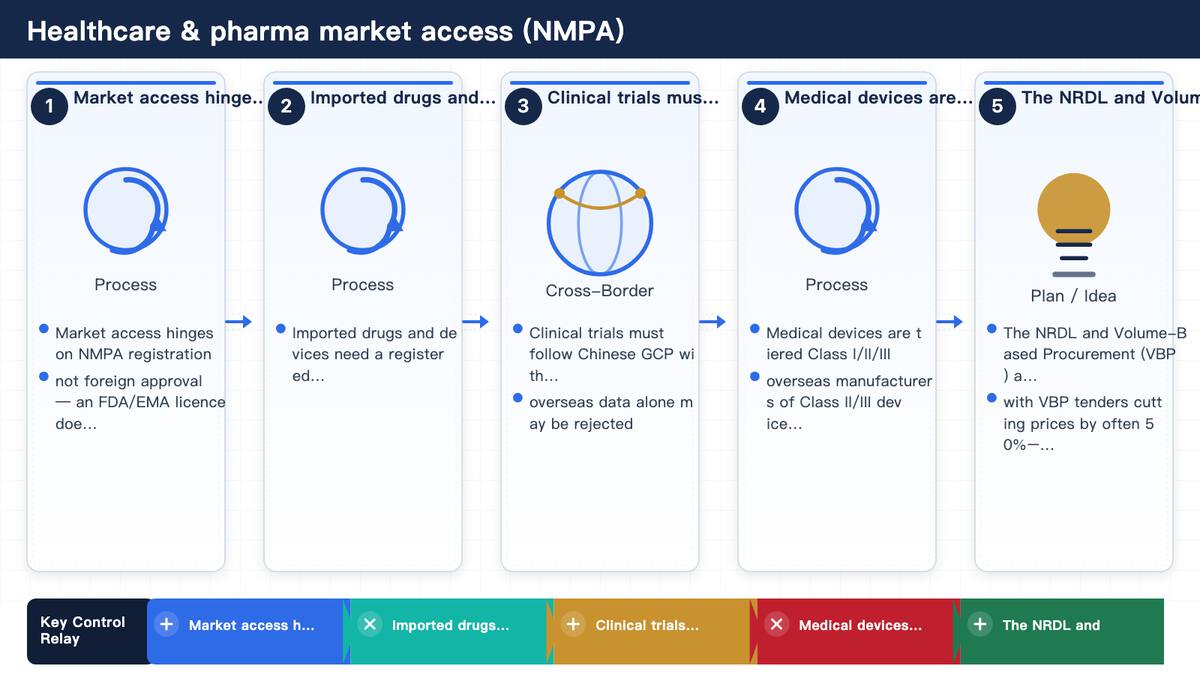
- Market access hinges on NMPA registration, not foreign approval — an FDA/EMA licence does not register a product in China.
市场准入关键在于NMPA注册而非境外批准——FDA或EMA许可并不等于在中国注册。- Imported drugs and devices need a registered China responsible agent to serve as the domestic Marketing Authorisation Holder stand-in with real lifecycle duties.
进口药品与器械须有登记的境内责任代理人,作为境内上市许可持有人的代位人,承担真实的全生命周期职责。- Clinical trials must follow Chinese GCP with NMPA approval and generally use local sites and Chinese patient populations; overseas data alone may be rejected.
临床试验须遵循中国GCP并取得NMPA批准,通常须设国内研究中心并纳入中国患者人群;仅境外数据可能被拒。- Medical devices are tiered Class I/II/III; overseas manufacturers of Class II/III devices must register their production site with the NMPA.
医疗器械按风险分一/二/三类;二类、三类境外生产企业须向NMPA登记其生产场地。- The NRDL and Volume-Based Procurement (VBP) are the dominant commercial gateways, with VBP tenders cutting prices by often 50%–90%.
《国家医保药品目录》与集中带量采购(VBP)是主导性商业关口,VBP中标常以50%–90%的降价换取约定采购量。- Approved products require Chinese labels and package inserts, and import clearance hinges on the NMPA registration certificate as a key document.
获批产品须配中文标签与说明书,进口清关以NMPA注册证作为关键单证。
Healthcare & pharma market access (NMPA) | 医疗医药准入(药监局)
Overview
Pharmaceuticals and medical devices are among the most heavily regulated products in China, supervised primarily by the National Medical Products Administration (NMPA). Market access hinges on registration, not merely on foreign approval: a drug or device lawfully sold in the EU or US generally cannot be marketed in China until it has gone through China’s own registration pathway and met Chinese standards.
This article explains the drug and device registration routes, clinical-trial requirements, and the practical steps a foreign pharma or medtech company should plan for. It is informational and must not be treated as regulatory or legal advice; confirm current requirements with the NMPA and qualified PRC counsel.
The NMPA and the marketing-authorisation-holder system
The NMPA (www.nmpa.gov.cn; English: english.nmpa.gov.cn) oversees drugs, medical devices, and cosmetics nationwide, supported by its centres for drug evaluation (CDE), medical-device evaluation (CMDE), and inspection. China operates a Marketing Authorisation Holder (MAH) system: the holder — which may be a domestic entity or, for imported products, the overseas manufacturer represented by a China responsible agent — bears the lifecycle responsibilities for a product. Foreign companies therefore need a registered China agent to act as the domestic responsible party for imported drugs and devices.
The MAH’s responsibilities are not limited to winning approval; they extend across the product’s life — pharmacovigilance and adverse-drug-reaction monitoring, post-market studies and risk-management plans, lot-release and traceability, and recall execution. For imported products, the China responsible agent stands in for the overseas MAH on these duties and can be held directly accountable by the NMPA for quality and safety failures in the China market. This makes agent selection a governance decision, not a paperwork one: the agent must have the regulatory capacity, quality-system interface, and personnel to discharge obligations such as timely adverse-event reporting and recall coordination. A weak agent is a recurring root cause of post-market enforcement actions.
Drug registration pathways
Chemical drugs are classified into five categories (Class 1 innovative, through Classes 2–5 for modified, generic, and imported/domestic equivalents), and biological products follow a parallel framework. A new innovative drug (Class 1) requires full non-clinical and clinical data generated to Chinese Good Clinical Practice (GCP) and Good Laboratory Practice standards. Generic drugs rely on bioequivalence and quality-consistency studies. Imported drugs are registered through the NMPA’s drug-evaluation centre, with dossiers submitted in the required CTD-style format and, for most new drugs, via the marketing-authorisation application after a completed clinical trial approved by the NMPA.
Clinical-trial requirements
Before a human trial in China, the sponsor must obtain NMPA approval (or, for certain listed trials, file a notification) and register the trial in the national drug-trial registration system. Trials must follow Chinese GCP; ethical review by a qualified institutional review board is mandatory, and the use of Chinese patient populations and sites is generally expected so that the data are relevant to the China population. The NMPA has, in recent years, aligned many technical guidelines with ICH standards to ease multinational, multi-regional trials, but local relevance and NMPA acceptance of overseas data still require careful planning.
A related point is the use of the communication channels (Pre-IND and formal communication meetings) with the CDE. The NMPA encourages sponsors to consult the centre at key milestones — before an IND for innovative drugs, on pivotal technical questions, and before the marketing-authorisation application. Meaningful communication materially reduces the risk of later demands for supplementary studies. For overseas-approved drugs that are clinically urgent and not yet marketed in China, conditional approval and priority-review pathways can shorten time-to-market, but they are conditioned on a commitment to complete confirmatory trials. Where overseas data are used for China registration, a racial-sensitivity (ethnic sensitivity) assessment and, where needed, bridging data should be anticipated.
Medical-device registration
Devices are tiered by risk into Class I (low), Class II (medium), and Class III (high). Class I devices are filed with the provincial NMPA office; Class II and III require NMPA or provincial registration (Class III and most Class II are registered with the NMPA/CMDE). Registration demands product technical requirements, type testing at an accredited lab, and a clinical evaluation or trial unless the device is exempt. Quality-system compliance (Good Manufacturing Practice for medical devices) is inspected, and overseas manufacturers of Class II/III devices must register their production site with the NMPA.
Another frequent blind spot in device registration is the choice of clinical-evaluation route. Not every Class II/III device requires a clinical trial: where a product is comparable to an already-marketed device of the same品种, a literature- and data-based “same-species” comparison can support exemption from trials; but novel or high-risk devices with no comparable predicate still need a trial. Companies should settle the clinical-evaluation strategy early — same-species comparison, trial exemption, or full trial — because it dictates the evidence-generation timeline and cost. In addition, the overseas manufacturing site of imported Class II/III devices must be registered with the NMPA, and the clean-room environment and quality system are subject to on-site inspection.
Post-market, labelling, and import considerations
Approved drugs and devices carry Chinese package inserts and labels; foreign-language-only labelling is not sufficient for the China market. Importers and responsible agents must maintain traceability and adverse-event reporting. Imported products enter through customs with the NMPA registration certificate as a key clearance document, and certain products face additional inspection by customs and SAMR. Reimbursement via the National Reimbursement Drug List and Volume-Based Procurement (VBP) are commercial-access factors a market-entry plan should weigh, though they sit outside the registration step itself.
A market-entry plan that stops at registration understates the real access barrier. The National Reimbursement Drug List (NRDL) negotiation and the Volume-Based Procurement (VBP, “集中带量采购”) program are the dominant commercial gateways: inclusion in the NRDL makes a drug reimbursable under basic medical insurance and unlocks hospital demand, while VBP tenders — which now cover many chemical generics, some biosimilars, and high-value devices — award volume in exchange for steep price cuts (often 50%–90%). Winning a VBP tender guarantees large, near-certain volume but at compressed margins, and losing can mean effective exclusion from public hospitals. Foreign companies should model the reimbursement and VBP scenario explicitly rather than treating them as downstream marketing concerns. Separately, data and market-exclusivity protections (e.g. for innovative drugs and paediatric/rare-disease indications) can shape the timing and defensibility of a launch.
Common pitfalls
- Assuming foreign approval is enough. An FDA or EMA licence does not register a product in China. A separate NMPA pathway, meeting Chinese standards and often Chinese clinical data, is mandatory before any lawful marketing.
- Relying on overseas trial data alone. Even where NMPA accepts foreign data under ICH-aligned guidance, trials are expected to follow Chinese GCP with local sites and Chinese patient populations; data without local relevance risks rejection or a requirement for bridging studies.
- Treating the China responsible agent as a formality. The agent is the domestic MAH stand-in with real lifecycle duties — pharmacovigilance, recalls, traceability. A weak agent is a frequent root cause of enforcement.
- Forgetting the registration certificate at customs. Import clearance hinges on the NMPA registration certificate as a key document; without it the product cannot enter, regardless of foreign readiness.
- Planning only for registration, not reimbursement. For most drugs and many devices, NRDL inclusion and VBP outcome — not the registration grant — determine commercial viability in the China market.
- Neglecting the device clinical-evaluation route analysis. Not all devices need trials, but the route choice (same-species comparison, exemption, or trial) sets the evidence cost and launch pace and should be settled at project kick-off.
What to do next
- Identify the correct classification early (drug class, device Class I/II/III) because it dictates the entire evidence and review path.
- Appoint a qualified China responsible agent to serve as the domestic party for imported-product registration and post-market duties.
- Plan clinical trials to Chinese GCP with NMPA approval and local sites; do not assume overseas trial data alone will suffice.
- Budget for type testing, stability studies, and GMP/site inspection lead times — these, not the fee, are usually the critical path.
- Prepare Chinese labelling, inserts, and a pharmacovigilance/traceability system before launch.
- Check reimbursement and VBP exposure as part of the commercial case, separate from registration.
Sources
- National Medical Products Administration (NMPA) — official portal: https://www.nmpa.gov.cn
- NMPA — English portal: https://english.nmpa.gov.cn
- NMPA — government-service portal (drug/device registration and clinical-trial filing): https://zwfw.nmpa.gov.cn
- NMPA — drug clinical-trial registration system (official portal, see service portal above): https://zwfw.nmpa.gov.cn
- National Healthcare Security Administration (NHSA) — National Reimbursement Drug List & Volume-Based Procurement: https://www.nhsa.gov.cn/ (official portal)
- State Administration for Market Regulation (SAMR) — medical-device and related oversight (official portal): https://www.samr.gov.cn/
Related reading
- see also: Food & beverage market entry & licensing (48-fnb-market-entry-licensing)
- see also: Financial services & fintech licensing (44-financial-services-fintech-licensing)
- see also: Import-export licensing & customs clearance (50-import-export-customs-clearance)
医疗医药准入(药监局)
概述
药品与医疗器械是中国监管最严格的产品类别之一,主要由国家药品监督管理局(NMPA)监管。市场准入的关键在于注册,而非仅凭境外批准:在欧盟或美国合法销售的药品或器械,通常须走完中国自身的注册路径并符合中国标准后,方可在华上市。
本文说明药品与器械的注册路径、临床试验要求,以及外资药企与医疗器械公司应规划的实务步骤。本文仅为信息参考,不构成监管或法律意见;请以 NMPA 及合格的中国法律顾问确认最新要求。
药监局与上市许可持有人制度
NMPA(www.nmpa.gov.cn;英文:english.nmpa.gov.cn)统筹全国药品、医疗器械与化妆品监管,下设药品审评中心(CDE)、医疗器械技术审评中心(CMDE)及查验中心。中国实行上市许可持有人(MAH)制度:持有人——可以是境内主体,进口产品则为由境内责任代理人代表的境外生产企业——对产品全生命周期负责。因此,外国公司需要一家已登记的境内代理人,作为进口药品与器械的境内责任主体。
MAH 的职责并不止于取得批准,而是贯穿产品全生命周期——药物警戒与药品不良反应监测、上市后研究与风险管理计划、批签发与可追溯,以及召回执行。对进口产品而言,境内责任代理人就这些职责代行境外 MAH,并可能因中国市场质量与安全问题被 NMPA 直接追责。这使得代理人选择是一项治理决策,而非文书工作:代理人须具备监管能力、质量体系接口与人员,以履行不良反应及时报告与召回协调等义务。薄弱的代理人是上市后执法行动的反复根因。
药品注册路径
化学药品分为五类(1 类创新药,至 2–5 类的改良型、仿制及进口/境内同品种),生物制品遵循平行框架。创新药(1 类)须提供符合中国《药物临床试验质量管理规范》(GCP)与《药物非临床研究质量管理规范》(GLP)的完整非临床与临床数据。仿制药依赖生物等效性与质量和一致性研究。进口药品通过 NMPA 药品审评中心注册,申报资料以 CTD 式格式提交,多数新药须在完成 NMPA 批准的临床试验后,通过上市许可申请注册。
临床试验要求
在中国开展人体试验前,申办方须取得 NMPA 批准(或特定已列明试验须进行备案),并在国家药物临床试验登记与信息公示平台登记。试验须遵循中国 GCP;经资质的伦理委员会审查为强制要求,且通常期望纳入中国患者人群与研究中心,以保证数据对中国人群的相关姓。近年来,NMPA 已将多项技术指南与 ICH 标准接轨,以便利跨国多区域试验,但境外数据的本地相关性与 NMPA 接受度仍需审慎规划。
值得注意的另一点是沟通交流(Pre-IND 与沟通交流会议)机制的利用。NMPA 鼓励申办方在关键节点与 CDE 沟通,尤其是创新药在临床试验申请前、关键技术问题以及上市许可申请前。充分的沟通交流可显著降低后期被要求补充研究的风险。此外,对于在境外已上市、境内未上市的临床急需药品,附条件批准与优先审评审批通道可缩短上市时间,但须以承诺完成确证性试验为前提。境外数据用于中国注册时,还需注意种族敏感性(ethnic sensitivity)评估与必要的桥接数据。
医疗器械注册
器械按风险分为第一类(低)、第二类(中)、第三类(高)。第一类向省级药监部门备案;第二类与第三类须注册(第三类及多数第二类由 NMPA/CMDE 注册)。注册须提交产品技术要求、在资质实验室进行的型检,以及临床评价或临床试验(除非属于豁免目录)。质量体系合规(《医疗器械生产质量管理规范》)须接受检查,第二类/第三类境外生产企业须向 NMPA 登记其生产场地。
器械注册的另一常见盲点是临床评价路径的选择。并非所有二类、三类器械都需临床试验——若产品属同品种已上市器械且能通过同品种比对路径证明安全有效,可免于临床试验;但若无同品种可比或属高风险创新,仍须开展临床试验。企业应尽早做临床评价路径论证,确定是走同品种比对、免于临床,还是临床试验,因为该选择直接决定证据生成的时间与成本。此外,进口二类、三类器械的境外生产场地须完成 NMPA 登记,且洁净生产环境与质量体系须接受现场核查。
上市后、标签与进口考量
已获批药品与器械须配有中文说明书与标签;仅外文标签不足以进入中国市场。进口商与责任代理人须保持可追溯性与不良事件报告。进口产品清关时须以 NMPA 注册证作为关键单证,部分产品还须接受海关与市场监管总局的额外检验。通过《国家医保药品目录》与药品集中带量采购(VBP)获得的报销,是市场准入计划应权衡的商业准入因素,尽管其处于注册步骤之外。
止于注册的准入计划低估了真正的准入壁垒。《国家医保药品目录》(NRDL)谈判与药品集中带量采购(VBP,”带量采购”)是主导性的商业关口:纳入 NRDL 使药品可由基本医疗保险报销,撬动医院需求;而 VBP 带量采购——现覆盖众多化学仿制药、部分生物类似药与高值耗材——以大幅降价(常为 50%–90%)换取约定采购量。中标即锁定大且近乎确定的销量,但利润被压缩;落标则可能被公立医院体系实质排除。外国公司应显式建模报销与 VBP 情景,而非将其视为下游营销问题。此外,数据保护与市场独占期(如创新药及儿科/罕见病适应症的保护)会影响上市的时机与可防御性。
常见误读
- 以为境外批准即足够。 FDA 或 EMA 许可并不等于在中国注册。在合法上市前,必须走完 NMPA 路径,符合中国标准并常需中国临床数据。
- 仅凭境外试验数据。 即便 NMPA 在 ICH 接轨指引下接受境外数据,试验仍须遵循中国 GCP 并设国内研究中心、纳入中国患者人群;缺乏本地相关性的数据有被拒或要求桥接研究之险。
- 把境内责任代理人当文书手续。 代理人是境内 MAH 代位人,承担真实的上市后职责——药物警戒、召回、可追溯。薄弱代理人是执法的常见根因。
- 在海关忘了注册证。 进口清关以 NMPA 注册证为关键单证;缺少它,产品无法入境,与境外准备程度无关。
- 只规划注册、不规划报销。 对多数药品与许多器械而言,NRDL 纳入与 VBP 结果——而非注册批件——决定其在中国市场的商业可行性。
- 忽视临床评价路径论证。 并非所有器械都需临床试验,但路径选择(同品种比对、免于临床或临床试验)决定证据成本与上市节奏,应在立项时即论证。
下一步建议
- 尽早确定正确分类(药品类别、器械一/二/三类),因其决定整个证据与审评路径。
- 指定合格的境内责任代理人,作为进口产品注册与上市后职责的境内主体。
- 按中国 GCP 规划临床试验并取得 NMPA 批准、设立国内研究中心;勿假设仅凭境外试验数据即可。
- 为型检、稳定性研究及 GMP/场地核查留出时间——通常关键路径在于此而非费用。
- 上市前准备好中文标签、说明书,以及药物警戒/可追溯体系。
- 将报销与带量采购敞口作为商业论证的一部分另行评估,与注册分离。
来源
- 国家药品监督管理局(NMPA)——官方门户:https://www.nmpa.gov.cn
- NMPA——英文门户:https://english.nmpa.gov.cn
- NMPA——政务服务门户(药品/器械注册与临床试验登记):https://zwfw.nmpa.gov.cn
- NMPA——药物临床试验登记与信息公示平台(见政务服务门户):https://zwfw.nmpa.gov.cn
- 国家医疗保障局(NHSA)——国家医保药品目录与集中带量采购:https://www.nhsa.gov.cn/(官方门户)
- 国家市场监督管理总局(SAMR)——医疗器械及相关监管(官方门户):https://www.samr.gov.cn/
相关阅读
- 参见:餐饮食品入华与许可(48-fnb-market-entry-licensing)
- 参见:金融服务与金融科技牌照(44-financial-services-fintech-licensing)
- 参见:进出口许可与海关清关(50-import-export-customs-clearances)