
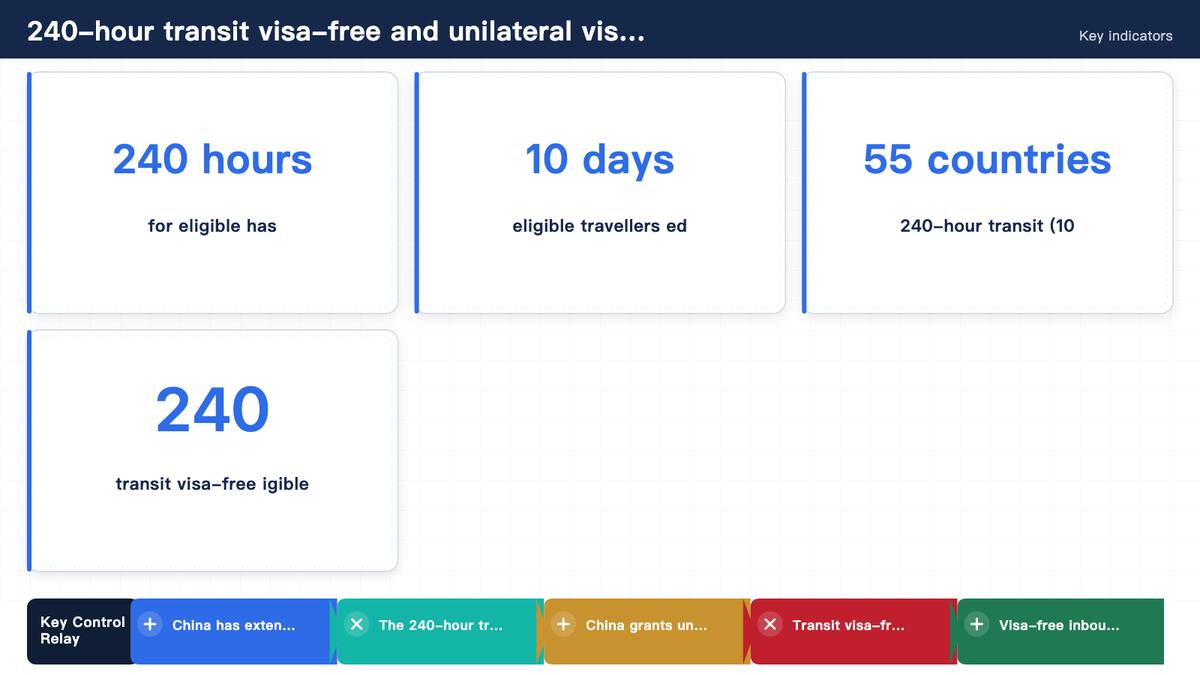
- China has extended transit visa-free stay to 240 hours (10 days) for eligible travellers from 55 countries.
中国已将55个国家的合资格旅客过境免签停留时间延长至240小时(10天)。- The 240-hour transit visa-free policy now applies at 65 ports across 24 provincial-level regions, up from 39 ports and 19 regions.
240小时过境免签政策现已覆盖24个省级行政区的65个口岸,较此前的39个口岸、19个地区进一步扩大。- China grants unilateral visa-free entry to 50 countries, with the policy extended through 31 December 2026.
中国对50个国家实行单方面免签入境,该政策已延长至2026年12月31日。- Transit visa-free visitors may travel across provincial borders within the allowed stay areas.
过境免签旅客可在允许的停留区域内跨省流动。- Visa-free inbound tourists reached 2.92 million in the 2026 New Year holiday, up 35.8% year on year.
2026年新年假期,免签入境游客达292万人次,同比增长35.8%。
240-hour transit visa-free and unilateral visa waivers: easier China entry in 2026 | 240小时过境免签与单方面免签:2026年更便利的来华通道
Overview
China’s inbound-travel facilitation accelerated sharply in 2024 and 2025, and the momentum carried into 2026. Two complementary instruments now make short-term China entry substantially easier for foreign business travellers, investors and tourists: the 240-hour transit visa-free scheme and a broad set of unilateral visa waivers.
On 17 December 2024, the National Immigration Administration (NIA) announced a major widening of the transit visa-free policy: the permitted stay was extended from 72/144 hours to 240 hours (10 days); the number of eligible countries rose from 54 to 55; applicable ports increased from 39 to 60; and the covered provincial-level regions grew from 19 to 24. Crucially, cross-provincial travel within the designated stay areas was permitted for the first time.
By March 2026, a consulate update confirmed the 240-hour policy had further expanded to 65 ports across 24 provincial-level regions. Separately, China’s unilateral visa-free programme now covers 50 countries, extended through 31 December 2026, alongside comprehensive mutual visa-free arrangements with 29 countries.
The 240-hour transit visa-free scheme
Eligibility
The scheme applies to passport holders of 55 countries who hold:
- a confirmed onward ticket to a third country or region;
- a valid visa or residence permit for that onward destination (where required); and
- entry through one of the designated ports.
Travellers must enter and exit via the approved ports and remain within the permitted stay areas during the 240-hour window.
Ports and regions
The policy now operates at 65 ports spanning 24 provincial-level regions. The expansion from 39 ports / 19 regions (the pre-December-2024 baseline) means many more cities — including major commercial hubs — are now entry points. This is materially relevant for business visitors who previously had to route through a limited set of gateway cities.
Cross-provincial movement
Unlike the older 72/144-hour schemes, which locked travellers into a single city or province, the 240-hour policy allows movement across provincial borders within the allowed stay areas. This supports multi-city business itineraries (e.g., Shanghai → Zhejiang → Jiangsu) without a formal visa.
Unilateral visa waivers
China grants unilateral visa-free entry to 50 countries, a policy originally introduced as a post-pandemic recovery measure and repeatedly extended. As of 2026, it is confirmed through 31 December 2026. In addition, China maintains comprehensive mutual visa-free agreements with 29 countries.
Practical implications:
- Nationals of these 50 countries may enter China for short stays (tourism, business, family visits) without obtaining a visa in advance.
- The unilateral measure is a sovereign policy choice and can be adjusted; travellers should verify current eligibility before departure.
- Combined with the transit scheme, the two instruments cover a very large share of prospective foreign business visitors.
Impact and demand signals
Demand confirms the policy is working. During the 2026 New Year holiday, visa-free inbound tourists reached 2.92 million, representing 35.8% year-on-year growth. The surge reflects both the breadth of the waiver coverage and the removal of friction in short-term entry.
For foreign investors and market-entry teams, the practical upside is direct:
- Reconnaissance trips — visiting factories, partners and regulators without visa lead time.
- Meeting-driven travel — multi-city roadshows and due-diligence visits under the cross-provincial rule.
- Faster onboarding — short-stay entry for technical staff and consultants during setup.
Practical guidance for business travellers
- Check the country list against the latest NIA and consulate notices before booking; lists are updated periodically.
- Choose an eligible port — confirm both arrival and departure airports/ports are on the 65-port list.
- Prepare onward proof — keep confirmed tickets and, where needed, the third-country visa.
- Plan routes within stay areas — leverage cross-provincial freedom but respect the boundary of permitted regions.
- Do not overstay — the 240-hour clock starts at entry; overstaying triggers penalties and future-entry risk.
Sources
- National Immigration Administration (NIA) — NIA press conference on widened transit visa-free policy (2024-12-17).
- Chinese Consulate in Barcelona — 2026-03 consulate update: 240-hour policy at 65 ports, 24 regions, 55 countries.
240小时过境免签与单方面免签:2026年更便利的来华通道
概述
中国入境旅行便利化在2024与2025年显著提速,并延续至2026年。两套互补机制让外国商务旅客、投资者与游客的短期来华大幅便利:其一是240小时过境免签制度,其二是范围广泛的单方面免签安排。
2024年12月17日,国家移民管理局宣布大幅放宽过境免签政策:允许停留时间由72/144小时延长至240小时(10天);适用国家由54个增至55个;适用口岸由39个增至60个;覆盖的省级行政区由19个增至24个。关键的是,首次允许在限定停留区域内跨省流动。
至2026年3月,领事机构更新确认,240小时政策已进一步扩展至24个省级行政区的65个口岸。与此同时,中国的单方面免签计划已覆盖50个国家,并延长至2026年12月31日;此外还与29个国家达成全面互免签证安排。
240小时过境免签制度
适用条件
该制度适用于55个国家的护照持有人,且须满足:
- 持有前往第三国或地区的已确认联程客票;
- 持有该目的地所需的有效签证或居留许可(如需要);
- 经指定的对外开放口岸入境。
旅客须经由批准的口岸入出境,并在240小时窗口期内停留在允许的区域内。
口岸与区域
该政策现于24个省级行政区的65个口岸实施。相较2024年12月前的39个口岸、19个地区,许多商业枢纽城市成为新的入境点。对商务访客而言,这意义重大——以往只能经由少数门户城市中转。
跨省流动
与旧版72/144小时制度将旅客锁定在单一城市或省份不同,240小时政策允许在允许的停留区域内跨省流动。这支持多城市商务行程(如上海→浙江→江苏),而无需正式签证。
单方面免签
中国对50个国家实行单方面免签入境,该政策最初作为疫后复苏措施推出,并多次延长。截至2026年,已确认延长至2026年12月31日。此外,中国与29个国家保持全面互免签证安排。
实际影响:
- 这50个国家的公民可免预先签证短期来华(旅游、商务、探亲)。
- 单方面措施为主权政策选择,可随时调整;旅客应在出发前核实当前资格。
- 与过境制度结合,两套机制覆盖了绝大多数潜在外国商务访客。
影响与需求信号
需求数据印证了政策成效。2026年新年假期,免签入境游客达292万人次,同比增长35.8%。这一激增既反映出免签覆盖之广,也体现出短期入境摩擦的消除。
对外国投资者与市场进入团队而言,实际利好直接可见:
- 考察行程——无需签证准备时间即可走访工厂、合作伙伴与监管方。
- 以会议为导向的出行——借助跨省规则开展多城市路演与尽职调查。
- 更快的人员到位——设立期间短期入境技术人员与顾问。
商务旅客实操建议
- 核对国家清单——出行前对照NIA及领事机构最新通知,清单会定期更新。
- 选择合格口岸——确认入境与离境机场/口岸均在65个口岸清单内。
- 准备过境凭证——保留已确认客票,并在需要时备妥第三国签证。
- 在停留区域内规划路线——善用跨省自由,但遵守允许区域的边界。
- 切勿逾期——240小时自入境起算,逾期将触发处罚及未来入境风险。
来源
- 国家移民管理局(NIA) — 关于放宽过境免签政策的发布会(2024-12-17)。
- 中国驻巴塞罗那总领事馆 — 2026-03领事更新:240小时政策覆盖65个口岸、24个地区、55国。