
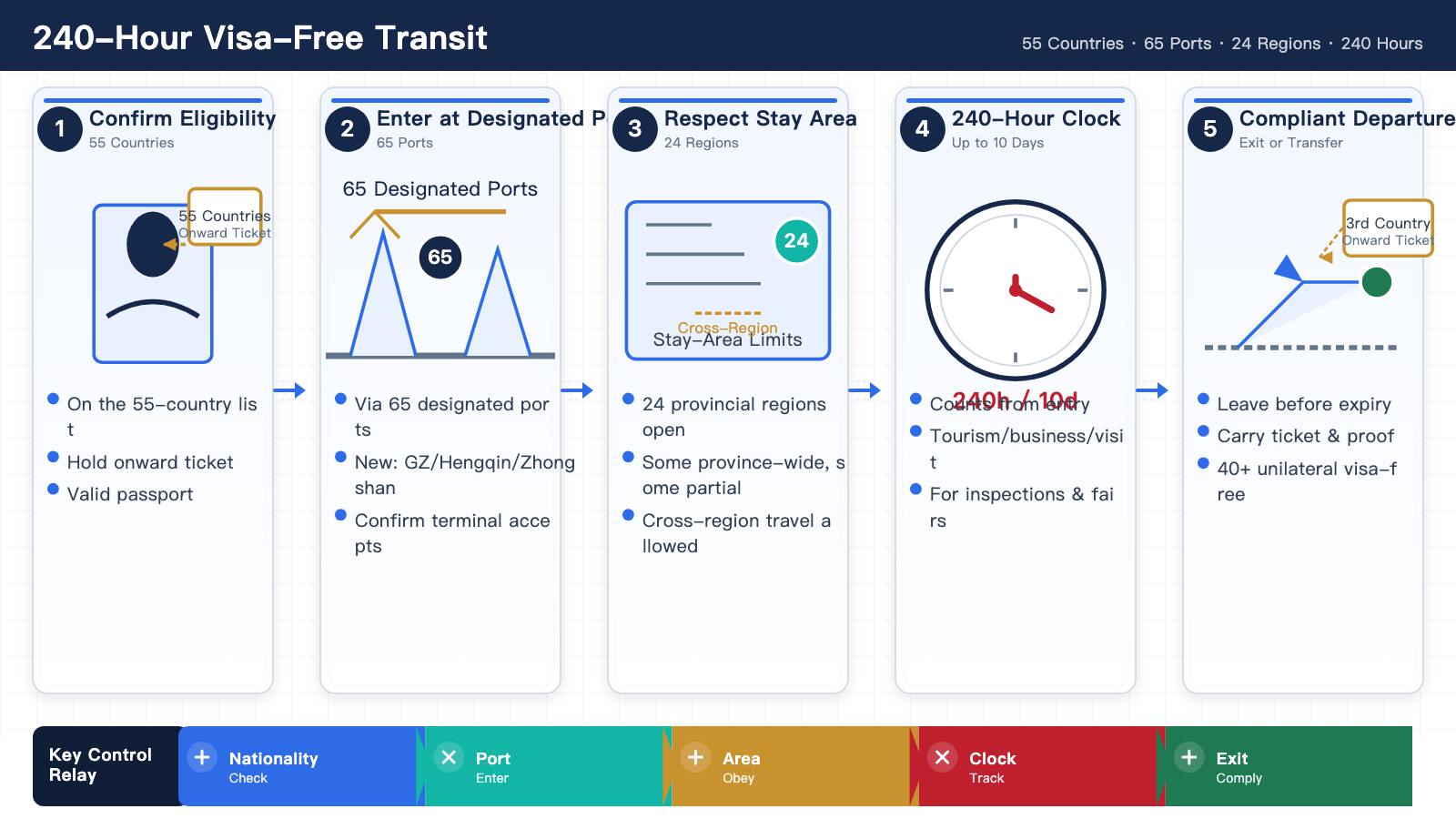
- China’s 240-hour visa-free transit lets eligible nationals of 55 countries transit to a third destination via 65 ports across 24 provincial-level regions, staying up to 10 days without a visa.
中国240小时过境免签允许55国合资格人员经24个省区市的65个口岸前往第三国(地区),免签停留最长10天。- In its first year the policy drove 40.6 million inbound foreign arrivals (+27.2% yoy), with 240-hour users up 60.8% versus the pre-optimisation baseline.
实施首年带动全国各口岸入境外籍人员4060万人次(同比+27.2%),240小时适用人数较优化前增60.8%。- The November 2025 expansion added Guangzhou, Hengqin, Zhongshan, the HK–Zhuhai–Macao Bridge and West Kowloon as new ports, raising the total from 60 to 65.
2025年11月扩围新增广州、横琴、中山、港珠澳大桥及西九龙等口岸,总数由60增至65。- Eligible activities during stay include tourism, business, visiting and family; the stay area spans 24 provinces, with some provinces open province-wide.
停留期间可从事旅游、商务、访问、探亲等活动;停留区域覆盖24个省区,部分省份全省开放。- A separate unilateral visa exemption for 40+ countries was extended to 31 December 2026, complementing the transit scheme for short visits.
面向40多个国家的单边免签已延长至2026年12月31日,与过境方案形成短期访问互补。- Practical step: confirm nationality and onward-ticket, enter via a designated port, and respect the stay area and 240-hour clock for business visits.
实操建议:确认国籍与联程机票,经指定口岸入境,并遵守停留区域与240小时时限以商务访问。
China’s 240-Hour Visa-Free Transit: Ports, Provinces and Business-Travel Practice (2026) | 240小时过境免签扩围:口岸、适用省份与商务旅行实务(2026)
China’s transit visa-free programme is one of the most tangible openings for business travellers. The 240-hour (10-day) visa-free transit now covers eligible nationals of 55 countries entering via 65 ports in 24 provincial-level regions for a stay of up to 10 days before proceeding to a third country or region. For foreign investors doing site visits, trade fairs and partner meetings, the scheme removes a major friction point.
How the policy expanded
The National Immigration Administration (NIA) first extended the stay from 72/144 hours to 240 hours and widened the ports and areas in a major relaxation. A November 2025 update added Guangzhou, Zhuhai’s Hengqin and Zhongshan, the Hong Kong–Zhuhai–Macao Bridge and the West Kowloon Station of the Guangzhou–Shenzhen–Hong Kong Express Rail Link, lifting the eligible ports from 60 to 65. The stay area grew to 24 provincial-level regions; Anhui, Hainan and Guizhou are open province-wide, while Shanxi (Taiyuan/Datong) and Jiangxi (Nanchang/Jingdezhen) are partially open. Travellers may move across the designated areas of the 24 regions.
Who and what
Eligible persons are nationals of 54–55 specified countries transiting to a third destination. During the stay they may engage in tourism, business, visiting and family activities — which covers the typical foreign-invested-enterprise scenario of a short inspection, a trade fair or a board meeting. A separate unilateral visa exemption for more than 40 countries (including France, Germany, Italy, the Netherlands, Spain and Sweden) was extended to 31 December 2026, giving another channel for short visits.
The impact
One year after implementation, inbound foreign arrivals through all ports reached 40.6 million (+27.2% year-on-year), and 240-hour transit users grew 60.8% over the pre-optimisation baseline. The NIA also let foreign travellers complete entry cards online before arrival from 20 November 2025. The momentum reflects both demand and China’s push for “institutional opening” in personnel exchange.
Practical business-travel steps
- Confirm eligibility. Check that your nationality is on the 55-country list and that you hold an onward ticket to a third country/region.
- Enter at a designated port. Use one of the 65 ports; confirm the specific terminal (e.g., the bridge or rail station) accepts transit.
- Respect the stay area. Travel only within the 24 designated regions; note province-wide vs partial openings.
- Mind the clock. The 240 hours run from entry; plan departure before expiry.
- Keep documents. Carry the onward ticket and accommodation/business-meeting proof if asked.
240小时过境免签扩围:口岸、适用省份与商务旅行实务(2026)
中国的过境免签是商务旅客感受最直观的开放举措。240小时(10天)过境免签现覆盖55国合资格人员,经24个省区市的65个口岸入境,前往第三国或地区前可免签停留最长10天。对来华考察、参展、会晤合伙人的外资人士而言,该政策消除了主要摩擦点。
政策如何扩围
国家移民管理局先将停留时间由72/144小时延长至240小时,并在一次大幅优化中扩大口岸与区域。2025年11月更新新增广州、珠海横琴、中山、港珠澳大桥及广深港高铁西九龙站等口岸,使适用口岸由60增至65。停留区域增至24个省区市;安徽、海南、贵州全省开放,山西(太原/大同)、江西(南昌/景德镇)部分开放。旅客可在24个区域的指定范围内跨省旅行。
适用对象与活动
合资格者为前往第三国(地区)的54–55个指定国家人员。停留期间可从事旅游、商务、访问、探亲——涵盖外商投资企业典型的短期考察、参展或董事会场景。面向40多个国家的单边免签(含法国、德国、意大利、荷兰、西班牙、瑞典等)已延长至2026年12月31日,为短期访问提供另一通道。
实施成效
实施一年来,全国各口岸入境外籍人员达4060万人次(同比+27.2%),240小时适用人数较优化前增60.8%。国家移民管理局自2025年11月20日起允许外籍旅客抵前在线填妥入境卡。这一势头既反映需求,也体现中国在人员往来领域”制度型开放”的推进。
商务旅行实操步骤
- 确认资格。 核对国籍在55国名单内,并持前往第三国(地区)的联程机票。
- 经指定口岸入境。 使用65个口岸之一;确认具体场站(如大桥或高铁站)受理过境。
- 遵守停留区域。 仅在24个指定区域内旅行;注意全省开放与部分开放之别。
- 留意时限。 240小时自入境起算,须在期满前离境。
- 备妥证件。 随身带联程机票及住宿/商务会晤证明以备查验。
What Changed in the Latest Round
The November 2025 relaxation was the most significant since the programme began. It added Guangzhou’s airports, Zhuhai’s Hengqin and Zhongshan, the Hong Kong–Zhuhai–Macao Bridge and the West Kowloon Station of the Guangzhou–Shenzhen–Hong Kong Express Rail Link as new 240-hour transit ports, raising the total from 60 to 65. The stay area expanded to 24 provincial-level regions, with Anhui, Hainan and Guizhou open province-wide. Alongside this, the unilateral visa exemption for more than 40 countries was extended to 31 December 2026, and foreign travellers were allowed to complete entry cards online before arrival from 20 November 2025. For business visitors, the practical effect is a near-seamless short stay for site visits, trade fairs and board meetings without a formal visa.
本轮2025年11月的放松是该项目启动以来力度最大的一次。新增广州机场、珠海横琴与中山、港珠澳大桥、广深港高铁西九龙站等为240小时过境口岸,总数由60增至65。停留区域扩至24个省区市,安徽、海南、贵州全省开放。与此同时,面向40多个国家的单边免签延长至2026年12月31日,自2025年11月20日起外籍旅客可抵前在线填妥入境卡。对商务访客而言,实地考察、参展与董事会等短期停留近乎无缝,无需正式签证。
Practitioner Quick Reference
- 55 countries, 65 ports, 24 regions, 240 hours: the headline parameters of the transit scheme.
55国、65口岸、24区域、240小时:过境方案的核心参数。 - New ports: Guangzhou, Hengqin, Zhongshan, the HK–Zhuhai–Macao Bridge and West Kowloon.
新增口岸:广州、横琴、中山、港珠澳大桥、西九龙。 - Activities allowed: tourism, business, visiting and family — covers inspections, fairs and meetings.
允许活动:旅游、商务、访问、探亲——涵盖考察、参展与会议。 - Unilateral visa-free complements: 40+ countries exempt to 31 Dec 2026 for short visits.
单边免签互补:40多国免签至2026年12月31日,适用短期访问。 - Online entry cards: complete the card before arrival from 20 Nov 2025.
在线入境卡:自2025年11月20日起可抵前填妥。
Common Pitfalls
- Wrong port: entering via a non-designated port breaks the transit eligibility.
口岸不符:经非指定口岸入境即丧失过境资格。 - Overstaying the area: leaving the 24 designated regions violates the condition.
越出区域:离开24个指定区域即违规。 - Missing the clock: the 240 hours run from entry; plan the outbound leg in time.
忽视时限:240小时自入境起算,须及时安排离境行程。
2026 Watchlist
- Further port additions: more airports and rail stations may be added to the 65-port list.
口岸再增:更多机场与高铁站或纳入65口岸清单。 - Unilateral visa-free expansion: the 40+ country list may extend beyond 31 Dec 2026.
单边免签扩国:40多国免签名单或延至2026年12月31日之后。 - Entry-card digitisation: online pre-arrival cards may expand to more traveller types.
入境卡数字化:抵前在线填卡或扩至更多旅客类型。
Key Figures
- 55 countries: nationalities eligible for the 240-hour transit scheme.
55国:适用240小时过境免签的国家。 - 65 ports: designated entry ports after the November 2025 expansion.
65个口岸:2025年11月扩围后的指定入境口岸。 - 24 regions: provincial-level areas open for the stay.
24个区域:开放停留的省区市。 - 40.6 million: inbound foreign arrivals in the first year (+27.2% yoy).
4060万人次:实施首年入境外籍人员(同比+27.2%)。
Sources