
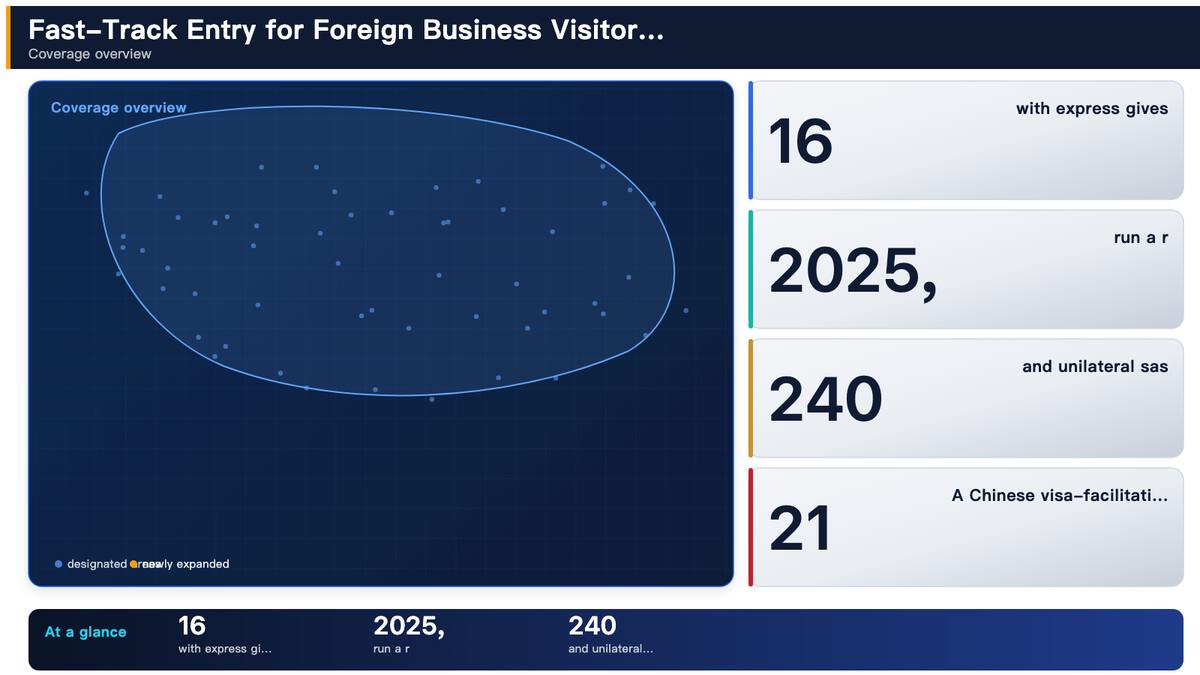
- A port visa (口岸签证) lets a foreign business visitor obtain an M visa on arrival at a designated Chinese port, when invited by a verified local entity.
口岸签证允许受邀的外籍商务人士在指定对外开放口岸落地办理M字签证。- The APEC Business Travel Card gives five-year, multi-entry access to 16 economies, with express clearance at dedicated lanes.
APEC商务旅行卡提供五年多次、可入境16个经济体的待遇,并享专用通道快速通关。- A Chinese-venture’s mainland staff can hold the APEC card; foreign nationals apply to their own economy, not to China.
中外合资、外商独资企业的中方人员可申办APEC卡;外籍人士向其所属经济体申请,不向中国申请。- Since April 2025, some cities run a special-invitation facility for frequent foreign business visitors, covering spouses and children.
自2025年4月起,部分城市对外籍商务常客试行专项签证便利邀请函,惠及配偶与子女。- Port visas and the APEC card sit alongside the 240-hour transit and unilateral visa-free schemes as fast-track entry tools.
口岸签证与APEC卡,与240小时过境免签、单方面免签共同构成快速入境工具箱。- Plan the document stack early: invitation letter, port-of-entry approval and, for the card, the foreign-affairs office filing.
及早准备文件链:邀请函、入境口岸批准备案,持卡则经外事办公室申报。
Fast-Track Entry for Foreign Business Visitors: China Port Visas and the APEC Business Travel Card | 外籍商务人士快速入境:中国口岸签证与APEC商务旅行卡
The Fast-Track Toolkit
When a foreign business visitor needs to reach China quickly—for a signing, a board meeting, a factory audit or a tender—three fast-track tools sit alongside the familiar 240-hour transit and unilateral visa-free schemes: the port visa (口岸签证), the APEC Business Travel Card (ABTC), and the newer special-invitation facility for frequent business visitors. Each serves a different profile; together they shrink the time from “we need you in Shanghai” to “you are through immigration”.
Port Visas: a Visa on Arrival for Business
A port visa is issued by the exit-entry administration at a designated open port to a foreign national who holds an invitation from a verified Chinese entity and meets the statutory grounds—sudden commercial activity, tender participation, or other urgent, justified business need. The inviting entity applies in advance to the public-security exit-entry authority at the intended port of entry; once approved, the visitor obtains an M (business) visa on arrival without first visiting a Chinese embassy. Port visas are the right tool when lead time is too short for a consular application but the visit is genuine and documentable. They are not a substitute for long-stay work or residence permits.
The APEC Business Travel Card
The APEC Business Travel Card is a multilateral visa-facilitation arrangement among the 21 APEC economies. A Chinese cardholder receives five-year validity, multiple entry, and stays of at least 60 days per visit (60 or 90 days depending on the economy), plus express clearance at dedicated APEC lanes. China joined in 2002; mainland cardholders may enter 16 economies (the United States and Canada are transit members that do not approve external cardholders but offer expedited visa and clearance conveniences). The card is for business travel only—not tourism, family visits or medical trips.
Who Can Hold the Card
Under the scheme, eligible Chinese applicants include government officials handling APEC affairs, central and local state-owned enterprise personnel, private-enterprise personnel, and personnel of Chinese-foreign equity joint ventures, wholly foreign-owned enterprises and Hong Kong/Macao/Taiwan-invested enterprises. The application runs a three-tier review: the enterprise preliminarily reviews, the local foreign-affairs office reviews, and the Department of Consular Affairs of the Ministry of Foreign Affairs gives final approval. A foreign national cannot apply for the card in China—they apply to their own economy’s authority. From 2023, a virtual card with equal legal effect is accepted for foreign nationals entering China.
The 2025 Special-Invitation Facility
Since April 2025, several cities have trialled a special visa-facilitation invitation letter for foreign business visitors with frequent, well-recorded travel to China. Invited visitors—often senior executives and technical staff of foreign-invested enterprises—obtain a single visa procedure that yields a five-year, multiple-entry visa with stays up to 180 days, and the benefit extends to spouses and minor children. In one city’s account, the facility sat alongside the 240-hour transit, the 30-day unilateral visa-free and the 30-day business visa as a fifth, longer-horizon option for trusted business travellers.
How the Tools Compare
| Tool | Best for | Validity / stay | Who applies |
|---|---|---|---|
| Port visa | Urgent, short, documentable visit | M visa on arrival | Invited visitor, via host entity |
| APEC card | Recurring Asia-Pacific travel | 5 years, multi-entry, 60–90 days | Chinese-venture mainland staff |
| Special invitation | Frequent trusted visitors | 5 years, up to 180 days, family | Host city foreign-affairs office |
| 240-hour transit | Back-to-back regional trips | 240 hours, no visa | Eligible transit nationalities |
| Unilateral visa-free | Short leisure/business stays | 30 days, no visa | Listed countries |
Practical Steps for a Foreign-Invested Enterprise
- Keep an invitation template ready: entity details, visitor profile, purpose, itinerary and port of entry.
- For urgent arrivals, pre-file the port visa with the exit-entry authority at the chosen port; do not rely on walk-up issuance.
- Enrol frequent mainland travellers for the APEC card through the local foreign-affairs office; budget two to three months for multi-economy approval.
- Ask the host city about the special-invitation facility if you have recurring senior visitors.
- Track stay limits—port visas and transit are short; for work or residence, use the proper permit, not a business visa.
- Centralise the record—keep invitation letters, port approvals, card filings and entry stamps in one file so the next application is repeatable and auditable.
Related Reading
See our 240-hour visa-free transit guide (No. 79), regional visa-free schemes in 2026 (No. 173) and unilateral visa-free policy (No. 186).
外籍商务人士快速入境:中国口岸签证与APEC商务旅行卡
快速入境工具箱
当外籍商务人士需紧急来华——签约、董事会、工厂审核或投标——除熟知的240小时过境免签与单方面免签外,还有三件快速工具:口岸签证、APEC商务旅行卡与较新的外籍商务常客专项签证便利邀请函。三者适配不同人群,共同把”我们需要你到上海”到”你已过边检”的时间大幅压缩。
口岸签证:落地即办的商务签证
口岸签证由指定对外开放口岸的公安出入境管理机关,向持有经核实的中国境内单位邀请、且符合法定情形——临时商务活动、参与投标或其他紧急正当商务需求——的外国人签发。邀请单位事先向拟入境口岸的公安出入境机关申请;获批后,访客抵港即可办理M字(商务)签证,无需先赴中国使馆。当时间不足以走领事申请、但访问真实且有据可查时,口岸签证是最合适的工具。它不能替代长期的工作或居留许可。
APEC商务旅行卡
APEC商务旅行卡是21个APEC经济体间的多边签证便利化安排。中国持卡人享有五年有效、多次入境、每次停留至少60天(按经济体为60或90天),并在APEC专用通道快速通关。中国于2002年加入;内地持卡人可入境16个经济体(美国、加拿大为过渡成员,不审批外部持卡人,但提供签证与通关便利)。该卡仅用于商务旅行,不适用于旅游、探亲或就医。
谁能持卡
根据制度,符合条件的中国申请人包括:从事APEC事务的政府官员,中央及地方国有企业人员,民营企业人员,以及中外合资、外商独资和港澳台资企业的中方人员。申请实行三级审批:企业初审、地方外办复审、外交部领事司终审。外籍人士不能在中国申请该卡——须向其所属经济体主管部门申请。2023年起,具有同等效力的虚拟卡被接受用于外籍人士入境。
2025年专项签证便利邀请函
自2025年4月起,多个城市对外籍商务常客试行专项签证便利邀请函。受邀者多为外资企业的外籍高管与技术骨干,一次签证手续即可获得五年多次、单次最长180天、并惠及配偶与未成年子女的签证。据某市表述,该便利与240小时过境、30天单方面免签、30天商务签证并列,成为面向可信商务旅客的第五种、更长效选项。
工具对比
| 工具 | 最适用 | 有效期/停留 | 由谁申请 |
|---|---|---|---|
| 口岸签证 | 紧急、短期、有凭证的访问 | 落地M签证 | 受邀访客,经邀请单位 |
| APEC卡 | 频繁的亚太差旅 | 5年、多次、60—90天 | 外资企业中方人员 |
| 专项邀请 | 频繁可信访客 | 5年、最长180天、含家属 | 属地外事办公室 |
| 240小时过境 | 接连的区域行程 | 240小时、免签 | 符合条件过境国籍 |
| 单方面免签 | 短期商务/休闲 | 30天、免签 | 清单内国家 |
外资企业的实操步骤
- 备好邀请函模板:单位信息、访客画像、目的、行程与入境口岸。
- 紧急抵达时,预先在选定口岸的出入境机关申报口岸签证;不要依赖现场即办。
- 为频繁出行的境内人员申办APEC卡,经属地外事办公室;预留二至三个月多经济体审批周期。
- 如有反复到访的高管,向属地城市咨询专项邀请便利。
- 盯住停留上限——口岸签证与过境均较短;工作或居留须用相应许可,而非商务签证。
- 集中归档——将邀请函、口岸批准备案、持卡申报与入境验讫章归入同一档案,使下一次申请可复用、可审计。
延伸阅读
可参阅本站240小时过境免签指南(编号79)、2026年区域性免签政策(编号173)与单方面免签政策(编号186)。
Sources