
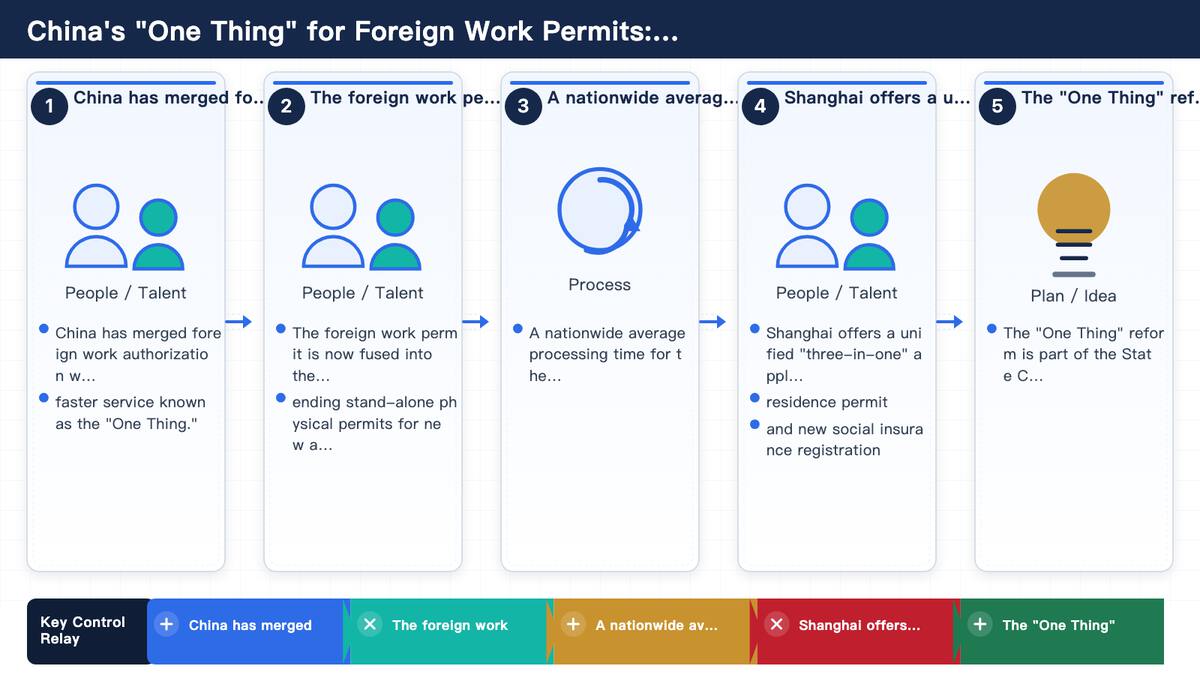
- China has merged foreign work authorization with social security functions into a single, faster service known as the “One Thing.” 中国已将外国人在华工作的多项审批整合为一项更快捷的”一件事”服务。
- The foreign work permit is now fused into the social security card (“Juying Card”) and the electronic social security card, ending stand-alone physical permits for new applicants. 外国工作许可证现已融合进社会保障卡(”聚英卡”)和电子社保卡,新办人员不再发放实体工作许可证。
- A nationwide average processing time for the foreign work permit has been cut to 6 working days. 全国办理外国人来华工作许可平均时长已压减至 6 个工作日。
- Shanghai offers a unified “three-in-one” application covering work permit, residence permit, and new social insurance registration, completed in 11 working days. 上海提供工作许可、居留许可和新办社保登记”三位一体”统一申请,审批时长缩减至 11 个工作日。
- The “One Thing” reform is part of the State Council Office’s 2026 first batch of key “efficiently get one thing done” items. “一件事”改革已列入国务院办公厅《”高效办成一件事”2026 年度第一批重点事项清单》。
- Electronic social security card services now span more than 200 “one-card” scenarios in government, healthcare, transport, and finance. 电子社保卡 App 英文版升级后,已覆盖政务、医疗、交通、金融等 200 多个”一卡通”场景。
- Sixteen provinces have opened work-permit verification interfaces, and seventeen have passed related assessment inspections. 16 个省(区、市)已开通外国人工作许可查验接口,17 个省(区、市)已通过相关考核检查。
China’s “One Thing” for Foreign Work Permits: Card-Certificate Fusion and Faster Approval | 外国人来华工作”一件事”:证卡融合与提速审批
Overview
In 2024 and 2026, China’s Ministry of Human Resources and Social Security (MOHRSS) advanced two complementary reforms aimed at foreign professionals: the “One Thing” integrated service for foreigners working in China, and the fusion of the foreign work permit with the social security card — the so-called “card-certificate fusion.” Together, these measures reduce paperwork, shorten waiting times, and turn a formerly fragmented set of approvals into a single, coordinated process.
The legal anchor for card-certificate fusion is the MOHRSS notice on integrating the foreign work permit with the social security card (MOHRSS Document No. 75 of 2024, effective December 1, 2024, with further implementation in 2026). The “One Thing” integration builds on this foundation by consolidating several procedures that used to be handled separately by different agencies.
For employers hiring foreign talent and for the professionals themselves, the practical effect is straightforward: fewer forms, fewer trips, and a clearer timeline.
The “One Thing” Integration
The “One Thing” reform integrates the following procedures into a single service package:
- Issuance, change, and renewal of the foreigner’s work permit for working in China;
- Issuance, change, and renewal of the foreigner’s residence permit;
- Social insurance registration for foreigners working in China;
- Professional title examination and review for foreigners working in China.
Instead of submitting separate dossiers to separate windows, applicants now prepare one set of materials. Government back offices then conduct parallel, joint approval (“background parallel approval”), so the steps that once ran in sequence now advance together. This is the core design principle of the “One Thing”: one set of materials, one coordinated backend, and a single outcome for the applicant.
The reform’s standing is confirmed at the highest administrative level. The General Office of the State Council issued the 2026 first batch of key items under its “efficiently get one thing done” program, and the foreigner-work “One Thing” is among those listed items. That placement signals both political priority and a mandate for local governments to deliver measurable service improvements.
Card-Certificate Fusion
Card-certificate fusion is the technical and administrative mechanism that loads work-permit information directly onto the social security card — branded as the “Juying Card” (聚英卡) — and onto the electronic social security card. The governing notice is MOHRSS Document No. 75 of 2024, which took effect on December 1, 2024, and is being further rolled out during 2026.
The most visible change concerns the physical permit. For newly issued work permits, the entire process is handled online, and no physical work-permit certificate is issued. The permit exists as data carried by the social security card and its electronic counterpart. For foreigners who already hold a physical work permit, the transition follows a “no change, no exchange” principle (不变不换): existing valid physical certificates remain usable and need not be swapped unless a change or renewal is required.
This design reduces document loss, simplifies verification, and lets a single card serve multiple purposes — identity, work authorization, and social-security access — in everyday life.
Processing Timelines
Measurable speed gains are central to the reform. Nationwide, the average time to process a foreigner’s work permit for working in China has been compressed to 6 working days.
Shanghai demonstrates the more ambitious model. The city offers a unified “three-in-one” application that combines the work permit, the residence permit, and new social-insurance registration into a single submission. Under this model, the combined approval timeline is reduced to 11 working days. The Shanghai case is frequently cited as the template for what integrated, parallel approval can achieve when municipal agencies coordinate closely.
Who Is Eligible
The reforms apply to foreigners who come to China to work, and to the employers that hire them. The integrated service covers the full lifecycle of the work relationship: initial issuance, subsequent changes (such as employer or position changes), and renewal at the end of a valid period. It also reaches the associated residence-permit procedures and the social-insurance registration that accompanies lawful employment, as well as professional-title review for those who need it.
Because the “One Thing” is built around one set of materials and parallel approval, eligibility does not create a new substantive test. Rather, it streamlines how existing requirements are satisfied and evidenced.
Practical Steps for Employers
Employers preparing to hire or renew foreign staff should expect the following pattern:
- Consolidate documents early. Because the service runs on one set of materials, gather the work-permit, residence-permit, social-insurance, and (where relevant) professional-title documents together rather than in separate cycles.
- Use the online channel for new permits. New work permits are processed entirely online and no physical certificate is issued, so plan systems around the electronic record and the social security card.
- Check the local model. Timelines and the exact bundle of procedures differ by locality. Shanghai’s “three-in-one” unified application is the most integrated example; other regions are implementing the “One Thing” at their own pace.
- Prepare for verification. With 16 provinces already opening work-permit verification interfaces, counterparties such as banks, hospitals, and transport operators can check status electronically. Keep the electronic social security card current.
- Manage transitions for existing staff. Holders of older physical permits keep them under the “no change, no exchange” rule; trigger replacement only when a change or renewal is genuinely needed.
Related Reading
- MOHRSS Document No. 75 of 2024 on integrating the foreign work permit with the social security card.
- People’s Daily Online report on the foreigner-work “One Thing” and its role in sharing China’s development opportunities.
- The National Immigration Administration for residence permits and visas, the other half of the integrated service.
外国人来华工作”一件事”:证卡融合与提速审批
概述
2024 年至 2026 年,人力资源社会保障部推出两项相互配套、面向外国专业人才的重要改革:一是外国人来华工作”一件事”集成服务,二是外国工作许可证与社会保障卡的融合集成,即”证卡融合”。两项改革共同作用,减少了纸质材料、缩短了等候时间,把过去分散在多个部门的审批整合成一套协调统一的办理流程。
证卡融合的制度依据是《人力资源社会保障部关于做好外国人工作许可证与社会保障卡融合集成工作的通知》(人社部发〔2024〕75号),自 2024 年 12 月 1 日起施行,并于 2026 年进一步落地。”一件事”集成则在此基础之上,把过去需分别办理的若干事项归并整合。
对于聘用外国人才的单位和外国专业人士本人而言,实际效果很直接:表单更少、跑动更少、时限更清楚。
“一件事”集成
“一件事”改革将以下事项整合为一项服务包:
- 外国人来华工作许可的签发、变更、延期;
- 外国人居留证件的签发、变更、延期;
- 外国人来华工作社会保险登记;
- 外国人来华工作职称评审。
申请人不再分别向不同窗口提交不同案卷,而是准备一套材料。政府后台随之开展并联审批,原本串行推进的环节得以同步进行。这正是”一件事”的核心设计原则:一套材料、一个后台、面向申请人一份结果。
改革的地位在最高行政层级得到确认。国务院办公厅印发《”高效办成一件事”2026 年度第一批重点事项清单》,外国人来华工作”一件事”位列其中。这一安排既体现了政策优先级,也对地方政府提出了可量化的服务改善要求。
证卡融合
证卡融合是一项技术与行政机制,将工作许可信息直接加载至社会保障卡(品牌名为”聚英卡”)以及电子社保卡。主管文件为《人力资源社会保障部关于做好外国人工作许可证与社会保障卡融合集成工作的通知》(人社部发〔2024〕75号),自 2024 年 12 月 1 日起施行,并在 2026 年进一步落地。
最直观的变化体现在实体证件上。新办工作许可全程网办,不再发放实体工作许可证。许可以数据形式承载于社会保障卡及其电子凭证。已领取实体工作许可证的外国人,按照”不变不换”原则过渡:现有有效实体证件可继续使用,除非发生变更或延期,否则无需换发。
这一设计降低了证件遗失风险,简化了核验流程,并使一张卡片在日常生活中兼具身份、工作授权与社保功能的多重用途。
办理时限
可量化的提速是改革的重心。全国范围内,办理外国人来华工作许可平均时长已压减至 6 个工作日。
上海展示了更具雄心的模式。该市提供”三位一体”统一申请,将工作许可、居留许可与新办社保登记合并为一次提交。在此模式下,合并审批时长缩减至 11 个工作日。上海案例常被视作集成并联审批的样板,展示出市级部门紧密协同所能达到的效果。
适用对象
改革适用于来华工作的外国人及其聘用单位。”一件事”覆盖劳动关系全周期:首次签发、后续变更(如用人单位或岗位变动)、以及有效期届满时的延期。它还延伸至配套的居留证件事项、随合法就业一并办理的社会保险登记,以及有需要者的职称评审。
由于”一件事”以一套材料和并联审批为基础,集成本身并不创设新的实质准入门槛,而是简化既有要求的满足与证明方式。
用人单位实操步骤
计划聘用或续聘外国员工的用人单位,可预期如下办理节奏:
- 尽早整合材料。 由于服务依托一套材料,应将工作许可、居留证件、社保登记以及(如适用)职称评审材料一并收集,而非分周期办理。
- 新办许可走线上。 新办工作许可全程网办且不发实体证,系统应围绕电子记录与社保卡进行规划。
- 了解本地模式。 各地时限与事项组合存在差异。上海的”三位一体”统一申请是最集成的范例,其他地区正按自身节奏推进”一件事”。
- 做好核验准备。 随着 16 个省(区、市)已开通工作许可查验接口,银行、医院、交通运营方等可电子核验状态,应保持电子社保卡为最新。
- 管理存量人员过渡。 持旧版实体证件者依”不变不换”规则保留,仅在确有变更或延期需要时再触发换发。
相关阅读
- 人社部发〔2024〕75号:关于做好外国人工作许可证与社会保障卡融合集成工作的通知。
- 人民网关于外国人来华工作”一件事”及其共享中国发展机遇作用的报道。
- 国家移民管理局,负责居留证件与签证——即集成服务的另一半。
Sources
- https://www.gov.cn/zhengce/zhengceku/202412/content_6991296.htm (人力资源社会保障部《关于做好外国人工作许可证与社会保障卡融合集成工作的通知》,人社部发〔2024〕75号)
- https://politics.people.com.cn/n1/2026/0202/c458474-40657462.html (人民网:外国人来华工作”一件事”让全球英才共享中国发展机遇,2026-02-02)
- https://www.nia.gov.cn/ (国家移民管理局,外国人居留证件与签证主管部门)