
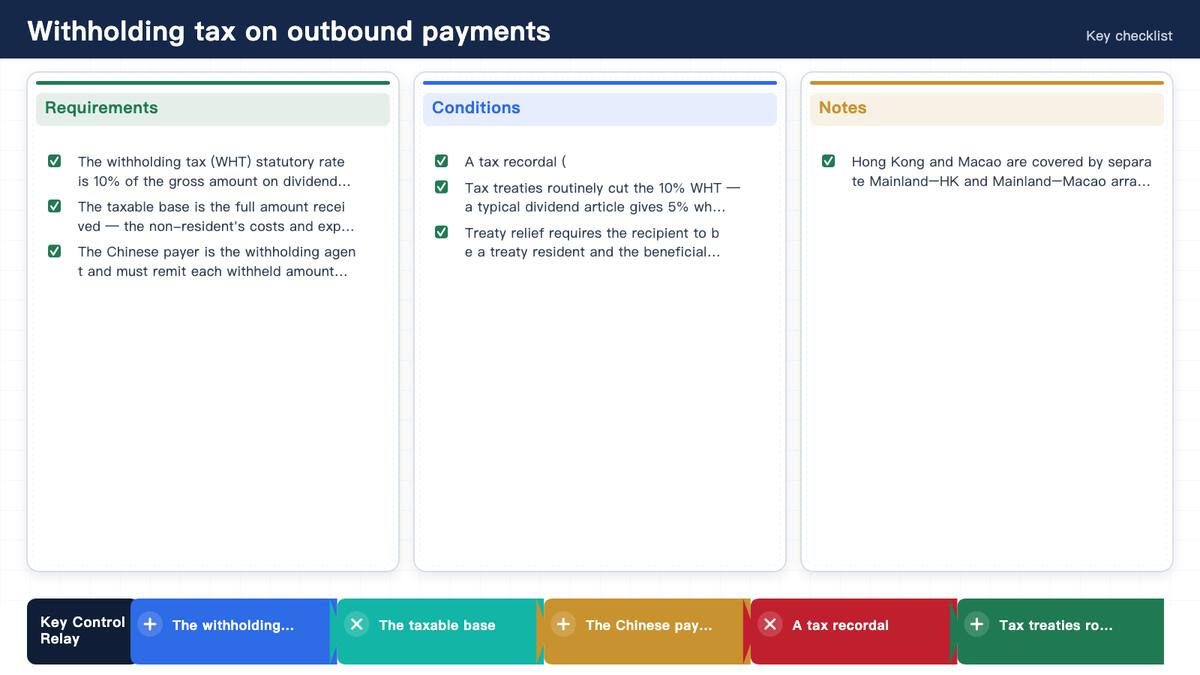
- The withholding tax (WHT) statutory rate is 10% of the gross amount on dividends, interest, royalties and rent — the passive, China-sourced income of a non-resident under EITL Article 3(3).
预提所得税法定税率为全额的 10%,适用对象为股息、利息、特许权使用费与租金——即非居民依《企业所得税法》第三条第三款的被动性、中国来源所得。- The taxable base is the full amount received — the non-resident’s costs and expenses cannot be deducted from the WHT base.
应税所得额为收入全额——非居民负担的成本费用不得从预提税税基中扣除。- The Chinese payer is the withholding agent and must remit each withheld amount to the treasury within seven days of withholding.
中国支付方为扣缴义务人,须于每次扣缴之日起七日内将代扣税款缴入国库。- A tax recordal (备案) is required before remitting single service/royalty outbound payments of USD 50,000 equivalent or more; below that, generally not.
单笔对外支付服务费、特许权使用费等达到等值 5 万美元以上,须办理税务备案后方可汇出;低于该门槛一般无需备案。- Tax treaties routinely cut the 10% WHT — a typical dividend article gives 5% where the beneficial owner holds at least 25% of the payer’s capital, else 10%; interest/royalty often 10%, 7% or lower.
税收协定普遍下调 10% 的预提税——典型股息条款在受益所有人直接持有支付方至少 25% 资本时适用 5%,否则 10%;利息与特许权使用费常降至 10%、7% 或更低。- Treaty relief requires the recipient to be a treaty resident and the beneficial owner of the income; relief is now claimed by self-assessment (SAT Announcement [2019] No. 35), not prior approval.
协定待遇要求收款人为协定居民且为所得的受益所有人;待遇现按自行判断、申报享受办理(国家税务总局公告 2019 年第 35 号),而非事前审批。- Hong Kong and Macao are covered by separate Mainland–HK and Mainland–Macao arrangements that apply the same beneficial-owner logic.
香港、澳门依单独的《内地与香港/澳门关于对所得避免双重征税的安排》处理,适用同样的受益所有人逻辑。
Withholding tax on outbound payments | 对外支付的预提所得税
Overview
When a China resident enterprise pays certain cross-border amounts to a non-resident — most importantly dividends, interest and royalties — Chinese tax law imposes a withholding tax (WHT, 预提所得税) at the payer. The mechanism is “source withholding” (源泉扣缴): the Chinese payer is the withholding agent and must deduct the tax from each payment. The headline statutory rate is 10% of the gross amount, but that rate is frequently reduced to 5% (or lower) where a bilateral tax treaty applies and the recipient qualifies. Understanding when 10% bites, how the filing works, and how to reach the treaty-reduced rate is essential for any foreign investor receiving income from a China entity. This article focuses on the outbound-payment mechanics; the eligibility and “beneficial owner” test for treaty relief are covered in our companion *Tax treaty benefits for foreign investors*.
The 10% statutory rate and what it applies to
The legal basis is the *Enterprise Income Tax Law* (EITL). Article 37 provides that for the income described in Article 3(3) earned by a non-resident enterprise, tax is collected by source withholding, with the payer as withholding agent; the tax is withheld from each payment or each payment due. Article 4 sets the rate for such non-resident income at 20%, but the EITL Implementation Regulations reduce it to 10%. The relevant Article 3(3) income is the passive, China-sourced income of a non-resident with no establishment in China: dividends and bonus (equity investment income), interest, rent, and royalties. Critically, the taxable base is the full amount received (收入全额) — there is no deduction for costs or expenses borne by the non-resident (EITL Article 19). So a USD 1,000,000 royalty paid out generally carries a USD 100,000 WHT at the statutory rate.
The source-of-income rules matter for determining whether China can tax at all. Under the Implementation Regulations, dividends are sourced where the paying enterprise is resident; interest, rent and royalties are sourced where the payer/enterprise or individual bearing or paying the income is located. In practice, a payment by a China company to an overseas parent for a dividend, loan interest or licence fee is China-sourced and within the WHT net.
Filing, withholding and the outbound payment tax recordal
The payer’s obligation is mechanical and time-bound. Under EITL Article 40, the withholding agent must pay each withheld amount into the treasury within seven days of the withholding and file the withholding enterprise-income-tax return with the local tax authority. The detailed procedural rules are in SAT Announcement [2017] No. 37 (*Issues concerning source withholding for non-resident enterprise income tax*), which also sets the FX conversion to RMB at the central parity rate on the withholding-incurred date.
Separately, cross-border service-trade and similar outbound payments are subject to a tax recordal (税务备案) before remittance. Under the SAT/SAFE rule (Announcement [2013] No. 40, as applied), a domestic payer making a single outbound payment of services, royalties and similar items of USD 50,000 equivalent or more must complete the tax recordal; below that threshold the recordal is generally not required. This recordal is about the outbound payment channel, not the WHT rate, and it sits alongside (not in place of) the withholding obligation where both apply. The non-resident recipient’s own treaty-benefit claim, where relevant, is handled under SAT Announcement [2019] No. 35 (*Administration of non-resident taxpayers enjoying tax-treaty benefits*) — a self-assessment regime in which the non-resident determines eligibility and enjoys the benefit, retaining supporting materials for follow-up administration.
The treaty-reduction path
China has an extensive network of bilateral tax treaties (see *Tax treaty benefits for foreign investors*), and these routinely cut the 10% WHT. A typical dividend article gives a 5% rate where the beneficial owner is a company directly holding at least 25% of the payer’s capital, and 10% otherwise; interest and royalty articles often reduce to 10%, 7% or lower depending on the treaty. The path to the reduced rate is therefore: (1) confirm a treaty exists between China and the recipient’s jurisdiction; (2) confirm the recipient is a treaty resident and the “beneficial owner” of the income; (3) have the payer apply the reduced rate when withholding, supported by the recipient’s tax-residence certificate and beneficial-owner evidence; (4) retain the file for post-event administration. Where the recipient fails the beneficial-owner test or the main-purpose test, the 10% statutory rate (or general anti-avoidance) applies. Hong Kong and Macao are covered by separate Mainland–HK and Mainland–Macao arrangements that follow the same beneficial-owner logic.
Practical checklist
Getting this right protects both the payer (who is liable if it under-withholds) and the recipient (who wants the lowest lawful rate). Key disciplines: compute WHT on the gross amount, not net; withhold and remit within seven days; complete the outbound payment tax recordal for service/royalty payments at or above the USD 50,000 threshold; obtain the non-resident’s tax-residence certificate before applying any treaty rate; and document the beneficial-ownership analysis. Treat the WHT and the treaty claim as one coordinated exercise, decided before the payment date rather than reconciled after it.
What to do next
- Identify whether each outbound payment is a dividend, interest, royalty, rent or other Article 3(3) item — this determines WHT exposure.
- Withhold at 10% of the gross amount by default, and remit to the treasury within seven days of withholding.
- Complete the outbound payment tax recordal for service/royalty payments of USD 50,000 equivalent or more before remitting.
- To use a treaty rate, obtain the recipient’s tax-residence certificate and run the beneficial-owner test first.
- Apply the reduced treaty rate at the withholding stage, with supporting documents retained for follow-up administration.
- Coordinate the WHT, the treaty claim and the remittance date as a single plan, not separate steps.
Sources
- Enterprise Income Tax Law (Chairman Decree No. 63) — Articles 3, 4, 19, 37, 40 (Shanghai Tax, bilingual)
- Guiding notes on source withholding for non-resident enterprise income tax (SAT, PDF)
- Withholding enterprise income tax — applicable rules and basis (Fujian Tax)
- Outbound payment tax recordal for service trade etc. (Guangdong Tax, bilingual form)
Related reading
- see also: Profit repatriation: the basics
- see also: Tax treaty benefits for foreign investors
- see also: Greater Bay Area: opportunities for SMEs
对外支付的预提所得税
概述
当中国居民企业向非居民支付某些跨境款项——最重要的是股息、利息与特许权使用费——中国税法在支付方环节征收预提所得税(WHT,预提所得税)。其机制为”源泉扣缴”:中国支付方为扣缴义务人,须在每次支付中扣税。法定税率为全额的 10%,但在双边税收协定适用且收款人符合条件时,常降至 5%(或更低)。厘清 10% 何时触发、申报如何办理、以及如何取得协定降低后的税率,对任何从在华实体取得收入的外国投资者都至关重要。本文聚焦对外支付的机制;协定待遇的资格与”受益所有人”测试,详见本系列姊妹篇《外商投资企业的税收协定待遇》。
10% 法定税率及其适用对象
法律依据是《企业所得税法》。第三十七条规定,对非居民企业取得本法第三条第三款规定的所得应纳的所得税,实行源泉扣缴,以支付人为扣缴义务人,税款由扣缴义务人在每次支付或到期应支付时从款项中扣缴。第四条规定此类非居民所得税率为 20%,但《企业所得税法实施条例》第九十一条减按 10%。相关的第三条第三款所得,是指非居民未设立机构场所、或取得与其机构场所无实际联系的被动性、中国来源所得:股息红利等权益性投资收益、利息、租金、特许权使用费。关键点是,应税所得额为收入全额——非居民负担的成本费用不得扣除(税法第十九条)。因此,一笔 100 万美元的特许权使用费,通常按法定税率产生 10 万美元的预提税。
所得来源规则决定了中国是否有权征税。依据实施条例第七条,股息按分配企业所在地确定来源;利息、租金、特许权使用费按负担或支付所得的企业或个人所在地确定。实务中,中国公司向境外母公司支付的股息、贷款利息或许可费,均属中国来源,落入预提税范围。
申报、扣缴与对外支付税务备案
支付方的义务机械且有时限。依企业所得税法第四十条,扣缴义务人每次代扣的税款,应自代扣之日起七日内缴入国库,并向所在地税务机关报送扣缴企业所得税报告表。具体程序规则见《国家税务总局关于非居民企业所得税源泉扣缴有关问题的公告》(国家税务总局公告 2017 年第 37 号),其中并规定按扣缴义务发生之日的人民币汇率中间价折算人民币。
此外,跨境服务贸易等对外支付在汇出前须办理税务备案。依国家税务总局、国家外汇管理局规定(2013 年第 40 号公告及适用口径),境内支付人单笔对外支付服务费、特许权使用费等达到等值 5 万美元以上的,须办理税务备案;低于该门槛一般无需备案。该备案针对对外支付通道,而非预提税率,在与扣缴义务并存时一并适用。非居民收款人自身的协定待遇主张,依《国家税务总局关于发布〈非居民纳税人享受税收协定待遇管理办法〉的公告》(国家税务总局公告 2019 年第 35 号)办理——属自行判断、申报享受、留存备查的事后管理。
协定降低税率的路径
中国拥有广泛的双边税收协定网络(见《外商投资企业的税收协定待遇》),这些协定普遍下调 10% 的预提税。典型的股息条款规定,受益所有人是直接持有支付方至少 25% 资本的公司时税率 5%,否则 10%;利息与特许权使用费条款常降至 10%、7% 或更低,依协定而定。因此,取得降低后税率的路径为:(1)确认中国与收款人所在管辖区之间存在协定;(2)确认收款人为协定居民且是该所得的”受益所有人”;(3)由支付方在扣缴时适用降低后税率,并以收款人的税收居民身份证明与受益所有人证据为支撑;(4)留存资料备查。若收款人未通过受益所有人测试或主要目的测试,则适用 10% 法定税率(或一般反避税规则)。香港、澳门依单独的《内地与香港/澳门特别行政区关于对所得避免双重征税的安排》处理,遵循同样的受益所有人逻辑。
实务清单
做对这一点,既保护支付方(少扣缴须承担责任),也保护收款人(争取最低合法税率)。关键纪律:按全额而非净额计算预提税;在七日内扣缴并上缴;对达到等值 5 万美元门槛的服务/特许权支付办理对外支付税务备案;在适用任何协定税率前取得非居民的税收居民身份证明;并记录受益所有人分析。应将预提税与协定主张作为同一协调动作,在付款日前确定,而非付款后补救。
下一步建议
- 识别每笔对外支付属于股息、利息、特许权使用费、租金还是其他第三条第三款项目——这决定预提税暴露。
- 默认就全额按 10% 扣缴,并在扣缴后七日内缴入国库。
- 对等值 5 万美元以上的服务/特许权支付,在汇出前办理对外支付税务备案。
- 欲适用协定税率,先取得收款人税收居民身份证明并做受益所有人测试。
- 在扣缴环节适用降低后的协定税率,并留存支撑资料备查。
- 将预提税、协定主张与汇出日期作为单一计划协调,而非分步处理。
来源
- 《中华人民共和国企业所得税法》(主席令第 63 号)第三、四、十九、三十七、四十条(上海税务,双语)
- 非居民企业源泉扣缴税收指引(国家税务总局,PDF)
- 代扣代缴企业所得税——适用规则与依据(福建税务)
- 服务贸易等项目对外支付税务备案(广东税务,双语表单)
相关阅读
- see also: 利润汇出:基础要点
- see also: 外商投资企业的税收协定待遇
- see also: 粤港澳大湾区:中小企业的机遇