
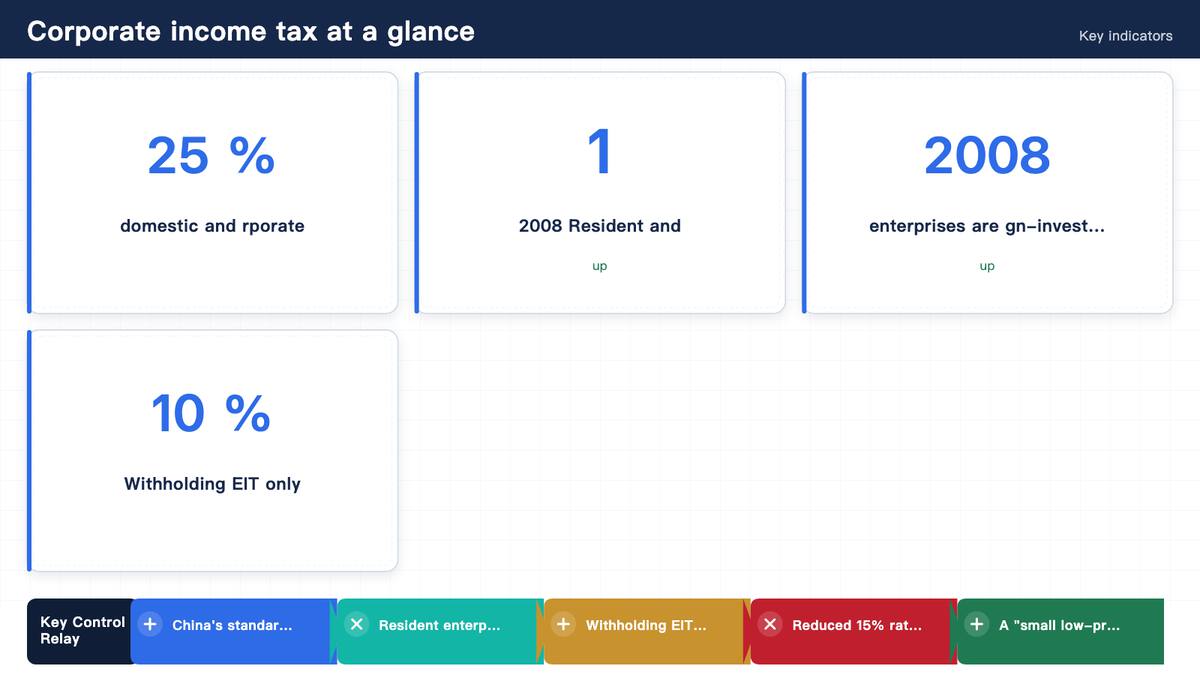
- China’s standard corporate income tax (EIT) rate is a flat 25%, unified for domestic and foreign-invested enterprises since 1 January 2008.
中国企业所得税标准税率为统一的 25%,自 2008 年 1 月 1 日起对内资与外商投资企业统一适用。- Resident enterprises are taxed on worldwide income, while non-resident enterprises are taxed only on China-source income, usually by 10% withholding.
居民企业就全球所得纳税,非居民企业仅就中国来源所得纳税,通常按 10% 源泉扣缴。- Withholding EIT on passive income (dividends, interest, royalties) is 10% under domestic law and is often reduced to 5%–7% on dividends by tax treaties.
股息、利息、特许权使用费等被动所得的预提所得税国内法税率为 10%,税收协定常将股息进一步降至 5%–7%。- Reduced 15% rates apply to high-and-new-technology enterprises and to Hainan FTP encouraged-industry enterprises meeting the substantive-operation and 60% main-business tests.
高新技术企业,以及满足实质性运营与主营收入 60% 条件的海南自贸港鼓励类企业,可适用 15% 优惠税率。- A “small low-profit enterprise” faces an effective ~5% rate (25% of income included, taxed at 20%) for taxable income up to RMB 3 million.
小型微利企业对年应纳税所得额不超过 300 万元的部分实际税负约 5%(减按 25% 计入、按 20% 计税)。- Annual CIT returns are due within five months after year-end, provisional tax is paid monthly/quarterly within 15 days, and losses may be carried forward up to five years.
企业所得税年度申报在年度终了后五个月内完成,分月/分季预缴于 15 日内,亏损可向后结转不超过五年。- A foreign tax credit offsets overseas EIT paid, and treaty benefits are claimed by self-assessment and record-filing rather than prior approval.
境外已纳所得税可抵免中国应纳税额,协定待遇通过自行判断、申报享受(留存备查)而非事前审批适用。- Outbound profit flows are actively monitored via the profit-reinvestment deferral and the controlled-foreign-company (CFC) rule.
利润外流受利润再投资递延纳税与受控外国企业(CFC)规则持续监管。
Corporate income tax at a glance | 企业所得税概览
Overview
China’s enterprise income tax (EIT, 企业所得税) is the central direct tax on the profits of enterprises operating in the country. It is governed by the Enterprise Income Tax Law of the People’s Republic of China (adopted by the National People’s Congress on 16 March 2007 and effective from 1 January 2008) and the implementing regulations issued by the State Council. The law replaced the earlier dual regime that separately taxed domestic enterprises and foreign-invested enterprises, unifying the statutory rate at 25% and establishing a single, residence-and-source-based framework. For a foreign investor, the most important early questions are not the headline rate but three structural distinctions: whether the entity is a resident or non-resident enterprise, which reduced rate (if any) applies, and how passive income flowing out of China is taxed at source.
Under this framework, China operates both a worldwide-taxation model for resident enterprises and a source-based, withholding model for certain non-resident income. The system is also heavily shaped by tax treaties: China has signed comprehensive double-taxation agreements (and arrangements with Hong Kong and Macau) that routinely reduce the statutory 10% withholding rate on dividends, interest and royalties. Understanding these layers is essential before structuring a holding company, choosing a market-entry vehicle, or repatriating profits.
The standard 25% rate and the taxable base
The default EIT rate is 25% (Article 4 of the Law). Taxable income is computed as the annual gross revenue minus non-taxable income, tax-exempt income, allowable deductions, and losses carried forward from prior years. Deductions follow the general principle that expenses must be “reasonable” and “directly related” to earning income; the law expressly denies deductions for items such as dividends paid to investors, EIT itself, late-payment penalties, and sponsorships.
A few base mechanics matter for foreign-invested enterprises (FIEs). First, losses may be carried forward for up to five years. Second, a foreign tax credit is available: an enterprise that pays foreign EIT on overseas income may credit it against its Chinese liability, subject to a limitation calculated per income category. Third, annual CIT returns are filed within five months after the end of the tax year (the calendar year), and provisional tax is paid monthly or quarterly, with returns due within 15 days after each period. Fourth, related-party transactions must be disclosed through the annual associated-party transaction reporting form, and transfer pricing must follow the arm’s-length principle (see the dedicated article on transfer pricing for FIEs).
Reduced rates: 15% and 20%
The law and subsequent regulations provide meaningful reduced rates. A “high-and-new-technology enterprise” (高新技术企业) recognised under the national programme is taxed at 15% rather than 25%. Encouraged-industry enterprises registered in the Hainan Free Trade Port that meet the substantive-operation and main-business tests also enjoy 15% (see the dedicated Hainan articles). A “small low-profit enterprise” (小型微利企业) is subject to a statutory 20% rate, and in practice the effective burden is far lower because only a portion of taxable income is included—broadly, for taxable income up to RMB 3 million, 25% of the income is included in the taxable base and taxed at 20%, producing an effective 5% rate; the precise thresholds and inclusion ratios have been adjusted repeatedly and should be confirmed against the current year’s rules. Regional and sectoral incentives (western development, key infrastructure, environmental protection, etc.) can also lower the effective rate, and treaty or domestic exemptions may apply to specific income such as qualified dividend income between resident enterprises.
Because the reduced rates are conditional, the planning question is rarely “what is the rate?” but “do we satisfy the conditions, and can we evidence it?” High-tech status requires qualification and periodic re-assessment; the Hainan 15% rate requires Hainan registration, substantive operation, and main-business revenue of at least 60% of total revenue; small low-profit status depends on the employee, asset, and profit thresholds then in force. Each must be documented in the tax filing.
Resident vs non-resident enterprises
The Law divides taxpayers into resident and non-resident enterprises. A resident enterprise is one established under Chinese law, or established under foreign law but whose “place of effective management” is in China—broadly, the institution that exercises substantial and overall management and control over the enterprise’s production, operations, personnel, finance, and property. Resident enterprises are taxed on worldwide income. A non-resident enterprise is one established under foreign law without a Chinese place of effective management; it is taxed on China-source income only, and the exact scope depends on whether it has an “establishment or place” (roughly, a permanent establishment) in China.
For a non-resident with an establishment in China, EIT at 25% applies to China-source income attributable to that establishment plus foreign income effectively connected to it, with self-filing and normal provisional/annual compliance. For a non-resident without a Chinese establishment, or with an establishment but on income not effectively connected to it, only China-source income is taxed, and that tax is collected by withholding at source (the “withholding EIT” described next). The residence distinction therefore drives both the rate and the entire compliance model.
Withholding tax on passive income
Where a non-resident has no Chinese establishment (or the income is not effectively connected to one), dividends, interest, royalties, rents, and similar passive items are subject to withholding EIT. The statutory rate is 20%, but the implementing regulations reduce it to 10% (Article 27 and implementing regulations Article 91), applied to the gross amount (for dividends, interest, rents, and royalties) or to the net amount (for property transfers). The payer is the withholding agent and must deduct the tax when making each payment. The 10% is a domestic-law default; tax treaties frequently lower it—commonly 5% or 7% on dividends (depending on ownership), 10% on interest, and 10% (or lower for certain equipment/industrial royalties) on royalties. A non-resident claims treaty benefits by self-assessing and filing, having moved from prior approval to a record-filing model.
Two additional mechanisms are relevant to foreign investors. First, the profit-reinvestment deferral: under domestic policy, foreign investors that directly reinvest distributed profits into qualifying domestic projects may defer the withholding EIT otherwise due on the distribution (subject to conditions and recapture if the reinvestment is later wound down). Second, the controlled-foreign-company rule can pull passive income of a low-taxed foreign subsidiary into the resident parent’s income where there is no reasonable business need for the deferral. Both illustrate that outbound profit flows are actively monitored.
Worked examples and practical notes
Illustrating the resident/non-resident split: a Singapore holding company that merely owns shares in a China WFOE but makes no management decisions in China is a non-resident; only its China-source income (for example, dividends from the WFOE) is taxed in China, by withholding. By contrast, if the group’s regional management function—board meetings, treasury, and key hiring decisions—is stationed in the China WFOE, that entity may be deemed a resident subject to worldwide taxation, a very different exposure.
On withholding, consider a China WFOE paying a 5% royalty to its US parent for a trademark licence. The gross royalty is subject to 10% withholding EIT unless the China–US treaty lowers it (the treaty generally caps royalty withholding at 10%, though certain equipment or industrial royalties may be lower; the exact limitation depends on the treaty article and the beneficial-owner test). The WFOE must withhold and remit when it pays, and the payment may also trigger a 6% VAT withholding where the service is consumed in China. A foreign investor modelling repatriation must therefore net both taxes.
Finally, note how the layers interact: a Hainan-substantive high-tech manufacturer could combine the 15% CIT rate with the R&D super-deduction and, on outbound dividends, the treaty-reduced withholding—three layers that, taken together, can materially lower the effective tax cost of a China operation compared with a plain 25% baseline.
The 25% baseline, the residence test, and the 10% withholding are the three constants every foreign-investor model should start from; the reduced rates and exemptions are then layered on only where the conditions are clearly met.
What to do next
- Confirm the entity’s residence status (incorporation place vs. place of effective management) before finalising the holding and entry structure.
- Map every outbound payment (dividends, interest, royalties, service fees) to its correct withholding treatment and check the applicable tax treaty rate.
- If targeting a reduced rate, verify the qualifying conditions early (high-tech recognition, Hainan registration + substantive operation + 60% main-business revenue, or small low-profit thresholds).
- Build the compliance calendar: quarterly provisional returns within 15 days, annual return within five months, and the associated-party transaction reporting form.
- Engage a qualified tax adviser to model worldwide vs. source taxation, the foreign tax credit, and transfer-pricing exposure before repatriating profits.
Sources
- 国家税务总局 12366 法律法规库 — 中华人民共和国企业所得税法: https://12366.chinatax.gov.cn/bzds/058/058-5-1.html
- 国家税务总局 — 非居民企业源泉扣缴税收指引: https://fgk.chinatax.gov.cn/zcfgk/c100022/c5215636/5215636/files/3vrnwpby.pdf
- 国家税务总局 (State Taxation Administration) official portal: https://www.chinatax.gov.cn/
Related reading
- see also: Hainan FTP preferential CIT: practice notes (16-hainan-ftp-preferential-cit)
- see also: R&D super-deduction for foreign-invested firms (18-rd-super-deduction)
- see also: Transfer pricing rules for FIEs (21-transfer-pricing-fie)
企业所得税概览
概述
企业所得税是中国对经营企业利润征收的核心直接税,由《中华人民共和国企业所得税法》(2007 年 3 月 16 日全国人大通过,2008 年 1 月 1 日起施行)及国务院制定的实施条例规范。该法取代了对内资企业与外商投资企业分别征税的旧双轨制,将法定税率统一为 25%,并建立起以”居民/非居民”和”来源地”为基础的统一框架。对外国投资者而言,最先要弄清的往往不是名义税率,而是三处结构性区分:企业属于居民企业还是非居民企业、是否适用某项优惠税率、以及利润流出中国时的被动所得如何按源泉扣缴征税。
在这一框架下,中国对居民企业实行”全球征税”,对非居民企业的特定所得实行”来源地 + 源泉扣缴”。整个制度还深受税收协定的塑造:中国已与多数国家和地区签署全面避免双重征税协定(及对香港、澳门的安排),其中普遍将股息、利息、特许权使用费的法定 10% 预提税率进一步调低。在搭建持股架构、选择市场进入载体或汇出利润之前,理解这些层次至关重要。
标准 25% 税率与计税基础
企业所得税的默认税率为 25%(税法第四条)。应纳税所得额 = 年度收入总额 − 不征税收入 − 免税收入 − 各项扣除 − 允许弥补的以前年度亏损。扣除遵循”与取得收入相关且合理”的一般原则;税法明确不得扣除的项目包括向投资者支付的股息红利、企业所得税税款本身、税收滞纳金、罚金及赞助支出等。
对外商投资企业有几项基础规则尤为关键。其一,亏损可向后结转弥补,最长不超过五年。其二,允许境外税收抵免:居民企业就其境外所得在境外已纳所得税,可在限额内抵免中国应纳税额(按国别/所得类型计算)。其三,企业所得税按纳税年度(公历 1 月 1 日至 12 月 31 日)计算,分月或分季预缴,年度终了之日起五个月内报送年度申报表并汇算清缴。其四,与关联方之间的业务往来须随年度申报附送《企业年度关联业务往来报告表》,关联交易须遵循独立交易原则(详见本专题”外商投资企业的转让定价规则”)。
优惠税率:15% 与 20%
税法及后续法规提供了力度可观的优惠税率。经认定的”国家需要重点扶持的高新技术企业”(高新技术企业)减按 15% 税率征税,而非 25%。注册在海南自由贸易港、符合”实质性运营”与”主营收入”条件的鼓励类产业企业,同样适用 15%(见本专题海南系列文章)。”小型微利企业”法定税率为 20%,实务中实际税负更低——其应纳税所得额中仅一部分计入计税基础:大致而言,对年应纳税所得额不超过 300 万元的部分,减按 25% 计入应纳税所得额并按 20% 税率缴纳,实际税负约 5%;具体减计比例与门槛历年多次调整,须以当年有效规则为准。西部大开发、重点基础设施、环境保护等区域与行业性优惠亦可降低实际税负;居民企业之间符合条件的股息红利等还可能适用免税。
由于优惠税率均附条件,真正的筹划问题通常不是”税率是多少”,而是”我们是否满足这些条件,且能否举证”。高新技术企业须通过认定并定期复核;海南 15% 税率要求海南注册、实质性运营且主营业务收入占比不低于 60%;小型微利企业取决于当时的从业人数、资产总额与利润门槛。各项均须在申报中留存证据。
居民企业与非居民企业
税法将纳税人划分为居民企业与非居民企业(第二条)。居民企业指依法在中国境内成立,或依照外国(地区)法律成立但实际管理机构在中国境内的企业;”实际管理机构”一般是指对企业的生产经营、人员、财务、财产等实施实质性全面管理和控制的机构。居民企业就来源于中国境内、境外的所得缴纳企业所得税(全球征税)。非居民企业指依照外国法律成立且实际管理机构不在中国境内者,仅就中国来源所得纳税,具体范围取决于其在中国境内是否设有”机构、场所”(近似常设机构概念)。
对于在中国境内设有机构、场所的非居民企业,就其所设机构、场所取得的中国来源所得,以及发生在境外但与该机构、场所有实际联系的所得,按 25% 自行申报缴纳;而对未设立机构、场所,或虽有机构、场所但所得与之无实际联系的非居民,仅就中国来源所得征税,且由支付人在支付环节源泉扣缴(即下文”预提所得税”)。因此,”居民与否”直接决定了税率与整套合规模式。
被动所得的预提所得税
当非居民在中国无常设机构(或有关所得与机构、场所无实际联系)时,其取得的股息、利息、特许权使用费、租金等被动所得适用预提所得税。法定税率为 20%,但实施条例将其减按 10% 征收(税法第二十七条及实施条例第九十一条),并以收入全额(股息、利息、租金、特许权使用费)或差额(财产转让)为计税依据。支付人为扣缴义务人,须在每次支付或到期应支付时扣税。这 10% 是国内法默认值;税收协定常进一步调低——股息多为 5% 或 7%(视持股比例),利息多为 10%,特许权使用费为 10%(部分设备/工业类特许权可能更低)。非居民通过”自行判断、自行申报享受”的备查方式(已由审批改为备查)适用协定待遇。
对外国投资者还有两项机制值得注意。一是利润再投资递延纳税:境外投资者将从境内企业分得的利润直接用于境内符合条件的再投资,可在投资期间暂缓缴纳预提所得税(须满足条件和后续回收时的补税规则)。二是受控外国企业规则(第四十五条):居民企业控制的设立在实际税负明显偏低国家(地区)的企业,若非出于合理经营需要而对利润不作分配或减少分配,该利润中应归属于居民企业的部分须计入当期收入。二者都说明,利润外流受到持续监管。
实务示例与操作要点
以居民/非居民划分为例:一家新加坡控股公司仅持有中国 WFOE 股权、并不在中国境内作管理决策,属于非居民;其仅中国来源所得(例如来自 WFOE 的股息)在中国按源泉扣缴纳税。相反,若集团的区域管理职能——董事会会议、资金与关键人事决策——设在 WFOE,则该主体可能被认定为居民、承担全球征税,暴露面截然不同。
就预提而言,假设中国 WFOE 向其美国母公司支付 5% 商标许可特许权使用费。该特许权使用费全额按 10% 征预提所得税,除非中美协定调低(协定通常也将特许权使用费上限设为 10%,但部分设备或工业类特许权可能更低;具体限制取决于协定条款与受益所有人测试)。WFOE 须在支付时扣缴并解缴,且该支付在服务于中国境内消费时还可能触发 6% 增值税代扣。因此建模利润汇出时,须将两税一并净额计算。
最后注意各层如何叠加:一家在海南实质性运营的高新制造商,可同时适用 15% CIT 税率、研发费用加计扣除,并就对外股息适用协定调低的预提税率——这三层叠加,相较单纯的 25% 基准,可显著降低中国运营的有效税负。
下一步建议
- 在敲定持股与进入架构前,先确认企业的居民身份(注册地 vs. 实际管理机构所在地)。
- 将每一笔对外支付(股息、利息、特许权使用费、服务费)映射到正确的扣缴处理,并核对适用的税收协定税率。
- 若拟适用优惠税率,尽早核验资格条件(高新认定、海南注册 + 实质性运营 + 主营收入≥60%,或小型微利门槛)。
- 建立合规日历:季度预缴申报在 15 日内、年度申报在五个月内,并随报附送关联业务往来报告表。
- 在汇出利润前,聘请合格税务顾问对全球征税 vs. 来源地征税、境外税收抵免及转让定价风险进行建模分析。
来源
- 国家税务总局 12366 法律法规库 — 中华人民共和国企业所得税法: https://12366.chinatax.gov.cn/bzds/058/058-5-1.html
- 国家税务总局 — 非居民企业源泉扣缴税收指引: https://fgk.chinatax.gov.cn/zcfgk/c100022/c5215636/5215636/files/3vrnwpby.pdf
- 国家税务总局 (State Taxation Administration) 官方网站: https://www.chinatax.gov.cn/
相关阅读
- 见:海南自贸港企业所得税优惠实务要点(16-hainan-ftp-preferential-cit)
- 见:外资企业的研发费用加计扣除(18-rd-super-deduction)
- 见:外商投资企业的转让定价规则(21-transfer-pricing-fie)