
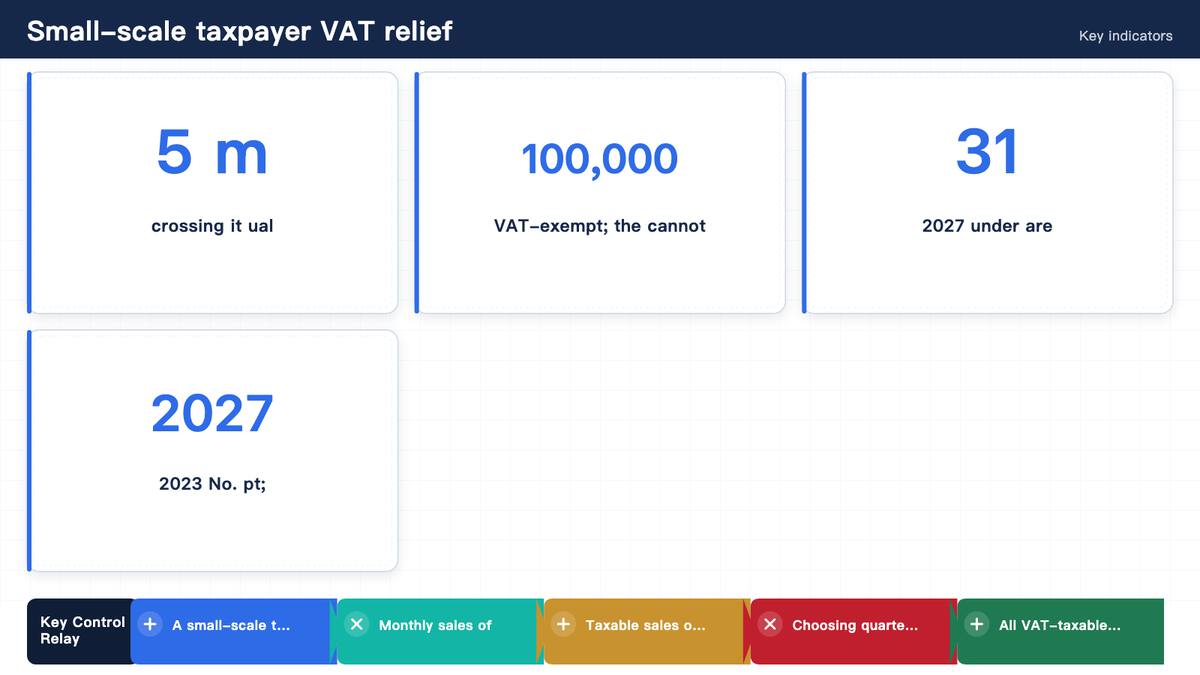
- A small-scale taxpayer is one whose annual VAT taxable sales do not exceed RMB 5 million; crossing it generally forces general-taxpayer registration, which cannot be reversed.
小规模纳税人指年增值税应税销售额不超过 500 万元的纳税人;一旦跨线通常须登记为一般纳税人且不可逆转。- Monthly sales of RMB 100,000 or less are VAT-exempt; the relief runs through 31 December 2027 under Announcement 2023 No. 19.
月销售额 10 万元以下免征增值税;该优惠依 2023 年第 19 号公告执行至 2027 年 12 月 31 日。- Taxable sales otherwise at 3% are levied at a reduced 1% (prepayment projects likewise at 1%), a reduction of the statutory small-scale levy rate.
原本适用 3% 征收率的应税销售减按 1% 征收(预缴项目同样减按 1%),系对法定小规模征收率的减征。- Choosing quarterly filing raises the equivalent threshold to RMB 300,000 per quarter, protecting the exemption when monthly sales are uneven.
选择按季申报将等效门槛提高至每季 30 万元,可在月度销售不均时保护免税资格。- All VAT-taxable sales (goods, services, intangibles, property) aggregate for the test; real-estate and difference-method carve-outs can preserve part of the exemption.
所有增值税应税销售(货物、服务、无形资产、不动产)合并作门槛测试;不动产与差额征税剔除规则可保留部分免税。- Small-scale taxpayers may self-issue 1% special VAT invoices, but issuing a 3% special invoice to satisfy a customer’s input credit taxes that sale at 3%, not 1%.
小规模纳税人可自行开具 1% 专票,但为满足客户进项抵扣而开 3% 专票的,该笔销售按 3% 而非 1% 征税。
Small-scale taxpayer VAT relief | 小规模纳税人增值税优惠
Overview
China’s value-added tax (VAT) system splits taxpayers into general taxpayers and small-scale taxpayers, and the latter enjoy a standing package of reliefs that is especially relevant to foreign-invested start-ups, representative trading vehicles, and the China subsidiaries of smaller overseas groups. The current relief—codified in Ministry of Finance and SAT Announcement 2023 No. 19 (supplemented by SAT Announcement 2023 No. 1)—has two pillars: a VAT exemption for monthly sales up to RMB 100,000, and a reduced 1% levy rate for taxable sales otherwise subject to the 3% rate. Both run through 31 December 2027. This note explains who qualifies, how the thresholds aggregate, and the invoicing consequences that foreign operators most often miss.
The relief is structurally simple but easy to mismanage. A small-scale taxpayer pays no VAT at all below the monthly threshold, and only 1% above it (on the 3%-rate portion); but the moment a customer needs a special VAT invoice (to claim input credit), the small-scale taxpayer faces a trade-off between its own tax saving and the customer’s deduction. Understanding that trade-off is the practical core of this article.
Who is a small-scale taxpayer
A small-scale taxpayer is defined by annual taxable sales: an entity or individual whose annual VAT taxable sales do not exceed RMB 5 million. The VAT Law (effective 1 January 2026) restates this threshold at RMB 5 million, with the State Council empowered to adjust it. A small-scale taxpayer computes VAT by the simplified method—sales multiplied by the levy rate—rather than by crediting input tax against output tax. If a small-scale taxpayer’s accounting is sound and it can provide accurate tax materials, it may register as a general taxpayer and use the standard credit method instead.
For foreign investors, the common scenarios are: a newly incorporated WFOE in its early, low-revenue phase; a sourcing or liaison vehicle with modest turnover; and certain service or trading subsidiaries. Note that registration as a small-scale taxpayer is the default for low-volume entities, but crossing the RMB 5 million annual threshold generally triggers a requirement to register as a general taxpayer (and once registered as general, an entity cannot revert to small-scale).
The two reliefs: RMB 100,000 exemption and the 1% levy rate
The first pillar is the exemption. Small-scale taxpayers with monthly sales of RMB 100,000 or less (inclusive) are exempt from VAT. The second pillar is the reduced rate: taxable sales subject to the 3% levy rate are instead levied at 1%, and prepayment projects subject to a 3% prepayment rate are prepaid at 1%. The 1% is a reduction of the statutory 3% small-scale levy rate, not a separate rate—so a small-scale taxpayer above the exemption threshold pays 1% on its 3%-rate sales.
The two pillars stack naturally: below RMB 100,000 monthly, no VAT is due at all; between RMB 100,001 and the point where general-taxpayer registration is required, VAT is due at 1% on the 3%-rate sales. The relief is broad in coverage—it applies to sales of goods, services, intangibles, and movables—but it is specific in mechanics, and the aggregation and invoicing rules below determine whether the exemption is actually captured.
Monthly vs quarterly, and how sales aggregate
The exemption threshold is expressed monthly (RMB 100,000), but small-scale taxpayers may choose to file monthly or quarterly; if filing quarterly, the equivalent threshold is RMB 300,000 per quarter. The choice matters: a business with volatile monthly sales can be better off filing quarterly, because a single strong month above RMB 100,000 does not forfeit the exemption for the whole quarter if the quarter total stays under RMB 300,000. By contrast, monthly filing exposes each month to the RMB 100,000 line.
For the threshold test, all VAT-taxable sales are aggregated—goods, labour, services, intangibles, and immovable property—to judge whether the exemption applies. Two carve-outs matter. First, under SAT Announcement 2023 No. 1, if total monthly sales exceed RMB 100,000 but the sales of immovable property (real estate) are deducted and the remainder is under RMB 100,000, the non-real-estate portion still enjoys the exemption. Second, taxpayers using the VAT difference (差额征税) method test the threshold on the post-difference amount. These rules reward careful sales classification.
Invoicing implications
Invoicing is where foreign operators most often stumble. A small-scale taxpayer issues ordinary VAT invoices (普通发票) at the 1% rate for its 3%-rate sales. Crucially, a small-scale taxpayer may also self-issue special VAT invoices (增值税专用发票) at 1% for the portion where the customer needs to claim input credit; since the policy change allowing this, small-scale taxpayers are no longer forced to visit a tax office to issue special invoices.
The trade-off: if a customer requires a 3% special VAT invoice (so it can claim a full 3% input credit), the small-scale taxpayer may choose to forgo the 1% reduction on that sale and issue a 3% special invoice—but that sale is then taxed at 3%, not 1%. A small-scale taxpayer cannot issue a 1% ordinary invoice and a 3% special invoice for the same transaction to “have it both ways.” Practical guidance: issue 1% invoices by default to preserve the relief, and only issue 3% special invoices where a specific customer’s input-credit need justifies the higher tax cost.
Worked examples and practical notes
Monthly vs quarterly: a small-scale trader has sales of RMB 80k, RMB 120k, and RMB 90k over three months. Filing monthly, month 2 (RMB 120k) is taxed at 1% (RMB 1,200) and months 1 and 3 are exempt. Filing quarterly, the quarter totals RMB 290k, below the RMB 300k line, so all three months are exempt—saving the RMB 1,200. The filing-frequency choice has a real cash effect.
Invoicing trade-off: the same trader sells RMB 50k of goods to Customer A, who needs a 3% special VAT invoice to claim input credit. If the trader issues a 3% special invoice, that RMB 50k is taxed at 3% (RMB 1,500); if A accepts a 1% invoice (claiming only 1% credit), the trader pays 1% (RMB 500). The trader should weigh its own RMB 1,000 saving against A’s RMB 1,000 extra input cost and negotiate accordingly.
Threshold aggregation: if the trader also sells a RMB 200k property in a month with RMB 90k of other sales (total RMB 290k, above RMB 100k), the RMB 90k non-real-estate portion is still exempt after deducting the property sale—so only the property is taxed at its own rate. Mis-aggregating loses the exemption on the RMB 90k.
Planning note for FIEs: a low-revenue China subsidiary can deliberately stay small to keep the small-scale benefits, but must watch the RMB 5m annual line—crossing it forces general-taxpayer registration, ending both the 1% rate and the exemption, and the change cannot be reversed. The threshold should be monitored monthly, not discovered at year-end.
A further common case concerns filing after issuing special invoices: a small-scale taxpayer that issues a special VAT invoice must still report and pay on that sale—issuing a special invoice does not exempt it, and ordinary and special invoices must be reported on separate lines, never folding special-invoice sales into the exemption column. Nor should a taxpayer suppress invoicing to stay small; that distorts revenue recognition and income tax and invites audit. From a group perspective, the parent often wants the China subsidiary to remain small to cut tax and compliance cost, but that clashes with growth. If crossing the RMB 5m line is likely within two years, registering as a general taxpayer early—to access input credits and customer-accepted invoices—avoids a disruptive mid-course switch and the client friction that comes with it.
In short, the small-scale regime rewards disciplined classification and invoicing: keep taxable sales honestly recorded, choose the filing frequency that fits your cash flow, and treat the RMB 5m line as a planning trigger rather than a surprise. A China subsidiary that grows past it should embrace general-taxpayer status as the next stage of maturity, not a penalty.
Honest invoicing and timely filing are the cheapest insurance a small-scale taxpayer can buy, and the surest guard against a forced, disruptive reclassification.
What to do next
- Identify whether your China entity is (or will become) a small-scale taxpayer—watch the RMB 5 million annual sales line that triggers general-taxpayer registration.
- Choose the filing frequency deliberately: quarterly filing can protect the exemption when monthly sales are uneven.
- Aggregate all taxable sales (goods, services, intangibles, property) for the threshold test, and use the real-estate and difference-method carve-outs where applicable.
- Default to 1% invoices; issue 3% special VAT invoices only where a customer’s input-credit need clearly justifies the extra tax.
- Reassess as you approach RMB 5 million annual sales, because general-taxpayer registration is then generally required and cannot be reversed.
Sources
- 国家税务总局法规库 — 财政部 税务总局关于增值税小规模纳税人减免增值税政策的公告(2023年第19号): https://fgk.chinatax.gov.cn/zcfgk/c102416/c5210457/content.html
- 国家税务总局 — 一文了解:增值税小规模纳税人如何享受月销售额10万元以下免征增值税政策: https://www.chinatax.gov.cn/chinatax/n810356/n3010387/c5211011/content.html
- 中国政府网 — 关于做好2023年降成本重点工作的通知(发改运行〔2023〕645号): https://www.gov.cn/zhengce/zhengceku/202306/content_6886123.htm
Related reading
- see also: VAT reform: what foreign firms should note (20-vat-reform-foreign-firms)
- see also: Corporate income tax at a glance (15-corporate-income-tax-overview)
- see also: Hainan FTP: incentives and who qualifies (17-hainan-ftp-incentives)
小规模纳税人增值税优惠
概述
中国的增值税制度将纳税人分为一般纳税人与小规模纳税人,后者享有一揽子长期性优惠,对外国投资的初创企业、贸易载体,以及海外中小集团的在华子公司尤为 relevant。现行优惠由财政部、税务总局公告 2023 年第 19 号(辅以税务总局公告 2023 年第 1 号)确立,含两大支柱:月销售额 10 万元以下免征增值税,以及原本适用 3% 征收率的应税销售收入减按 1% 征收。两项均执行至 2027 年 12 月 31 日。本文说明适用对象、门槛如何聚合,以及外国运营者最易忽略的开票后果。
该优惠结构简明却容易用错。小规模纳税人在月门槛以下完全不缴增值税,超过后仅就 3% 征收率部分按 1% 缴纳;但一旦客户需要增值税专用发票(以抵扣进项),小规模纳税人便面临”自身节税”与”客户抵扣”之间的权衡。理解这一权衡是本文的实务核心。
谁是小规模纳税人
小规模纳税人以年应纳税销售额界定:年增值税应税销售额未超过 500 万元的纳税人。自 2026 年 1 月 1 日施行的《增值税法》重申 500 万元门槛,并授权国务院调整。小规模纳税人按简易计税方法计缴增值税——以销售额乘以征收率,而非以销项税额抵扣进项税额。若小规模纳税人会计核算健全、能提供准确税务资料,可登记为一般纳税人,改用标准抵扣法。
对外国投资者常见的情形包括:处于早期、低营收阶段的新设外商独资企业;营业额有限的采购或联络载体;以及部分服务或贸易子公司。需注意,低体量主体默认按小规模纳税人管理,但一旦年销售额跨过 500 万元门槛,通常须登记为一般纳税人(且一经登记为一般纳税人,不得转回小规模)。
两项优惠:10 万元免税与 1% 征收率
第一支柱是免税。月销售额 10 万元及以下(含本数)的小规模纳税人,免征增值税。第二支柱是降率:原本适用 3% 征收率的应税销售收入减按 1% 征收,适用 3% 预征率的预缴项目减按 1% 预征。1% 是对法定 3% 小规模征收率的减征,而非独立税率——因此超过免税门槛的小规模纳税人,就其 3% 征收率销售按 1% 缴税。
两项自然叠加:月销售额 10 万元以下完全不缴;介于 10 万元以上至需登记一般纳税人之间,就 3% 征收率销售按 1% 缴税。优惠覆盖面广——适用于货物、劳务、无形资产与动产销售——但机制具体,能否真正享受取决于下文的开票与聚合规则。
按月 vs 按季,以及销售额如何聚合
免税门槛按月表述(10 万元),但小规模纳税人可选择按月或按季申报;若按季申报,等效门槛为每季 30 万元。这一选择很关键:月度销售波动的企业,按季申报往往更有利——只要季度总额低于 30 万元,单月冲高超过 10 万元也不会使整季丧失免税;而按月申报则每月都直面 10 万元线。
门槛测试中,所有增值税应税销售须合并计算——货物、劳务、服务、无形资产与不动产——以判断是否免税。两处剔除值得注意。其一,依税务总局公告 2023 年第 1 号,若合计月销售额超过 10 万元,但扣除当期销售不动产销售额后未超过 10 万元,其货物、劳务、服务、无形资产销售额仍可享受免税。其二,适用差额征税的,以差额后的余额为销售额判定门槛。这些规则奖励精细的销售分类。
发票开具的影响
开票是外国运营者最易出错之处。小规模纳税人就其 3% 征收率销售,按 1% 开具增值税普通发票。关键在于,小规模纳税人也可就客户需要抵扣进项的那部分,自行开具 1% 的增值税专用发票;自政策放开以来,小规模纳税人已不必再跑办税厅代开专票。
权衡在于:若客户要求 3% 增值税专用发票(以便全额抵扣 3% 进项),小规模纳税人可选择就该笔销售放弃 1% 减征、开具 3% 专票——但该笔销售随之按 3% 而非 1% 征税。同一笔交易,小规模纳税人不能既开 1% 普通发票又开 3% 专票”两头占”。实务建议:默认开具 1% 发票以保住优惠,仅在某一客户的进项抵扣需求明确值得额外税负时,才开具 3% 专票。
实务示例与操作要点
按月 vs 按季:某小规模纳税人三个月销售额分别为 8 万、12 万、9 万元。按月申报时,第 2 月(12 万)按 1% 缴税 1,200 元,第 1、3 月免税;按季申报时,季度合计 29 万元,低于 30 万元线,三个月全免——省下 1,200 元。申报频率的选择有真实现金流影响。
开票权衡:同一纳税人向客户 A 销售 5 万元货物,A 需要 3% 增值税专用发票以抵扣进项。若纳税人开 3% 专票,该 5 万元按 3% 缴 1,500 元;若 A 接受 1% 发票(仅抵扣 1%),纳税人缴 1%(500 元)。纳税人应权衡自身省下的 1,000 元与客户多付的 1,000 元进项成本,并据此协商。
门槛聚合:若该纳税人某月另有其他销售 9 万元、同时出售 20 万元不动产(合计 29 万元,超 10 万元),在扣除不动产销售额后,9 万元非不动产部分仍免税——仅不动产按其自身税率征税。聚合错误会丧失该 9 万元的免税。
对外资企业的规划提示:低营收的中国子公司可刻意保持小规模以享受小规模优惠,但须盯住 500 万元年销售额红线——一旦跨过,强制登记为一般纳税人,1% 征收率与免税均告终止,且不可逆转。该门槛应月度监控,而非在年末才被发现。
再补一类常见情形:小规模纳税人代开或自开专票后的申报。部分纳税人误以为”开了专票就不用报税”或”专票部分免税”,这是错误的——专票对应的销售额本身不属于免税范围,仍须按适用征收率申报纳税;免税仅适用于开具普通发票且未达门槛的部分。混合开具(部分普票、部分专票)时,须在申报表中分别填列,切勿将专票销售额并入免税栏次。另一误区是”为维持小规模身份尽量少开票”,这不仅影响收入确认与所得税,也可能因长期大量未开票收入引发稽查。小规模纳税人身份是税务选择,不是规避开票义务的理由。从集团视角看,母公司常希望中国子公司保持小规模以降低税负与合规成本,但这与业务增长存在天然张力:当中国市场需求起来、销售额逼近 500 万元,是主动登记一般纳税人(可抵扣进项、客户更接受专票),还是刻意压低营收维持小规模,是一道战略题。建议以三年业务规划倒推:若预计两年内必然超线,不如尽早登记一般纳税人,提前适配发票与抵扣体系,避免中途切换造成的客户与系统摩擦。账目清晰、申报合规的小规模纳税人,本身也是稳健经营的信号。
简言之,小规模制度奖赏的是规范的分类与开票:如实记录应税销售、按现金流选择合适的申报频率,并把 500 万元红线视为规划信号而非意外。当中国子公司成长越过该线,应以”进入下一阶段 maturity”的心态拥抱一般纳税人身份,而非将其视为惩罚。合规、清晰的小规模纳税人,本身就是稳健经营与良好税务治理的体现,也更易获得银行、客户与监管方的信任。
规范开票与如实申报,是小规模纳税人最稳的护城河,也是长期稳健经营的底色。
下一步建议
- 厘清你的中国主体是否(或将)为小规模纳税人——盯住触发一般纳税人登记的 500 万年销售额红线。
- 审慎选择申报频率:月度销售不均时,按季申报可保护免税资格。
- 将全部应税销售(货物、服务、无形资产、不动产)合并作门槛测试,并善用不动产与差额征税的剔除规则。
- 默认开 1% 发票;仅在客户进项抵扣需求明确合理时,才开具 3% 增值税专用发票。
- 临近 500 万年销售额时重新评估,因为届时通常须登记一般纳税人且不可逆转。
来源
- 国家税务总局法规库 — 财政部 税务总局关于增值税小规模纳税人减免增值税政策的公告(2023年第19号): https://fgk.chinatax.gov.cn/zcfgk/c102416/c5210457/content.html
- 国家税务总局 — 一文了解:增值税小规模纳税人如何享受月销售额10万元以下免征增值税政策: https://www.chinatax.gov.cn/chinatax/n810356/n3010387/c5211011/content.html
- 中国政府网 — 关于做好2023年降成本重点工作的通知(发改运行〔2023〕645号): https://www.gov.cn/zhengce/zhengceku/202306/content_6886123.htm
相关阅读
- 见:增值税改革:外资企业注意事项(20-vat-reform-foreign-firms)
- 见:企业所得税概览(15-corporate-income-tax-overview)
- 见:海南自贸港:优惠与适用对象(17-hainan-ftp-incentives)