
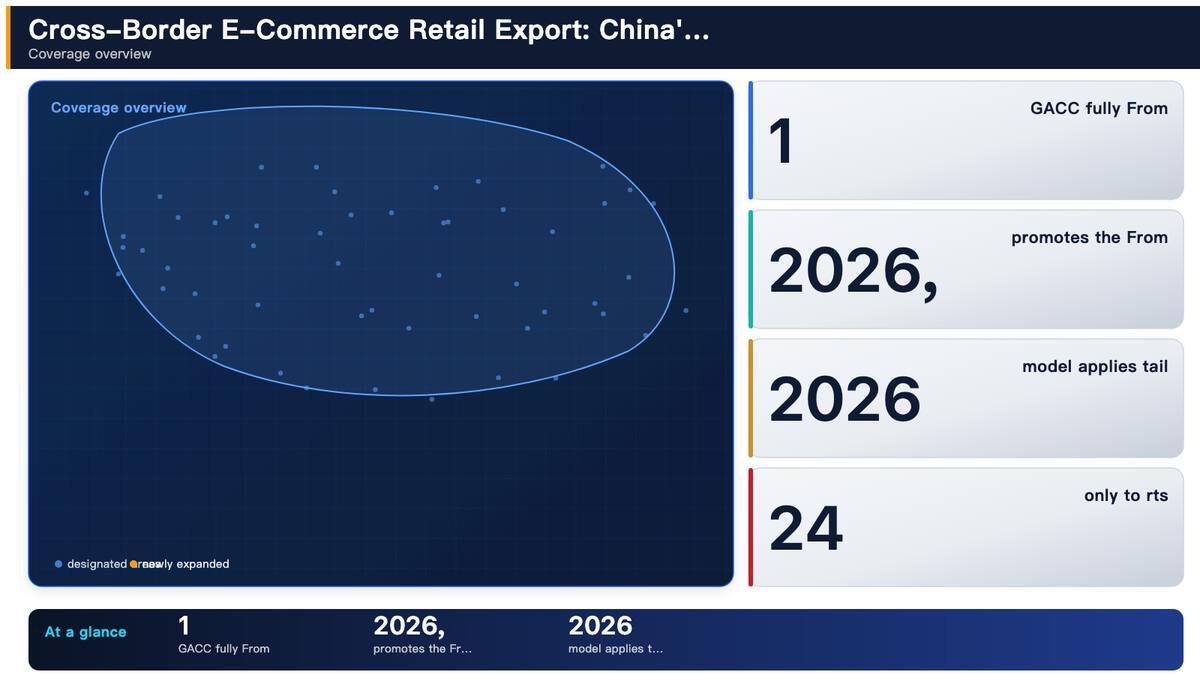
- From 1 April 2026, GACC fully promotes the cross-customs-district return model for cross-border e-commerce retail exports nationwide (Customs Notice 2026 No. 24).
自2026年4月1日起,海关总署在全国范围内全面推广跨境电商零售出口商品跨关区退货模式(海关总署公告2026年第24号)。- The model applies only to retail-export goods under the “9610” supervision code, letting returns enter at any customs port instead of only the original export port.
该模式仅适用于”9610模式”跨境电商零售出口商品,允许退货在全国任一海关口岸办理退运进境,而非仅限原出口口岸。- Returned goods may only go to a customs-supervised operation site that actually runs cross-border e-commerce retail export business.
退货商品仅允许退至开展跨境电商零售出口业务的海关监管作业场所(场地)。- Enterprises must operate compliantly, keep an independent work zone, and open or interface their production-system data with Customs systems.
开展业务的企业须规范经营、具备独立作业功能区,并将生产作业系统数据向海关开放或与海关信息化系统对接。- The model builds on a one-year pilot launched 15 December 2024 across 20 directly-affiliated customs houses; it is now mature enough for nationwide rollout.
该模式建立在2024年12月15日起20个直属海关试点一年的基础上,现已具备全国推广条件。- It sits inside the 2026 cross-border trade facilitation campaign: 24 departments, 45 cities, 29 measures to speed up clearance of new trade formats.
它属于2026年跨境贸易便利化专项行动的一部分:24个部门、45个城市、29项举措,力促新业态通关提速。
Cross-Border E-Commerce Retail Export: China’s Nationwide Cross-Customs-District Return Model (Customs Notice 2026 No. 24) | 跨境电商零售出口全国跨关区退货模式(海关总署公告2026年第24号)
Why this matters now
Cross-border e-commerce has become a primary growth engine for Chinese exports, but returns have been its quiet tax. Under the earlier arrangement, a retail parcel exported through one customs port and then returned from overseas generally had to be sent back through that same original export port. For an FIE running storefronts on global platforms, that meant building return-handling capacity in the exact city where goods first left China — inefficient when warehouses, consolidators, and after-sales centres are elsewhere.
On 12 March 2026 the General Administration of Customs (GACC) issued Customs Notice 2026 No. 24, deciding to promote the cross-customs-district return model for cross-border e-commerce retail export goods across all customs houses nationwide, effective 1 April 2026. The notice converts a successful year-long pilot into a standing national convenience, and it is a direct cost-and-time saving for foreign-invested sellers.
What the notice actually says
The notice is short and operative. Its core provisions:
- Scope. Cross-customs-district return applies only to cross-border e-commerce retail export goods — the “9610” supervision mode. It does not cover other trade modes or B2B bulk shipments.
- Where returns may land. Returned goods may be returned across customs districts, but only to a customs-supervised operation site (venue) that conducts cross-border e-commerce retail export business. A return cannot be routed to an arbitrary inland warehouse.
- Enterprise obligations. Enterprises running the cross-district return business must operate compliantly and maintain an independent work-function zone; their relevant production-operation system data must be opened to Customs or interfaced with the Customs information system.
- Effective date. The notice took effect on 1 April 2026; matters not covered follow existing Customs rules.
The “9610” code is the Customs supervision code for cross-border e-commerce retail exports — small, high-frequency parcels shipped directly to consumers. The model is purpose-built for that flow.
From pilot to nationwide
The national rollout is not a leap of faith. On 15 December 2024, GACC began a pilot of this cross-district return supervision model at 20 directly-affiliated customs houses — including Beijing, Tianjin, Dalian, Harbin, Shanghai, Nanjing, Hangzhou, Chengdu, and Urumqi. After roughly a year of operation, the model was judged mature enough for nationwide promotion. The step from 20 pilot customs houses to all Customs houses removes the geographic mismatch between where goods exit and where returns are best handled.
In plain terms: a seller that exports via, say, the Hangzhou port can now route overseas returns to a Shenzhen or Zhengzhou e-commerce supervised site closer to its return-processing centre, rather than shipping the parcel all the way back to Hangzhou. The “detour” is eliminated.
Compliance and system readiness
The convenience is conditional on discipline. Enterprises should note:
- Business qualification. Only entities actually conducting 9610 retail-export business at a supervised site may receive cross-district returns there.
- Physical segregation. A dedicated, independent work-function area for return handling is required — mixed use with unrelated operations is not acceptable.
- Data interface. The production-operation system must be open to, or connected with, the Customs system. This is the same “data-to-Customs” logic seen across smart-supervision reforms; inaccurate or stale data invites audit.
- Documentary integrity. Returns remain subject to existing Customs declaration and supervision rules; the notice only changes the permitted port of entry, not the underlying declaration obligations.
FIEs already integrated with the China International Trade Single Window and with platform-level order data will find the interface requirement straightforward; those still on manual processes should upgrade before scaling return volumes.
Where it fits in 2026 trade-facilitation policy
The notice is one brick in a larger wall. In March 2026, GACC, together with 24 departments and units — including the Cyberspace Administration, the NDRC, the Ministry of Industry and Information Technology, the Ministry of Public Security, the Ministry of Finance, the Ministry of Transport, and MOFCOM — launched the 2026 cross-border trade facilitation special campaign across 45 cities. Building on 25 cities in 2025, the 2026 round adds 20 cities (Hohhot, Changchun, Suzhou, Jinhua, Quanzhou, Nanchang, Yantai, Wuhan, Changsha, Zhuhai, Nanning, Kunming, Xi’an, Lanzhou, Yinchuan, and others). It puts forward 29 measures around four tasks: upgrading goods-trade clearance, developing services trade, innovating digital and green trade, and improving smart-port construction, standards connectivity, and enterprise services.
Within those 29 measures, “optimising supervision service for new trade formats” and “deepening import-export clearance-mode innovation” are exactly the logic behind Notice 2024/2026 No. 24. For an FIE, the return model should be read alongside the broader facilitation package — faster clearance, smarter ports, and better enterprise services — rather than in isolation.
Practical steps for FIE sellers
- Map your return flow. Identify where overseas returns physically concentrate and which supervised e-commerce sites are nearest; re-point returns to the optimal port rather than the export port.
- Confirm site eligibility. Verify the receiving supervised site conducts 9610 retail-export business and can accept cross-district returns.
- Stand up the work zone and data link. Build the independent return-handling area and connect your system to Customs before volume ramps.
- Train customs brokers. Ensure declarations reflect the cross-district return route and comply with existing rules.
- Track the campaign. Monitor the 2026 facilitation campaign for complementary measures (e.g., overseas-warehouse return conveniences) that may further cut cost.
Related reading
See our articles on two-step declaration, AEO certification, and customs advance ruling for the wider clearance toolkit.
跨境电商零售出口全国跨关区退货模式(海关总署公告2026年第24号)
为何当下重要
跨境电商已成为中国出口的主力增长引擎,但退货是其中隐形的成本负担。在早先的安排下,经某一海关口岸零售出口、随后从海外退回的包裹,一般须退回原出口口岸。对于在全球平台开店的外商投资企业,这意味着必须在货物最初离开中国的那个城市建立退货处理能力——而当仓库、集拼商与售后中心位于他处时,这种做法效率低下。
2026年3月12日,海关总署发布2026年第24号公告,决定自2026年4月1日起在全国海关推广跨境电商零售出口商品跨关区退货模式。该公告将成功运行一年的试点转为长期全国性便利措施,对外商投资卖家是直接降本增效。
公告究竟说了什么
公告简短且具操作性,核心条款如下:
- 适用范围。 跨关区退货仅适用于跨境电商零售出口商品,即”9610″监管模式,不覆盖其他贸易方式或B2B大宗货物。
- 退货落点。 退货商品可跨关区退回,但仅允许退至开展跨境电商零售出口业务的海关监管作业场所(场地),不能路由至任意内陆仓库。
- 企业义务。 开展跨关区退货业务的企业须规范经营、具备独立作业功能区,相关生产作业系统数据应向海关开放或与海关信息化系统对接。
- 生效日期。 自2026年4月1日起施行,未尽事宜按海关现行规定执行。
“9610”是跨境电商零售出口的海关监管代码,对应直接发往消费者的小批量、高频次包裹。该模式正是为这一流向量身定制。
从试点到全国
全国推广并非冒进。2024年12月15日,海关总署在北京、天津、大连、哈尔滨、上海、南京、杭州、成都、乌鲁木齐等20个直属海关启动跨关区退货监管模式试点。运行约一年后,该模式被认定具备全国推广条件。从20个试点海关扩展到全部海关,消除了货物出口地与退货最优处理地之间的地理错配。
通俗地说:经杭州口岸出口的卖家,现在可将海外退货路由至更靠近其退货处理中心的深圳或郑州电商监管场地,而无须将包裹千里迢迢运回杭州。所谓”绕路”由此消除。
合规与系统准备
便利以规范为条件。企业应注意:
- 经营资格。 仅在实际开展9610零售出口业务、且设有关监管场地的主体,方可接收跨关区退货。
- 物理隔离。 须设独立退货处理作业功能区,不得与无关业务混用。
- 数据对接。 生产作业系统须向海关开放或对接,这与智慧监管改革中”数据向海关报送”的逻辑一致;数据不准或滞后易招致稽查。
- 单证完整。 退货仍受既有报关与监管规则约束;公告仅改变允许的进境口岸,不改变 underlying 申报义务。
已对接中国国际贸易单一窗口及平台订单数据的外商投资企业,会觉得对接要求顺理成章;仍依赖手工流程的企业应在放量前完成升级。
在2026年贸易便利化政策中的位置
该公告是更大版图中的一块。2026年3月,海关总署会同中央网信办、国家发展改革委、工业和信息化部、公安部、财政部、交通运输部、商务部等24个部门(单位),在45个城市部署2026年跨境贸易便利化专项行动。在2025年25个城市基础上,2026年新增呼和浩特、长春、苏州、金华、泉州、南昌、烟台、武汉、长沙、珠海、南宁、昆明、西安、兰州、银川等20个城市,共45城。围绕优化升级货物贸易、发展服务贸易、创新发展数字与绿色贸易等重点任务,提出29项举措,涵盖深化进出口通关监管模式创新、优化外贸新业态监管服务、提升跨境物流效能、加强数智口岸建设、推进标准规则互联互通、强化对企综合服务等。
在这29项举措中,”优化外贸新业态监管服务”与”深化进出口通关监管模式创新”正是第24号公告背后的逻辑。对外商投资企业而言,退货模式应与更广的便利化一揽子措施——更快通关、更智慧口岸、更优对企服务——一并看待,而非孤立理解。
外商投资企业卖家的实操步骤
- 梳理退货流向。 识别海外退货的物理集中地及最近的电商监管场地,将退货重新指向最优口岸而非出口口岸。
- 确认场地资格。 核实接收监管场地实际开展9610零售出口业务且可接收跨关区退货。
- 搭建作业区与数据链路。 在放量前建成独立退货处理区并将系统对接海关。
- 培训报关行。 确保申报体现跨关区退货路由并符合既有规则。
- 跟踪专项行动。 关注2026年便利化专项行动中互补措施(如海外仓退运便利),可能进一步降本。
延伸阅读
请参阅我们关于两步申报、AEO认证与海关预裁定的文章,了解更完整的通关工具箱。
Sources
- 海关总署公告2026年第24号(关于全面推广跨境电商零售出口商品跨关区退货的公告,署令〔2026〕24号,2026-03-12发布,2026-04-01施行):<http://www.customs.gov.cn/customs/2026-03/16/article_2026031615471568933.html>
- 海关总署:牵头部署开展2026年跨境贸易便利化专项行动(24部门、45城市、29项举措):<http://www.customs.gov.cn/customs/2026-03/16/article_2026031714343413703.html>
- 国家外汇管理局大连市分局(中国政府网来源):4月1日起跨境电商退货不再”绕路”,商品可全国跨关区通退:<https://www.safe.gov.cn/dalian/2026/0316/2663.html>