
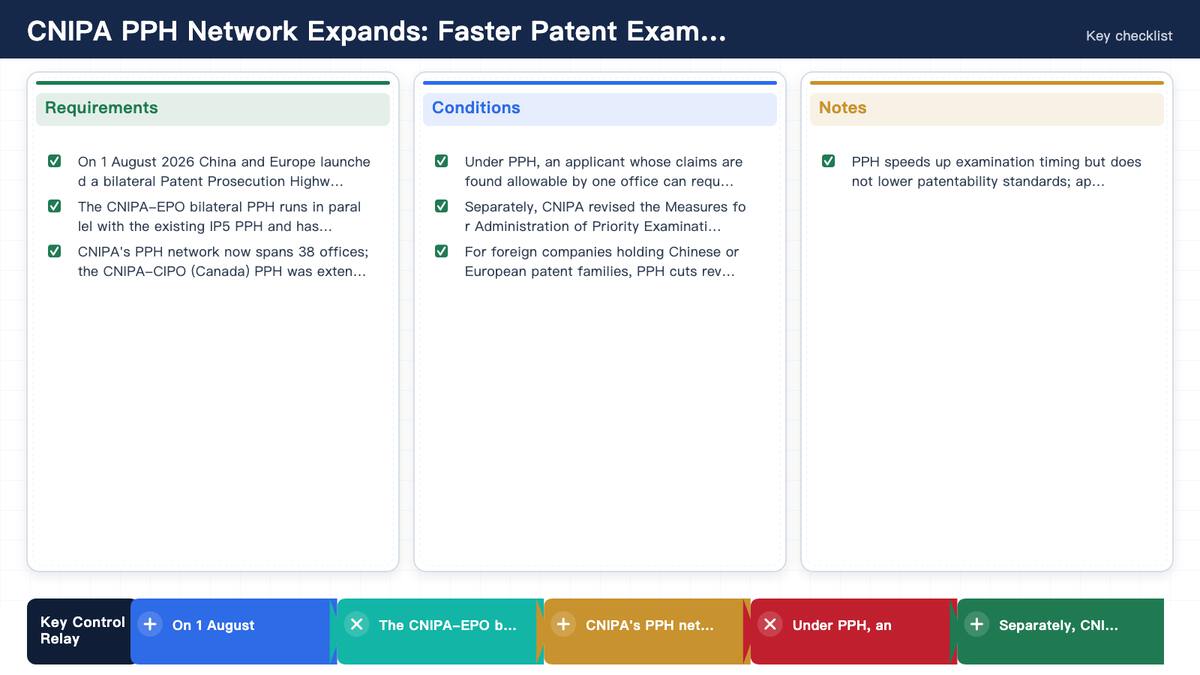
- On 1 August 2026 China and Europe launched a bilateral Patent Prosecution Highway (PPH) pilot, while a separate PPH pilot between CNIPA and Indonesia’s DGIP also took effect the same day.
2026年8月1日,中国与欧洲的双边专利审查高速路(PPH)试点正式启动,同日中国国家知识产权局与印度尼西亚司法部知识产权总司之间的PPH试点项目也同步生效。
- The CNIPA-EPO bilateral PPH runs in parallel with the existing IP5 PPH and has no fixed end date, giving European and Chinese applicants a faster route to aligned patent protection.
中欧双边PPH与既有的IP5 PPH并行运行,未设定固定终止日期,为欧洲与中国申请人提供了更快的专利保护协同通道。
- CNIPA’s PPH network now spans 38 offices; the CNIPA-CIPO (Canada) PPH was extended for five more years from 1 September 2026 to 31 August 2031.
国家知识产权局PPH合作网络已覆盖38个专利审查机构;中加(拿大)PPH试点自2026年9月1日起再延长五年,至2031年8月31日。
- Under PPH, an applicant whose claims are found allowable by one office can request accelerated examination at the other office using the earlier search and examination results.
在PPH机制下,申请人的权利要求若已在一个审查机构被认定可授权,即可依据在先检索与审查结果,向另一机构申请加快审查。
- Separately, CNIPA revised the Measures for Administration of Priority Examination of Patents (Order No. 85), effective 1 September 2026, prioritising emerging, future and core-technology industries.
此外,国家知识产权局修订发布《专利优先审查管理办法》(局令第85号),自2026年9月1日起施行,优先支持新兴产业、未来产业与关键核心技术攻关。
- For foreign companies holding Chinese or European patent families, PPH cuts review cycles and costs, and strengthens patent certainty before entering commercial licensing or litigation.
对持有中国或欧洲专利族的外资企业而言,PPH可压缩审查周期、降低费用,并在进入商业许可或诉讼前增强专利确定性。
- PPH speeds up examination timing but does not lower patentability standards; applicants must still verify eligibility, claim correspondence and the applicable request guidelines case by case.
PPH改变的是审查节奏而非授权标准;申请人仍须逐案核验适用条件、权利要求对应关系及对应PPH请求指南。
CNIPA PPH Network Expands: Faster Patent Examination for Foreign Applicants in 2026 | 国家知识产权局PPH网络扩容:2026年外资申请人的专利快速审查新通道
Why this matters now
For a multinational enterprise with parallel patent families in China and overseas, one of the most persistent pain points has been the gap between when a patent becomes commercially critical and when the Chinese examination is finished. Two CNIPA announcements in August 2026 directly address that friction. On 1 August 2026, the bilateral PPH pilot between the China National Intellectual Property Administration (CNIPA) and the European Patent Office (EPO) officially commenced, and on the same day the CNIPA-DGIP PPH pilot with Indonesia’s Directorate General of Intellectual Property also launched. Both run alongside the long-standing IP5 PPH framework, giving applicants in those corridors a dedicated, predictable fast track. The CNIPA-CIPO PPH with Canada was extended for another five years from 1 September 2026. For European, Southeast Asian and Canadian investors in China, the practical message is simple: the Chinese side of a global patent family can now move noticeably faster.
What the new pilots actually change
PPH is a work-sharing mechanism between patent offices. When the office of first filing has determined that at least one claim in an application is allowable, the applicant can ask the office of second filing to use that earlier search and examination result to accelerate the corresponding application. The CNIPA-EPO bilateral pilot is deliberately additive rather than replacing: it coexists with the IP5 PPH, applies the same substantive conditions, and — unlike the original time-boxed trials — has no fixed termination date, although it can still be suspended, amended or ended by mutual agreement. For a European company, this means that a favourable examination outcome obtained at the EPO can be carried into CNIPA examination, and vice versa for Chinese applicants filing at the EPO. The CNIPA-DGIP pilot with Indonesia similarly opens a fast track into the fast-growing ASEAN market, useful for companies building supply chains across Southeast Asia.
The wider 2026 procedural picture
The PPH expansion lands in the middle of a broader modernisation of Chinese examination tools. On 30 July 2026, CNIPA issued the revised Measures for Administration of Priority Examination of Patents (Order No. 85), effective 1 September 2026. The revised measures tilt priority examination towards emerging industries, future industries and key core-technology breakthroughs, stress innovation value and transformation prospects, and tighten the procedure: invention requests must be filed during substantive examination before the first office action, the response deadline for applicants in priority examination is shortened from two months to one, and the circumstances for refusing or terminating priority treatment are clarified. Integrity constraints were added as well — requesters or agencies found violating good-faith principles can be barred from filing priority-examination requests for one year. Where PPH addresses the international pipeline, priority examination addresses the domestic one; together they compress the time from filing to grant.
Practical steps for foreign applicants
- Map the family. Identify which counterpart applications have already received an allowable opinion abroad (EPO, DGIP or an IP5 office) and which Chinese applications correspond to them.
- Check eligibility. Confirm the earliest priority date, the one-to-one claim correspondence, and whether usable national or PCT work product exists.
- File the PPH request properly. Submit it to CNIPA under the bilateral pilot rules for the relevant corridor; the request procedure and fees mirror existing PPH practice.
- Consider priority examination for strategic filings. For key-core and emerging-technology cases, the revised 2026 measures offer a domestic fast track with new integrity and timing rules to respect.
- Budget for acceleration. Neither PPH nor priority examination adds official fees for the basic request, but response deadlines tighten, so plan attorney capacity.
- Track and maintain. Because PPH changes timing but not standards, keep quality-focused drafting and portfolio maintenance discipline throughout.
Risks and compliance notes
PPH should not be mistaken for an easier grant. Accelerated cases go through the same substantive examination; using work product from one office is a time-saver, not a standards waiver. Foreign applicants should also be careful with the tightened priority-examination deadlines — a one-month response window demands prompt instructions. Finally, because CNIPA has expanded to 38 PPH partners, multinationals should review which of their corridors now qualify, since the cost of ignoring an available fast track is measured in lost market lead time for products and licensing positions.
国家知识产权局PPH网络扩容:2026年外资申请人的专利快速审查新通道
为什么当下重要
对在中国与海外同时布局专利族的大型跨国企业而言,最常见的痛点之一,是专利变得具有商业价值的时间与国内审查完成的时间之间存在的落差。国家知识产权局(CNIPA)2026年8月的两项公告直接回应了这种摩擦。2026年8月1日,中国国家知识产权局与欧洲专利局(EPO)之间的双边专利审查高速路(PPH)试点正式启动;同一天,中印(尼)专利审查高速路(CNIPA-DGIP PPH)试点也正式生效。二者与长期运行的IP5 PPH框架并行,为这些通道的申请人提供了专门、可预期的快速路径。中国与加拿大之间的PPH试点自2026年9月1日起再延长五年。对在华投资的欧洲、东南亚及加拿大企业而言,实际含义十分直白:全球专利族中的中国侧审查,现在可以明显更快。
新试点究竟改变了什么
PPH是审查机构之间的工作共享机制。当首次审查机构已认定申请中至少一项权利要求可以授权时,申请人可以请求后续审查机构利用此前的检索与审查结果,对相应申请进行加快审查。中欧双边PPH试点是刻意做”增量”而非”替代”:它与IP5 PPH并存,适用相同实质性条件,并且与早期设定期限的试验不同,不设固定终止日期,但仍可经双方同意暂停、修改或提前终止。对欧洲企业而言,这意味着在EPO获得的有利审查结论可以被带入CNIPA审查,反之亦然,中方申请人在EPO提出申请时同样适用。与印尼DGIP的PPH试点则为增长迅速的东盟市场打开了快速通道,对在东南亚建设供应链的企业尤其有用。
2026年更宏观的程序图景
PPH扩容正好发生在中国审查工具整体现代化的过程中。2026年7月30日,国家知识产权局发布修订后的《专利优先审查管理办法》(局令第85号),自2026年9月1日起施行。修订后的办法将优先审查向新兴产业、未来产业与关键核心技术攻关倾斜,强调创新价值与转化前景,并收紧程序:发明专利申请须在实质审查阶段且尚未作出首次处理时提出请求;优先审查中申请人答复审查意见的期限由两个月缩短为一个月;并细化了不予优先审查与终止优先审查的情形。办法还增加了诚信约束——违反诚信原则的请求人或代理机构,可能一年内被停止受理优先审查请求。如果说PPH解决的是国际管线,那么优先审查解决的是国内管线;二者合力压缩从申请到授权的整体周期。
外资申请人的操作步骤
- 梳理专利族。 找出哪些对应申请已在海外(EPO、DGIP或任一IP5机构)获得可授权意见,以及哪些中国申请与其对应。
- 核验条件。 确认最早优先权日、权利要求一一对应关系,以及是否存在可用的国家或PCT工作成果。
- 正确提出PPH请求。 按相关通道的双边试点规则向国家知识产权局提交请求;请求程序与费用与既有PPH实践一致。
- 战略性申请可考虑优先审查。 对关键核心技术与新兴产业案件,2026年修订办法提供了国内快速通道,但须遵守新的诚信与时限规则。
- 为加速做好准备。 PPH与优先审查的基本请求均不另收官方费用,但答复期限收紧,须提前规划代理能力。
- 跟踪与维护。 因为PPH改变的是节奏而非标准,应始终保持以质量为导向的撰写与组合维护纪律。
风险与合规提示
PPH不应被误解为更容易授权。加速案件仍要经历相同的实质审查;利用某一机构的工作成果只是节省时间,不是降低标准。外资申请人还应注意收紧后的优先审查期限——一个月的答复窗口要求及时作出指示。最后,由于国家知识产权局的PPH合作伙伴已达38个,跨国企业应重新审视哪些通道现在符合条件,因为忽视可用的快速通道,其代价是以产品上市与许可地位的市场领先时间衡量的。
Sources
- 国家知识产权局(CNIPA)英文官网”Official Information”栏目:CNIPA-DGIP PPH试点、CNIPA-EPO PPH试点2026-08-01启动,CNIPA-CIPO试点延长(2026-08-06发布):<https://english.cnipa.gov.cn/col/col1340/index.html?pageNum=1&uid=14154>
- 中国知识产权报/中国知识产权资讯网《中欧、中印(尼)专利审查高速路试点8月1日启动》:<https://www.iprchn.com/cipnews/news_content.aspx?newsId=147780>
- 商务部中国保护知识产权网《中欧专利审查高速路试点将于2026年8月1日启动》(转载国家知识产权局信息):<https://ipr.mofcom.gov.cn/article/gjxw/gbhj/om/oum/202608/1997250.html>
- 国家知识产权局2026年7月30日公布《专利优先审查管理办法》(局令第85号,2026-09-01施行):<https://www.cnipa.gov.cn/art/2026/7/30/art_99_207525.html>