
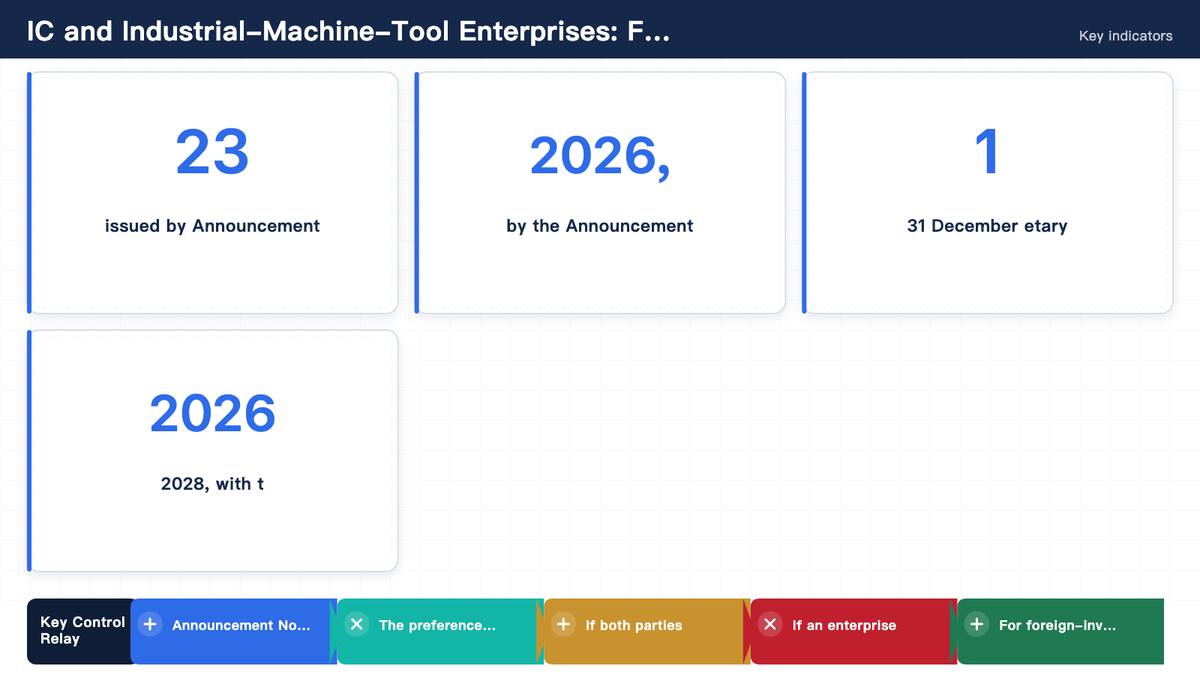
- Announcement No. 23 of 2026, jointly issued by the Ministry of Finance, the State Taxation Administration, the NDRC and the MIIT, lets IC and industrial-machine-tool enterprises defer income tax on non-monetary asset exchanges over up to five years.
财政部、税务总局、国家发展改革委、工业和信息化部 2026 年第 23 号公告允许集成电路企业、工业母机企业将非货币性资产交换所得在不超过 5 年期限内分期均匀计入应纳税所得额。
- The preference applies to non-monetary asset exchanges occurring between 1 January 2026 and 31 December 2028, with the recognised gain spread evenly across no more than five years.
优惠适用于 2026 年 1 月 1 日至 2028 年 12 月 31 日期间发生的非货币性资产交换,确认的所得可在不超过 5 年期限内分期均匀计入。
- If both parties to the exchange are IC or industrial-machine-tool enterprises, both may enjoy the preferential treatment; losses from such exchanges may not be deferred.
若交换双方均为集成电路企业、工业母机企业,双方均可享受本公告规定的税收优惠;交换所发生的损失不得分期确认。
- If an enterprise transfers an asset acquired in the exchange within five years, it must stop the deferral and settle all deferred tax in the annual filing of the year of transfer.
企业 5 年内转让所取得资产的,应停止执行分期纳税政策,并就尚未确认的交换所得在转让当年汇算清缴时一次性缴纳企业所得税。
- For foreign-invested semiconductor and machine-tool companies, the rule aligns with the broader trend of extended tax support for the integrated-circuit and high-end equipment sectors.
对外资半导体与机床企业而言,该规则与集成电路及高端装备行业持续扩展的税收支持趋势一致。
IC and Industrial-Machine-Tool Enterprises: Five-Year Deferral for Non-Monetary Asset Exchange Gains (Announcement No. 23 of 2026) | 集成电路与工业母机企业:非货币性资产交换所得可五年分期纳税(2026 年第 23 号公告)
Why this matters now
On 14 August 2026, the Ministry of Finance, the State Taxation Administration, the National Development and Reform Commission and the Ministry of Industry and Information Technology published Announcement No. 23 of 2026 on the corporate income tax treatment of non-monetary asset exchanges by integrated-circuit (IC) and industrial-machine-tool enterprises. Issued on 31 July 2026, the Announcement allows qualifying enterprises to spread the gain recognised on a non-monetary asset exchange evenly into taxable income over a period of up to five years for exchanges occurring between 1 January 2026 and 31 December 2028. For the IC and high-end machine-tool sectors — where asset exchanges, in-kind contributions and consolidation are common as enterprises restructure capacity — the rule materially improves cash-flow timing and reduces the tax cost of restructuring.
What the Announcement provides
The core rule is that an IC enterprise or industrial-machine-tool enterprise that engages in a non-monetary asset exchange during 2026–2028 may recognise the exchange gain arising under the current rules and spread it evenly into the taxable income of no more than five tax years, then pay CIT on it under the standard rules. The following points matter.
First, the gain is computed as the fair value of the non-monetary asset received in the exchange, less the tax basis of the asset given out and related taxes and fees. Second, the asset received takes as its tax basis its fair value plus the taxes and fees paid in the exchange. Third, where the exchange involves a mix of monetary and non-monetary consideration, only the part of the gain corresponding to the non-monetary-for-non-monetary exchange may use the deferral; the part corresponding to the receipt of monetary consideration follows the normal rules and cannot be deferred. Fourth, losses arising from a non-monetary asset exchange cannot be spread over multiple years. Fifth, if both parties to the exchange are IC or industrial-machine-tool enterprises, both may benefit from the deferral. Sixth, anti-abuse rule: if an enterprise transfers an asset it acquired in a deferred exchange within five years, it must stop the deferral and pay all unrecognised exchange gain in a lump sum in the annual CIT filing of the year of transfer.
The Announcement defines non-monetary assets by exclusion: cash, deposits, accounts receivable, notes receivable and held-to-maturity bond investments are monetary assets; everything else is non-monetary.
How it applies to foreign-invested enterprises
Foreign-invested enterprises operating in the IC sector — wafer fabrication, packaging and testing, design houses with qualifying status — and manufacturers of high-end industrial machine tools (including CNC machines and key components) should examine whether they qualify for the IC-enterprise and machine-tool-enterprise determinations under the relevant industry catalogues. For such companies, the deferral is operationally useful in at least three situations: contributing assets to a new Chinese subsidiary or joint venture in exchange for equity; restructuring manufacturing capacity by exchanging production lines or facilities with a partner; and in-kind investment in supply-chain or R&D entities. Because the deferral is elective in effect (the enterprise recognises and spreads the gain itself, with the five-year cap), financial teams should model the cash-flow benefit and the conditions under which the five-year window is safe — particularly the anti-abuse transfer rule, which accelerates all deferred tax if the acquired asset is transferred within five years.
Practical steps
- Confirm qualifying status. Verify that your entity is determined to be an IC enterprise or industrial-machine-tool enterprise under the applicable catalogues administered by the NDRC, MIIT and tax authorities.
- Scope the exchange. Check whether the transaction is a non-monetary asset exchange under the Announcement, and separate any monetary consideration, which cannot be deferred.
- Compute the deferred gain correctly. Use the fair value of the asset received less the tax basis of the asset transferred plus related taxes and fees; set the tax basis of the asset received accordingly.
- Model the five-year schedule. Spread the gain evenly, and track the schedule carefully so that if the asset is transferred within five years, the accelerated tax payment is provisioned for.
- Keep the exchange documented. Records of valuation, the exchange agreement and the tax-basis calculation support the filing position and answer any inspection questions.
- Coordinate with other incentives. Where the enterprise also benefits from other IC or machine-tool preferences (such as special deductions or preferential rates), ensure the interaction is consistent.
Compliance notes
The Announcement is a deferral, not an exemption: the deferred gain is ultimately taxed, and the timing benefit is lost (with full acceleration) if the acquired asset is disposed of within five years. Enterprises must follow the applicable annual-filing and documentation requirements, and the loss rules are deliberately non-symmetric — a loss on such an exchange must be recognised in full under the normal rules. Because the determination of IC-enterprise and machine-tool-enterprise status sits with specific catalogues and administrative processes, foreign investors should confirm status with the relevant authorities or with qualified advisers before relying on the benefit.
集成电路与工业母机企业:非货币性资产交换所得可五年分期纳税(2026 年第 23 号公告)/ IC and Industrial-Machine-Tool Enterprises: Five-Year Deferral for Non-Monetary Asset Exchange Gains (Announcement No. 23 of 2026)
为什么当下重要
2026 年 8 月 14 日,财政部、税务总局、国家发展改革委、工业和信息化部发布关于集成电路企业、工业母机企业非货币性资产交换企业所得税政策的公告(2026 年第 23 号)。该公告于 2026 年 7 月 31 日成文,允许符合条件的企业对 2026 年 1 月 1 日至 2028 年 12 月 31 日期间发生的非货币性资产交换,将按现行规定确认的交换所得在不超过 5 年期限内分期均匀计入应纳税所得额。对集成电路与高端机床行业——企业重组产能时常涉及资产置换、实物出资与整合——该规则显著改善现金流时点,降低重组税务成本。
公告的核心内容
核心规则是:集成电路企业或工业母机企业于 2026–2028 年期间发生非货币性资产交换,按现行规定确认的交换所得,可在不超过 5 年期限内分期均匀计入相应年度的应纳税所得额,再按现行政策计算缴纳企业所得税。以下要点值得注意。
其一,交换所得的计算:以换入非货币性资产的公允价值,扣除换出非货币性资产的计税基础及相关税费后的余额确认。其二,换入资产的计税基础为其公允价值加上支付的相关税费。其三,交易同时涉及货币性资产时,仅与”以非货币性资产换入非货币性资产”部分相对应的所得可适用分期纳税;以非货币性资产换入货币性资产的部分按正常规则确认所得或损失,不得享受分期。其四,交换发生的损失不得分期确认。其五,若交换双方均为集成电路企业、工业母机企业,双方均可享受。其六,反滥用规则:企业在 5 年内转让分期纳税所取得资产的,应停止执行分期,并就尚未确认的交换所得在转让当年的企业所得税年度汇算清缴时一次性缴纳。
公告以排除法界定非货币性资产:现金、存款、应收账款、应收票据以及准备持有至到期的债券投资等为货币性资产;其余为非货币性资产。
对外资企业的适用
在集成电路领域运营的外资企业——晶圆制造、封装测试、具资格的芯片设计公司——以及高端工业母机(含数控机床与关键部件)制造商,应核查是否依相关产业目录取得集成电路企业、工业母机企业认定。对此类公司,分期纳税在至少三种情形下具有操作价值:以资产作价出资设立境内子公司或合资企业换取股权;通过与伙伴置换生产线或设施重组制造产能;对供应链或研发实体的实物投资。由于分期在效果上是选择性的(企业自行确认并分期,5 年为上限),财务团队应测算现金流收益以及 5 年窗口安全的条件——特别是反滥用转让规则,若 5 年内转让所取得资产,将加速缴纳全部递延税款。
操作步骤
- 确认资格。 核验本主体是否依 NDRC、工信部与税务部门管理的适用目录被认定为集成电路企业或工业母机企业。
- 界定交换范围。 核查交易是否属于公告所指非货币性资产交换,并拆分任何货币性对价——该部分不得递延。
- 正确计算递延所得。 用换入资产公允价值减去换出资产计税基础及相关税费;相应确定换入资产计税基础。
- 测算五年进度。 均匀分摊所得并审慎跟踪进度,若 5 年内转让资产,须为加速纳税计提准备。
- 留存交换文档。 估值、交换协议与计税基础计算记录支撑申报立场并应对检查。
- 与其他优惠协同。 若企业同时享受其他集成电路或机床优惠(如加计扣除、优惠税率),确保衔接一致。
合规提示
公告提供的是递延而非免税:递延所得最终仍须纳税,若 5 年内处置换入资产,将失去时间价值并全额加速补缴。企业须遵循相应年度申报与文档要求;损失规则刻意不对称——此类交换的损失须按正常规则全额确认。由于集成电路企业、工业母机企业认定依赖特定目录与行政程序,外资投资者在依赖该利益前,应通过主管机关或合格顾问确认资格。
Sources
- 国家税务总局政策法规库《财政部 税务总局 国家发展改革委 工业和信息化部关于集成电路企业、工业母机企业非货币性资产交换企业所得税政策的公告》(2026年第23号):https://fgk.chinatax.gov.cn/zcfgk/c102416/c5251766/content.html
- 国家税务总局江苏省税务局《财政部 税务总局 国家发展改革委 工业和信息化部关于集成电路企业、工业母机企业非货币性资产交换企业所得税政策的公告》:https://jiangsu.chinatax.gov.cn/art/2026/7/31/art_23636_13201.html
- 国家税务总局上海市税务局《关于集成电路企业、工业母机企业非货币性资产交换企业所得税政策的公告》:https://shanghai.chinatax.gov.cn/gate/big5/shanghai.chinatax.gov.cn/zcfw/zcfgk/qysds/202608/t481290.html