
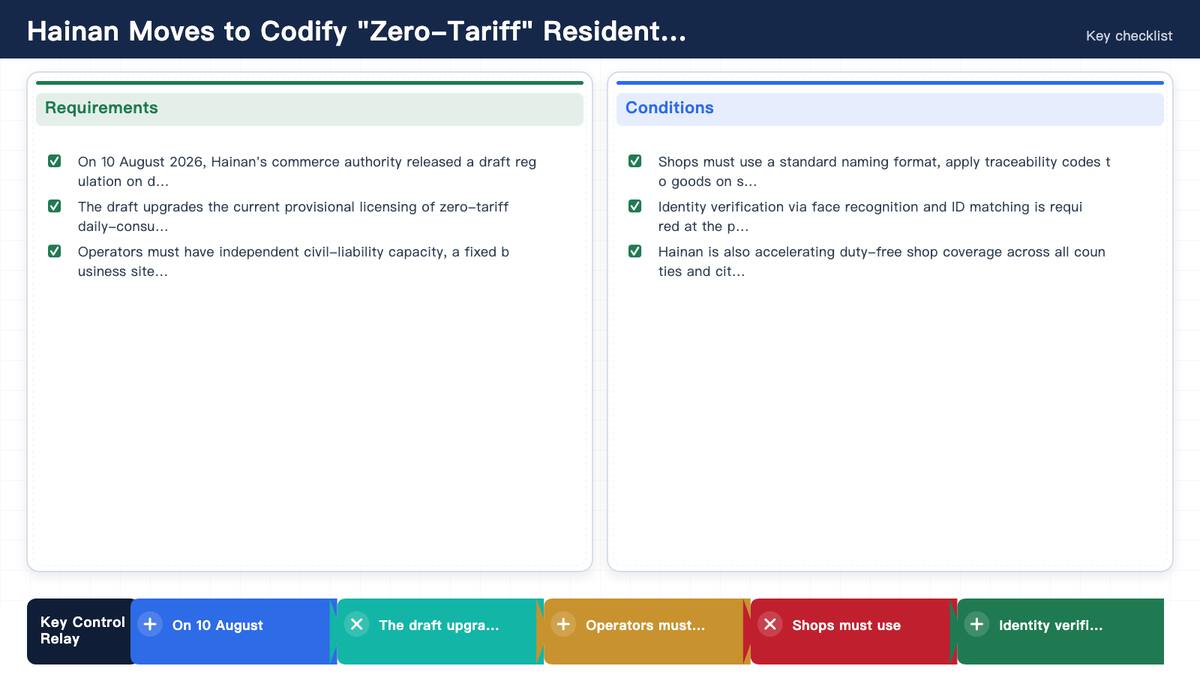
- On 10 August 2026, Hainan’s commerce authority released a draft regulation on duty-free shops selling “zero-tariff” daily consumer goods to island residents, seeking public comment until 8 September 2026.
2026 年 8 月 10 日,海南省商务厅公布《海南自由贸易港岛内居民消费”零关税”进境商品经营主体及免税店管理规定(征求意见稿)》,向社会公开征求意见至 2026 年 9 月 8 日。
- The draft upgrades the current provisional licensing of zero-tariff daily-consumption retail into a standing statutory licensing regime, with defined operator qualifications and shop rules.
征求意见稿拟把现行临时性许可升级为常态化法定许可,明确”零关税”日用消费品经营资格与免税店经营规范。
- Operators must have independent civil-liability capacity, a fixed business site in Hainan, at least one full year of retail operation, and sound financial, traceability, data-security and internal-audit systems.
经营主体须具备独立民事责任能力、在海南拥有固定经营场所、零售业务持续经营不少于一个完整自然年度,并具备健全的财务核算、商品溯源、数据安全与内部审计制度。
- Shops must use a standard naming format, apply traceability codes to goods on sale, and push sales data in real time to the province’s supervisory and customs platforms.
免税店须采用规范冠名格式,在售商品加贴专属溯源码,并向社会管理信息化平台、海关监管平台等实时推送销售数据。
- Identity verification via face recognition and ID matching is required at the point of sale, and reselling or arbitraging zero-tariff goods is explicitly prohibited.
销售环节须通过人脸识别、人证比对核验购买人身份;严禁倒卖、套利”零关税”商品。
- Hainan is also accelerating duty-free shop coverage across all counties and cities this year, while broader investment-and-financing reform encourages both foreign and private capital into FTP projects.
海南正加快免税店布局、力争年内实现全省各市县全覆盖;同时深化投融资改革,鼓励外资与民间资本参与自贸港项目。
Hainan Moves to Codify “Zero-Tariff” Resident Duty-Free Shops: Draft Rules and Business Opportunities (August 2026) | 海南推动”零关税”岛内居民免税店成文化:征求意见稿与商业机会(2026 年 8 月)
Why this matters now
On 10 August 2026, the Hainan Provincial Department of Commerce published the draft Regulations on Operators and Duty-Free Shops for “Zero-Tariff” Inbound Goods Consumed by Island Residents (《海南自由贸易港岛内居民消费”零关税”进境商品经营主体及免税店管理规定(征求意见稿)》) and opened a public-comment period running to 8 September 2026. The draft converts the temporary licensing regime for zero-tariff daily-consumption retail — which operated on an experimental basis after Hainan’s island-wide customs closure on 18 December 2025 — into a standing statutory licensing scheme with hard operator qualifications, shop rules, traceability requirements and enforcement teeth. Coming alongside the province’s push to put duty-free shops in every county and city within the year, the draft is the clearest signal yet of how Hainan intends to institutionalise the “island-resident consumption” pillar of its free-trade-port policy.
What the draft provides
The draft (seven chapters, 36 articles) sets out the operating-qualification regime, the procedures for establishing shops, operating standards, supervision and legal responsibility. The key elements are as follows.
First, zero-tariff daily-consumption retail is to be operated under licence, with the commerce department leading supervision, the anti-smuggling comprehensive governance body leading anti-smuggling work, customs supervising the goods and duty-free shops, and market-regulation, public-security, coast-guard and postal authorities playing their defined roles.
Second, operator eligibility is concrete. An applicant must have independent civil-liability capacity, a fixed business site in Hainan, stable operation and management capacity, at least one full natural year of continuous retail operation, sound systems for financial accounting, commodity traceability, data security and internal audit, and good credit standing.
Third, shop operating standards are standardised. All shops must adopt the naming format of “city/county/autonomous-county name + trade name + daily-consumption duty-free shop + address”. Shops must maintain complete purchase-sale-inventory and in/out warehouse ledgers, connect to the multi-department information system of commerce, customs, tax and public security, and push sales data in real time to Hainan’s social-management information platform, public-service platform and customs supervision platform. Goods on sale must carry a traceability code, with traceable categories managed by list.
Fourth, consumer purchase controls are strict. Shops must verify purchaser identity through face recognition and ID matching, ensure person-and-certificate consistency, refuse sales to non-qualified individuals, display anti-smuggling warnings, and warn buyers whose purchase volumes clearly exceed reasonable personal-use quantities about the legal consequences of resale.
Fifth, enforcement is layered. Supervisory authorities may conduct on-site inspections, retain contracts, invoices and ledgers, seal and seize suspected smuggled goods, and pursue resellers and arbitrageurs. The draft also sets up credit-records and joint-punishment mechanisms.
Implications for foreign and private investors
For foreign-invested enterprises, the draft matters in three ways. First, it defines a licensing path into a fast-growing retail segment: Hainan is adding duty-free shops across all counties and cities within the year, and duty-free shopping is being positioned as the province’s signature consumption sector. Second, the operator requirements — stable retail history, fixed premises, financial and traceability systems — are transparent and achievable for established retail operators, including international brand supply chains and licensed operators. Third, the zero-tariff mechanics create real margin dynamics: qualifying daily-consumption goods enter duty-free for island residents, and foreign brands that supply these shops can benefit from the province’s global-consumption-centre push. Separate but related, Hainan’s August investment-and-financing reform document encourages foreign-capital and private-capital participation in FTP projects and the establishment of market-oriented foreign-investment service agencies, so the regulatory clarity on duty-free retail complements a broader opening agenda.
Practical steps
- Review the draft and submit comments. Operators and brand owners can send written opinions to the Department of Commerce before 8 September 2026; substantive comments can shape the final rules.
- Map eligibility early. If you plan to operate or supply duty-free shops, assess whether your entity meets the retail-history, site, financial and traceability requirements, or whether a licensed partner is the faster route.
- Prepare traceability and data interfaces. The final rules will require ledger systems and real-time data pushes to Hainan’s supervision platforms; start architectural planning now.
- Assess brand positioning. For consumer brands, inclusion in the zero-tariff daily-consumption list and duty-free shop shelves is a channel decision with pricing and compliance dimensions.
- Align with investment support. Combine the duty-free opportunity with Hainan’s investment-incentive frameworks and the province’s reform agenda for foreign and private capital.
Compliance notes
The draft is not yet law; the public-comment period runs to 8 September 2026 and the final version may differ. Until the standing regulation is adopted, the provisional regime continues. Operators should also remember that “zero-tariff” applies to goods entering Hainan under the positive-list mechanism for island-resident consumption, and that the anti-smuggling and resale prohibitions carry significant penalties. Finally, duty-free retail in Hainan sits alongside the separate outlying-island (offshore) duty-free regime for departing travellers; the two channels have different buyers, rules and licences, and should not be conflated in planning.
海南推动”零关税”岛内居民免税店成文化:征求意见稿与商业机会(2026 年 8 月)/ Hainan Moves to Codify “Zero-Tariff” Resident Duty-Free Shops: Draft Rules and Business Opportunities (August 2026)
为什么当下重要
2026 年 8 月 10 日,海南省商务厅公布《海南自由贸易港岛内居民消费”零关税”进境商品经营主体及免税店管理规定(征求意见稿)》,面向社会公开征求意见至 2026 年 9 月 8 日。征求意见稿拟把全岛封关运作(2025 年 12 月 18 日启动)后按试点方式运行的”零关税”日用消费品零售临时许可,升级为具有硬性经营资格、门店规则、溯源要求与执法力度的常态化法定许可。结合海南”力争年内实现全省各市县免税店全覆盖”的部署,这份征求意见稿是海南将自贸港”岛内居民消费”支柱制度化的最清晰信号。
征求意见稿的主要内容
征求意见稿共七章三十六条,对经营资格、免税店设立程序、经营规范、监督管理和法律责任作出安排。要点如下。
一是”零关税”日用消费品零售实行许可管理。商务部门牵头监管,”零关税”反走私综合治理机构牵头反走私,海关监管货物与免税店,市场监管、公安、海警、邮政按职责分工查处流通环节违法。
二是经营资格门槛明确。申请主体须具备独立民事责任能力,在海南拥有固定经营场所,具备稳定经营与管理能力,零售业务持续经营不少于一个完整自然年度,拥有健全的财务核算、商品溯源、数据安全、内部审计及风险防控制度,且信用状况良好。
三是门店经营标准化。免税店统一采用”市、县、自治县名称+字号+日用消费品免税店+地址”冠名格式;建立完整购销存、出入库台账,对接商务、海关、税务、公安等多部门信息化监管体系,实时向海南社会管理信息化平台、公共服务平台、海关监管平台推送销售数据;在售商品按规定加贴专属溯源码,可溯源品类清单化管理。
四是购买环节严格核验。免税店须通过人脸识别、人证比对等技术核验购买人身份,严禁向不符合资质的个人售卖;门店须设置反走私警示标识;购买数量明显超出个人合理自用范围的,须告知倒卖套利的法律后果。
五是执法与惩戒分层。监管部门可现场检查、调取留存合同票据账簿电子数据,对涉嫌走私、无合法来源商品依法查封扣押;并对倒卖套利者建立失信名单联合惩戒。
对外资与民间投资者的意义
对外资企业,征求意见稿的意义有三。其一,它为快速增长的零售细分提供许可路径:海南年内将免税店铺到各市县,免税购物被定位为全省标志性消费板块。其二,经营要求——稳定零售历史、固定场所、财务与溯源体系——透明且对成熟零售运营商(包括国际品牌供应链与持牌运营商)可实现。其三,零关税机制创造真实毛利动态:符合资格的日用消费品对岛内居民免税入境,供应这些门店的外国品牌可受益于海南打造全球消费中心的努力。相关但独立的是,海南 8 月的投融资改革文件鼓励外资与民间资本参与自贸港项目、设立市场化外商投资服务机构,因此免税零售的监管清晰化与更广泛的开放议程相互配套。
操作步骤
- 研读征求意见稿并提出意见。 运营商与品牌方可在 9 月 8 日前向省商务厅提交书面意见,实质性建议可能影响最终规则。
- 尽早评估资格。 若计划运营或供应免税店,评估本主体是否满足零售历史、场所、财务与溯源要求,或与持牌伙伴合作是否更快。
- 准备溯源与数据接口。 最终规则将要求台账系统与向海南监管平台实时推送数据,现在即可启动架构规划。
- 评估品牌定位。 对消费品品牌而言,进入”零关税”日用消费品清单与免税店货架是有定价与合规维度的渠道决策。
- 与投资支持衔接。 将免税机会与海南的投资激励框架及省内外资、民间资本改革议程结合。
合规提示
征求意见稿尚未生效;征求意见期至 2026 年 9 月 8 日,最终版本可能不同。在常设规定通过前,临时制度继续适用。经营者还应记住,”零关税”适用于按正面清单管理、供岛内居民消费的进境商品,反走私与禁转卖条款处罚显著。最后,海南岛内居民免税零售与面向离岛旅客的离岛免税是两套体系,购买人、规则与牌照均不同,规划时不应混淆。
Sources
- 海南省商务厅《关于征求〈海南自由贸易港岛内居民消费”零关税”进境商品经营主体及免税店管理规定(征求意见稿)〉意见的公告》:https://dofcom.hainan.gov.cn/u/solicitation/754FF78FF8D89E709D4E7E4E1A0A1B35?ddtab=true
- 海南省商务厅《海南:加快日用消费品免税店布局,力争年内实现全省各市县全覆盖》(2026-08-13):https://dofcom.hainan.gov.cn/dofcom/xctp/202608/5d0c0b3f00664f55ab0d7215bf388d5a.shtml
- 海口市外事办公室《〈海南自由贸易港岛内居民消费”零关税”进境商品经营主体及免税店管理办法(试行)〉解读》:https://wsb.haikou.gov.cn/hkswsb/zxjd/202608/ed71906af8934baa98e5b05af0ab29b1.shtml
- 三亚市投资促进局《海南深化投融资改革,汇聚资本合力建设自贸港》:https://syipb.sanya.gov.cn/tzcjjsite/zxzx/202608/5fa3e0715afb48968204613415e123b4.shtml