
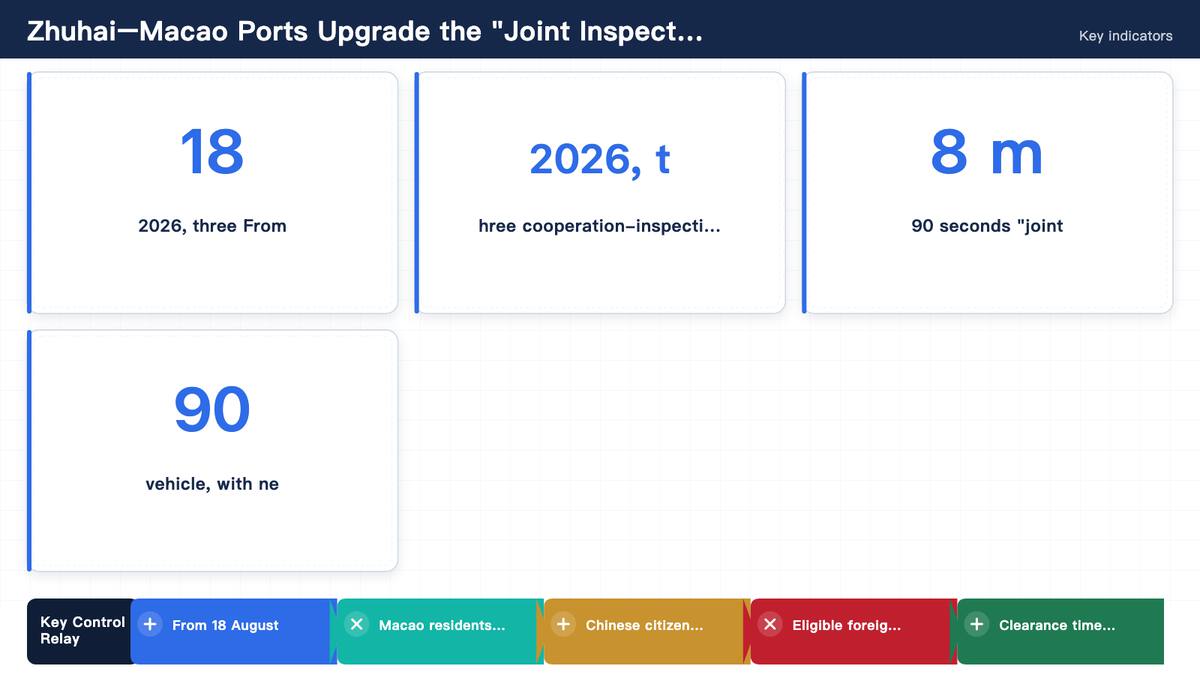
- From 18 August 2026, three cooperation-inspection ports — Hong Kong–Zhuhai–Macao Bridge, Hengqin and Qingmao — introduced three measures optimising the “joint inspection, one-stop release” model.
自 2026 年 8 月 18 日起,港珠澳大桥、横琴、青茂三个合作查验口岸实施优化”合作查验、一次放行”查验模式的三项便利措施。
- Macao residents and Hong Kong permanent residents may now use their Home Return Permit (including the non-Chinese-national version) in both directions at the cooperation fast lanes, realising “one-card clearance”.
澳门居民与香港永久性居民经合作快捷通道可双向交验回乡证(含非中国籍),实现”一证通关”。
- Chinese citizens holding a one-year multi-entry exit-entry permit can use the cooperation fast lanes at the Hong Kong–Zhuhai–Macao Bridge and Hengqin ports after completing e-channel filing.
持一年多次有效出入境通行证的中国公民,在办妥快捷通关备案后,可经港珠澳大桥珠澳查验大厅、横琴口岸合作快捷通道通行。
- Eligible foreigners and Taiwan residents may now drive through the “joint one-stop” lane at Hengqin port after filing, broadening the lane beyond Hong Kong and Macao residents.
符合条件的外国人与台湾居民在办妥备案后,可以驾车经横琴口岸”联合一站式”车道通行,通行人群大幅拓宽。
- Clearance time at the Hengqin “joint one-stop” lane has been cut from 8 minutes to under 90 seconds per vehicle, with the fastest at about 50 seconds.
横琴口岸”联合一站式”车道单台车通关时间已从 8 分钟压缩至 90 秒以内,最快约 50 秒。
- Traffic through the three ports reached 42 million person-trips in H1 2026, up 12.8% year on year, showing the corridor’s growing role for regional business travel.
2026 年上半年经三个口岸出入境客流累计达 4200 万人次,同比增长 12.8%,显示该通道对区域商务往来的作用日益增强。
Zhuhai–Macao Ports Upgrade the “Joint Inspection, One-Stop Release” Model: What It Means for Greater Bay Area Travel (August 2026) | 珠海—澳门口岸升级”合作查验、一次放行”模式:对粤港澳大湾区往来意味着什么(2026 年 8 月)
Why this matters now
On 18 August 2026, with approval from the Exit-Entry Administration and after coordination between the Zhuhai General Station of Exit-Entry Frontier Inspection and the Macao Public Security Police Force, three cooperation-inspection ports — Hong Kong–Zhuhai–Macao Bridge, Hengqin and Qingmao — began implementing three facilitation measures under the “joint inspection, one-stop release” (合作查验、一次放行) model. The measures expand the categories of travellers who can use the cooperation fast lanes and the “joint one-stop” vehicle lane, and simplify the documents that Macao and Hong Kong residents must present. For multinational companies with Greater Bay Area (GBA) operations, the change reduces the administrative cost of cross-border commuting between Zhuhai, Macao, Hengqin and Hong Kong — an increasingly important factor for regional headquarters, R&D and supply-chain staff.
What the three measures change
The first measure makes document handling more flexible. Macao residents and Hong Kong permanent residents travelling through the cooperation fast lanes at the three ports, and through the Hengqin vehicle lane, may now present either their ID cards or their Home Return Permit (including the version for non-Chinese nationals) in both directions. Previously, travellers had to switch documents depending on travel direction. The change effectively delivers “one-card clearance” and removes a common source of confusion at the gates.
The second measure widens the eligible population for the cooperation fast lanes. Chinese citizens who hold a one-year multi-entry People’s Republic of China Exit-Entry Permit, and who have completed the e-channel filing with both the mainland and Macao border inspection authorities, may use the fast lanes at the Hong Kong–Zhuhai–Macao Bridge port inspection hall and the Hengqin port (restricted to the ports for which they have filed). This is the latest step in a process that has gradually converged eligibility across different fast-lane categories.
The third measure is the most significant for foreign nationals. After completing e-channel filing, eligible foreigners and Taiwan residents may now drive through the “joint one-stop” vehicle lane at Hengqin port. Eligible foreigners include: those holding a foreign passport plus a Foreigner’s Permanent Residence ID Card; and those holding a foreign e-passport plus either a residence permit valid for more than six months or a multi-entry Chinese visa valid for more than six months (and who also meet Macao’s conditions for repeated entry). The lane, which has cut per-vehicle clearance from eight minutes to under 90 seconds since launch, now serves a much broader cross-border driving population.
Practical implications for business
For regional employers and their expatriate and cross-border staff, the practical effects are measurable. First, Hong Kong–Macao commuting for GBA staff becomes faster and less document-sensitive, which helps with meetings, audits and shift-based operations across Zhuhai and Macao. Second, foreign nationals who qualify for the Hengqin vehicle lane gain a materially faster route between Macao and Hengqin — the base for the Guangdong-Macao In-Depth Cooperation Zone — which is relevant for the growing number of foreign-invested operations in the zone. Third, the volume growth at these ports (42 million person-trips in the first half of 2026, up 12.8% year on year) signals sustained demand that makes smooth, compliant clearance a business-relevant capability rather than an administrative detail.
Practical steps for companies and travellers
- Check eligibility for the vehicle lane. Foreign staff who hold a permanent residence card, or a qualifying residence permit or long-term multi-entry visa plus Macao re-entry rights, should complete the e-channel filing with both border authorities before relying on the lane.
- Standardise document packs for fast lanes. Ensure Macao/Hong Kong resident employees use the Home Return Permit consistently in both directions and understand the “one-card” option.
- Update internal travel guidance. Mobility teams in the GBA should refresh instructions for mainland staff who hold the one-year multi-entry permit and wish to use the cooperation fast lanes.
- Plan clearance time realistically. Even with sub-90-second lanes, peak-hour queues remain; schedule cross-border meetings with buffer time.
- Keep filings current. E-channel registrations are tied to specific ports and document validity; renew passports, permits and visas in time to avoid losing the convenience.
- Watch for further port-level expansion. The model has been replicated across ports since 2018 and may extend to more crossing points and traveller categories.
Compliance notes
These are operational facilitation measures, not changes to immigration status or border-control legal requirements. Travellers must still hold valid documents and comply with the purpose-of-stay rules of their entry categories. The “one-stop release” speeds inspection but does not relax entry conditions; business visitors who need to work in China for longer periods or take up employment must still use the work permit and residence permit routes. Vehicle drivers must also meet all mainland and Macao driving and insurance requirements. As with all exit-entry policy, the practical implementation can be adjusted, so companies should verify current port-level rules before major cross-border events.
珠海—澳门口岸升级”合作查验、一次放行”模式:对粤港澳大湾区往来意味着什么(2026 年 8 月)/ Zhuhai–Macao Ports Upgrade the “Joint Inspection, One-Stop Release” Model: What It Means for Greater Bay Area Travel (August 2026)
为什么当下重要
2026 年 8 月 18 日,经中华人民共和国出入境管理局批准,珠海出入境边防检查总站与澳门治安警察局协商,在港珠澳大桥、横琴、青茂三个合作查验口岸正式实施优化”合作查验、一次放行”查验模式的三项便利措施。三项措施扩大合作快捷通道与”联合一站式”车道的适用人群,并简化澳门、香港居民须出示的证件。对在粤港澳大湾区设有业务的跨国企业而言,这项调整降低了珠海、澳门、横琴与香港之间跨境通勤的行政成本——对区域总部、研发与供应链人员日益重要。
三项措施改变了什么
第一项措施使证件交验更灵活。澳门居民及香港永久性居民经三个口岸的合作快捷通道、以及横琴口岸车辆”联合一站式”通道通行时,出入境双向既可交验身份证,也可交验回乡证(含非中国籍版本)。此前旅客需按通行方向切换证件。此举实质上实现”一证通关”,消除了闸口常见的证件混淆问题。
第二项措施扩大合作快捷通道适用人群。持一年多次有效中华人民共和国出入境通行证的中国公民,在办妥内地与澳门边检机关快捷通关备案手续后,可经港珠澳大桥珠海公路口岸珠澳查验大厅、横琴口岸合作快捷通道通行(限已备案口岸)。这是各类快捷通道适用人员范围逐渐趋同的又一进展。
第三项措施对外籍人士意义最大。在办妥内地与澳门边检机关快捷通关备案手续后,符合条件的外国人和台湾居民可以驾车经横琴口岸”联合一站式”车道通行。符合条件的外国人包括:持外国护照及外国人永久居留身份证的外国人;持外国电子护照及 6 个月以上外国人居留许可或 6 个月以上多次有效中国签证的外国人(须同时符合外国人多次进入澳门的条件)。该车道自启用以来单台车通关时间已从 8 分钟压缩至 90 秒以内,如今服务更多跨境驾车人群。
对企业的实操影响
对区域雇主及其外派与跨境员工而言,实际效果可量化。其一,大湾区员工的港澳通勤更快、对证件更不敏感,有利于珠海与澳门间的会议、审计与倒班运营。其二,符合条件的外籍人士在横琴车辆通道上获得澳门与横琴之间更快的路径——横琴是粤澳深度合作区所在地,对区内日益增多的外资运营至关重要。其三,这些口岸的客流增长(2026 年上半年 4200 万人次,同比增 12.8%)表明需求持续旺盛,顺畅合规通关日益成为与业务相关的能力,而非行政细节。
公司与旅客的操作步骤
- 核验车辆通道资格。 持永久居留身份证、或符合要求的居留许可/长期多次签证且具备澳门再入境条件的外籍员工,应先在两地边检完成电子通道备案。
- 标准化快捷通道证件包。 确保港澳居民雇员双向一致使用回乡证,并理解”一证通行”选项。
- 更新内部出行指引。 大湾区的差旅团队应为持一年多次出入境通行证的大陆员工更新合作快捷通道使用说明。
- 留出通关缓冲。 即便车道低于 90 秒,高峰仍可能排队;跨境会议应预留时间。
- 保持备案有效。 电子通道备案绑定特定口岸与证件有效期;及时更新护照、通行证与签证以免失去便利。
- 关注口岸级扩容。 该模式自 2018 年起跨口岸复制推广,可能继续延伸至更多口岸与人群。
合规提示
这些是操作性便利措施,不是移民身份或边检法定要求的变化。旅客仍须持有效证件并遵守其入境类别的停留目的规则。”一次放行”加快查验,但不放宽入境条件;需要在华长期工作或就职的商务访客仍须走工作许可与居留许可路径。驾车人员还须满足内地与澳门的全部驾驶与保险要求。与所有出入境政策一样,实际执行细节可能调整,重大跨境活动前应核实现行口岸规则。
Sources
- 珠海市人民政府《港珠澳大桥、横琴、青茂三口岸通关体验再升级 8月18日起实施三项通关便利举措》:https://www.zhuhai.gov.cn/hd/rdhy/content/post_3933436.html
- 横琴粤澳深度合作区官网《18日起,横琴口岸实施通关便利新措施》:https://www.hengqin.gov.cn/macao_zh_hans/hzqgl/dtyw/dtxx/content/post_3933509.html
- 澳门特别行政区政府入口网站《合作查验自助通道、联合一站式车道新增三项查验安排》(2026-08-17):https://www.gov.mo/zh-hant/news/1259511/
- 人民日报《进一步便利粤港澳大湾区人员往来》(2026-08-19 第7版):https://data.people.com.cn/rmrb/20260819/7/1995c91a555b409e8bedcdcdef2c7545