
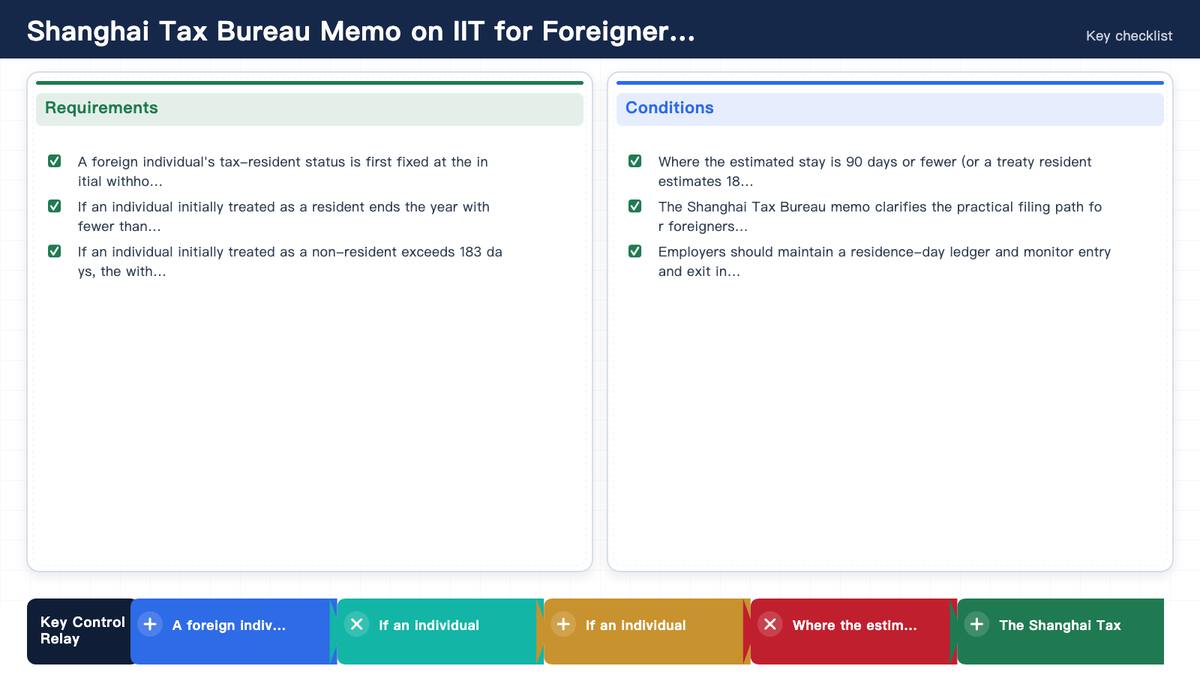
- A foreign individual’s tax-resident status is first fixed at the initial withholding by estimating the in-China residence days for the year, then corrected against the actual stay once known.
外籍个人的税收居民身份在首次扣缴时,依据对当年境内居住天数的预计确定,待实际停留明确后再予更正。
- If an individual initially treated as a resident ends the year with fewer than 183 days, the employer must report and recompute as a non-resident; the resulting top-up tax carries no late-payment penalty when corrected in time.
预计为居民、但年终实际不足183天的,用人单位须按非居民重新申报计税;及时更正产生的补税不加收滞纳金。
- If an individual initially treated as a non-resident exceeds 183 days, the withholding method during the year stays unchanged and the difference is settled at the year-end comprehensive-income reconciliation.
预计为非居民、但实际超过183天的,年度内扣缴方式保持不变,差额于年末综合所得汇算时多退少补。
- Where the estimated stay is 90 days or fewer (or a treaty resident estimates 183 days or fewer) but actual exceeds it, the employer must report within 15 days after the month the threshold is crossed and top up tax without late penalty.
预计停留不超90天(或协定居民预计不超183天)但实际超出的,应在达到阈值的月度终了后15日内报告,并补缴税款,不加收滞纳金。
- The Shanghai Tax Bureau memo clarifies the practical filing path for foreigners whose China stay changes, grounded in the IIT Law, its Implementation Regulations, MOF/STA Announcement 2019 No. 35 and STA Announcement 2018 No. 61.
上海税局备忘录基于个人所得税法、实施条例、2019年第35号公告及2018年第61号公告,厘清外籍个人停留时间变化的实务申报路径。
- Employers should maintain a residence-day ledger and monitor entry and exit in real time to anticipate residency changes and meet every declaration deadline.
企业应建立居住天数台账并实时监控出入境,以预判身份变化、严守各项申报期限。
Shanghai Tax Bureau Memo on IIT for Foreigners Whose China Stay Changes: Residency Re-Determination and Filing Rules | 上海税局关于外籍个人境内停留时间变化个税问题的备忘录:身份重定与申报规则
Overview
The Shanghai Tax Bureau recently issued a memorandum addressing a recurring, high-exposure question for foreign-invested enterprises: when a foreign individual’s actual stay in China diverges from the estimate made at the start of the tax year, how should the employer handle individual income tax (IIT) withholding and filing? The trigger is practical. Consider Company A, which hired two foreign employees. For Bob, the finance team withheld IIT as a tax resident based on an expected stay of 183 days or more, but Bob left early and finished the year with fewer than 183 days. For Anna, the team withheld as a non-resident, yet by year-end her actual stay exceeded 183 days. Neither outcome matched the first-declaration assumption.
The memo’s core message is reassuring for payroll teams: at the first declaration in a tax year, the employer may provisionally determine the individual as a resident or non-resident based on a reasonable estimate of in-China residence days, and then correct the treatment once the actual stay is known. This article walks through the residency divide, the first-declaration rule, the three correction scenarios the memo spells out, and the compliance actions enterprises should take.
The 183-Day Residency Divide
Under the Individual Income Tax Law and its Implementation Regulations, an individual is a tax resident if they (1) have a domicile in China, or (2) have no domicile but reside in China for an aggregate of 183 days or more within a tax year (1 January to 31 December).
- Tax residents are liable on worldwide income. Comprehensive income is settled annually through a reconciliation (annual filing), and the individual may claim either the special additional deductions or the expatriate tax-exempt allowances.
- Non-residents are liable only on China-sourced income, taxed monthly or per occurrence, and are exempt from the annual reconciliation. Withholding generally finalises the liability.
The dividing line matters because a mistaken classification changes both the withholding basis during the year and the year-end obligation. The status is therefore not something the employer must wait until December to confirm; it is set at the first declaration on the basis of an estimate, and corrected if reality differs.
First Declaration by Estimated Residence Days
Announcement 2019 No. 35 and the Implementation Regulations make clear that, at the first withholding in a tax year, the employer need not wait for the full-year residence count. Instead, it should estimate, from the employment contract, assignment term, entry plan and expected stay, the number of in-China residence days for the year, and withhold IIT according to that estimated status.
This estimated-status approach is precisely what Company A applied: Bob was provisionally a resident, Anna provisionally a non-resident. The law accepts provisional status as a valid starting point. The obligation is to correct it once the actual outcome is known, following the rules below.
Correcting the Estimate: Three Scenarios
The memo sets out three correction scenarios.
Scenario 1 — Estimated resident becomes actual non-resident (Bob)
Bob was provisionally withheld as a resident, but an early departure left him with fewer than 183 residence days, so he no longer meets the resident condition.
- Reporting window: from the date it becomes clear the 183-day condition cannot be met, up to 15 days after year-end, the employer must report to the competent tax authority.
- Tax treatment: recompute the full-year tax liability as a non-resident, and handle any refund or top-up. Crucially, the top-up tax is not subject to late-payment penalty when the correction is made in time.
Scenario 2 — Estimated non-resident becomes actual resident (Anna)
Anna was provisionally withheld as a non-resident, but an extended stay pushed her past 183 days, meeting the resident condition.
- Withholding unchanged: the withholding method during the year is not switched mid-year; the employer keeps withholding as a non-resident.
- Year-end settlement: after year-end, Anna files a comprehensive-income reconciliation as a resident, recomputing taxable income and applicable rates, then comparing against tax already withheld for a refund or top-up.
- Special case: if she leaves China during the year and is not expected to return before year-end, she may elect to file the reconciliation before departure.
Scenario 3 — Estimated short stay becomes a longer stay
Where a no-domicile individual estimated a yearly stay of 90 days or fewer (or a treaty resident estimated 183 days or fewer within the treaty period) but actually stays longer, the employer must, within 15 days after the month in which the 90-day (or 183-day) threshold is crossed, report to the competent tax authority, recompute the salary income of prior months, and top up the tax — again without late-payment penalty on the top-up.
Legal Basis
The memo rests on four instruments:
- Individual Income Tax Law of the PRC — the residency threshold and filing framework.
- Implementation Regulations of the IIT Law (State Council Decree No. 707) — detailed residency and withholding rules.
- MOF/STA Announcement 2019 No. 35 — policies on non-residents and no-domicile residents.
- STA Announcement 2018 No. 61 — the withholding declaration management measures.
Together they establish that provisional, estimate-based first declarations are permissible, and that timely correction carries no late-payment penalty.
Compliance Takeaways for Employers
For foreign-invested enterprises, the memo turns an awkward edge case into a manageable process. The constructive response is operational:
- Estimate properly at first declaration. Base the resident/non-resident call on the contract, assignment term and entry plan, not on hope.
- Track residence days. Maintain a defensible ledger (border records, leave calendars) and flag the 90-day, 183-day and 30-day thresholds automatically.
- Monitor continuously. As soon as a departure or extension makes the resident condition unmeetable or met, trigger the relevant reporting clock.
- Meet the deadlines. Report within the statutory windows (15 days after the triggering month, or 15 days after year-end) so any top-up escapes the late-payment penalty.
- Keep documentation. Preserve recomputation working papers, treaty-benefit forms and allowance vouchers as part of the withholding record.
By treating residency as a living status rather than a once-a-year guess, employers can absorb stay changes without penalty exposure or reputational risk.
Sources
- 上海市税务局(上海税局关于外籍个人境内停留时间变化有关个税问题的备忘录)— https://shanghai.chinatax.gov.cn
- 《中华人民共和国个人所得税法》及其实施条例 — http://www.chinatax.gov.cn
- 财政部 税务总局公告2019年第35号(非居民个人和无住所居民个人有关个人所得税政策)— http://www.chinatax.gov.cn
- 国家税务总局公告2018年第61号(个人所得税扣缴申报管理办法)— http://www.chinatax.gov.cn
上海税局关于外籍个人境内停留时间变化个税问题的备忘录:身份重定与申报规则
概述
上海市税务局近期发布一份备忘录,回应了外资企业反复遇到、风险敞口较高的一类问题:当外籍个人当年实际在华停留时间与年初预计不一致时,用人单位应如何办理个人所得税的扣缴与申报?现实情形很典型。A公司招录了两名外籍员工:财务对鲍勃按居民个人预计满183天预扣预缴,但其提前离职、全年不足183天;对安娜按非居民个人扣缴,但其延长停留、年末超过183天。两种结果都与首次申报的假设不符。
备忘录的核心信息对薪酬团队是定心丸:在一个纳税年度的首次申报时,用人单位可依据对全年境内居住天数的合理预计,暂定其为居民或非居民,待实际停留明确后再予更正。本文依次说明居民身份的划分、首次申报规则、备忘录列明的三种更正情形,以及企业应采取的合规动作。
183天划分居民与非居民
根据《个人所得税法》及其实施条例,个人有下列情形之一的为 居民个人:(1)在中国境内有住所;或(2)无住所而一个纳税年度(1月1日至12月31日)内在中国境内居住 累计满183天。
- 居民个人 就 境内外所得 负有纳税义务,综合所得按年办理汇算,可就专项附加扣除与外籍免税津补贴择一适用。
- 非居民个人 仅就 境内所得 按月或按次纳税,并 免予年度汇算,通常扣缴即结清纳税义务。
这条分界线之所以关键,是因为身份误判会同时改变年度内的扣缴基础与年末义务。因此身份并非要等到12月才确认,而是在 首次申报 时按预计确定,实际结果不同则予以更正。
首次申报按预计居住天数判定
2019年第35号公告及实施条例明确,在纳税年度内首次扣缴时,用人单位无需等待全年居住天数确认,而应依据劳动合同、任职期限、入境计划、预计停留等情况,预计一个纳税年度内境内居住天数,按 预计身份 预扣预缴。
A公司正是如此操作:鲍勃暂按居民、安娜暂按非居民。法律认可”暂定身份”作为合法起点,义务在于实际结果明确后按下列规则更正。
预计身份与实际身份不一致:三种情形
备忘录列明三种更正情形。
情形一:预计为居民、实际为非居民(鲍勃)
鲍勃年初暂按居民申报,因提前离境导致全年不足183天,不再符合居民条件。
- 报告期限: 自确认无法达到居民条件之日起至 年度终了后15日内,向主管税务机关报告。
- 税款处理: 按非居民个人重新计算全年应纳税额,多退少补;按规定更正产生的补税 不加收滞纳金。
情形二:预计为非居民、实际为居民(安娜)
安娜年初暂按非居民申报,因延长停留、延期离境,全年满183天,符合居民条件。
- 扣缴不变: 年度内扣缴方法 不中途变更,仍按非居民扣缴。
- 汇算结算: 年度终了后按居民个人办理综合所得汇算清缴,重算应纳税所得额与适用税率,与已扣缴税款比对,多退少补。
- 特殊情形: 若当年离境且预计年度内不再入境,可在 离境前 办理汇算清缴。
情形三:预计短停留、实际变长
无住所个人预计全年境内居住累计不超90天(或对方税收居民预计在协定规定期间内停留不超183天),但实际超过的,应在达到90天(或183天)的 月度终了后15日内 向主管税务机关报告,就以前月份工资薪金所得重新计算应纳税款并补缴;补税 不加收税收滞纳金。
法律依据
备忘录建立在四部规范性文件之上:
- 《中华人民共和国个人所得税法》 — 居民身份门槛与申报框架。
- 《个人所得税法实施条例》(国务院令第707号)— 居民身份与扣缴细则。
- 财政部 税务总局公告2019年第35号 — 非居民个人和无住所居民个人有关个税政策。
- 国家税务总局公告2018年第61号 — 个人所得税扣缴申报管理办法。
四者共同确立了”允许按预计身份首次申报、及时更正不加收滞纳金”的规则基础。
对企业的合规建议
对外资企业而言,备忘录把一个棘手的边缘情形变成了可管理的流程。建设性的应对在于落地操作:
- 首次申报合理预计。 依据合同、任职期限与入境计划判定居民或非居民,而非凭主观期望。
- 追踪居住天数。 建立可举证的台账(出入境记录、休假日历),并对90天、183天、30天门槛自动预警。
- 持续监控。 一旦离境或延期使居民条件变得”不可能满足”或”已经满足”,立即触发相应的报告计时。
- 严守期限。 在法定期限内(触发当月终了后15日,或年度终了后15日)报告,使补税免于滞纳金。
- 留存文档。 将重算底稿、协定待遇报告表、津补贴凭证作为扣缴资料妥善保存。
把税收居民身份视为”动态状态”而非”一年一猜”,企业便能在员工停留时间变化时从容应对,避免滞纳金与声誉风险。
来源
- 上海市税务局(上海税局关于外籍个人境内停留时间变化有关个税问题的备忘录)— https://shanghai.chinatax.gov.cn
- 《中华人民共和国个人所得税法》及其实施条例 — http://www.chinatax.gov.cn
- 财政部 税务总局公告2019年第35号(非居民个人和无住所居民个人有关个税政策)— http://www.chinatax.gov.cn
- 国家税务总局公告2018年第61号(个人所得税扣缴申报管理办法)— http://www.chinatax.gov.cn